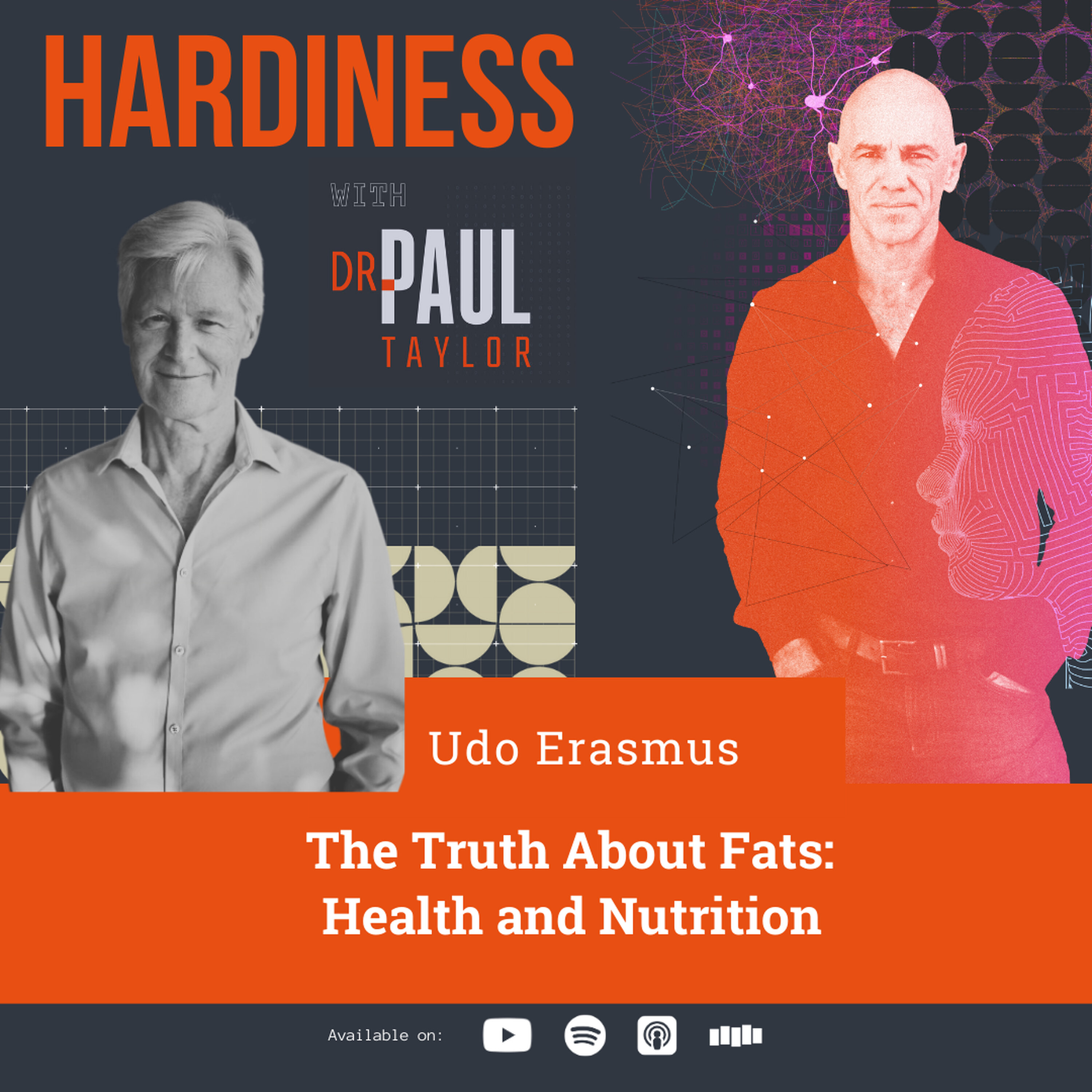
An Exploration of Dietary Fats: Udo Erasmus on Health and Nutrition
Episode Transcript
Udo Erasmus.
Welcome to the podcast.
Speaker 2Nice to be here.
Speaker 3I read your first book, well might not have been your first book, but it's probably the most famous, Fats that Hail, Fats that Kill.
Speaker 1In fact, I've still got a copy of it.
Speaker 3I read it must be Bloody Hell twenty years ago, I reckon, and I imagine it's still selling, is it?
Speaker 1Because it was the bible on fat back there.
Speaker 2It still is the only book out there that really went into depths because what people tend to do when they write like it took me six years of actually more, it took me six years of research to write the first one, which was called Fats and Oils that came out in nineteen eighty six.
Fats That Hill, Fats and Kill hit the shelves in nineteen ninety four, so I had basically six years and another the six years, so twelve years went into it.
And I and what actually I did that no one else has done.
It's kind of crazy, actually, I think.
But I read a study I got poisoned by pesticides.
I was looking for self help because the doctors didn't have anything.
And I'm reading all this stuff in the in the research and I read a study that said omega six is an essential nutrient, which means you can't make it, but you have to have it.
You have to therefore bring it in from outside.
If you don't get enough long enough, you die, because these are like really important nutrients.
And if you bring enough back into a deficient diet before you die, then all the problems that come from not getting enough are reversed and you get your health back.
Because life knows how to make a body, provided we take responsibility for bringing in the building blocks.
Everything else life does without us having to pay attention to it, but we have to bring in the building blocks, and you have to have the researchers have to have identified at least one biochemical reaction in which that nutrient is required and without which that biochemical reaction cannot take place.
So the very specific definition, very precise.
And then the very next study I read said omega six gives you cancer and kills you, and my head exploded.
It was like, wait, I have to have it so it can kill me, and so I thought I must be missing something.
And it was that trying to resolve that contradiction that got me looking at how oils are made and the damage done to oils and what that damage consists of and what causes that damage, And then got me thinking, oh my god, I can't get healthy on oils that are damaged.
We should make oils with health in mind.
I then developed a method for making oil with health and mind, and that we in nineteen eighty seven, we started selling flaxseed oil as the richest source of omega threes that are too low in ninety nine percent of the population.
And I was like, oh my god, could if we could make it with health and mind and we could bring it back to the population, Oh my god, we could help almost everybody.
And it was like that just I got so excited about that.
That's what drove that project.
But the people who these days tell you not to use seed oils and not to use omega sixes didn't do the homework.
None of them have talked to me, and they didn't do the homework that came from that contradiction.
They've never looked deeply enough, so they're giving bad advice.
And of course they always sell something else behind it.
You know, don't do that, do what I want you to buy.
So they are not only lying about the truth, they're also doing bait and switches.
Speaker 3I always tell you though that I always say that if if there anybody tells you that there's one diet that everybody should eat, they're either demented, they're trying to sell you something, or they're a member of a cult.
Speaker 2Pretty much, it pretty much comes down to that.
Speaker 3Yeah, And now the whole the nutrition is very very controversial, right, and which part elements, well, lots of parts of nutrition in terms of you know, what's the best diet.
Speaker 1You know, there's there's the diet wars.
There's the diet wars, aren't there, right, It's not one end one end.
You've got the vegans, vegetarians.
Speaker 3Then there's the high fat, low carb, the low fat high carb, the pelio, the carnivore on the other end, right, and then there's mediterrane and then there's the antic diet's the bloody South Beach diet.
Speaker 1It's on and on and on.
Speaker 2There's about six hundred of them, right, six hundred diet.
What is not controversial though, when it comes to nutrition, is that there are forty two essential nutrients, eighteen minerals, thirteen vitamins, ninety central amino acids from proteins, and two essential fatty acids from oils that are essential by the definition of you got to have it.
You can't make it, you got to bring it in from outside.
You die if you don't get enough long enough, and if you bring it back all the problems that come from not getting enough are reversed.
That's not controversial, although there are some people, although there are some people who say, well, they're actually twenty minerals and there's fourteen vitamins, and people keep trying to sneak some new stuff in it because if it's essential, you gotta have it, and that's good for marketing.
So there's some cheating going on in the marketplace.
But in terms of what are the essential nutrients, that's relatively well establish.
What's different in between people, though, is that we don't all need the exact same amount of any one of them, you know, like some people some people can get optimum from five hundred milligrams of vitamin C and some people can get optimum from three thousand or even more.
And of course the RDA the recommended government allows is like sixty milligrams.
Ye, what it is, I don't know what is in Australia, but it's way too low because they're not dealing with they're not dealing with optimum health.
They're dealing with minimum health.
Speaker 3Correct, And I think I think it's important for people to understand that the RDAs were established decades ago and were never designed to be indicating what is optimal.
It was all about what is the minimum needed to avoid a deficiency.
You know, for instance, if we take protein recommendations, we now know that the RDA protein's way too low, particularly as you get older.
Speaker 1Yeah, but.
Speaker 3If we let's so we're going to focus in a little bit on fats because that's your area of expertise, and then I want to widen the lens.
Speaker 1To overall health.
So you know that.
Speaker 3I think probably the worst thing that happened was nineteen eighty three.
That I'm pretty sure it was nineteen eighty three the first ditary recommendations or was it seventy seven in the United States to limit fat in the diet.
Speaker 2That was, Yeah, that was the Mcgovernent Report on Nutrition and Health, and that was published in nineteen seventy nine.
Speaker 3Yeah, and then we had the recommendations that we should eat a low fat diet and then everybody.
Speaker 2Lots lots of carbs, Yeah, lots of carbs.
Put him at the bottom of the food pyramit of fats on top.
You should eat the least possible.
Speaker 3Yeah, yeah, yeah, And and and we know nih that that is really a misconception and that a lot of that stuff was not based on randomized control trial evidence that was available at the time.
And then all of these big companies got very rich and making refined carbohyd.
Speaker 2Cell and carbon and you know, and the thing that struck me as the funniest thing because everybody thought, if you eat fats, you're going to get fat, and that was never true because fat suppress appetite.
They have more calories, but they suppress appetite and you get stable energy and you don't get blood sugar and insulin and craving swings.
Right.
But what we did when we went on that diet with the carbs at the bottom of the food pyramid that we should eat, the lost most of that was in nineteen seventy nine.
In the next twenty years, overweight went from twenty five to sixty percent of the American population.
And nobody questioned the pyramid.
Speaker 1No, it's just crazy, isn't that?
It's crazy?
And actually the scurry thing was I think it was.
Speaker 3I can't remember who it was that did an investigation that something like and and look, the numbers are probably slightly incorrect, but it's something like twenty two or of twenty nine of the people on the on the body, I can't remember.
The body that creates the American dietary guidelines currently have financial ties to big food.
I mean that that is just or big format.
Speaker 2I mean they call it regulatory capture.
The so the government institutions that are supposed to regulate the safety of the food supply are actually getting money either on the side or to that government institution from the people that they're supposed to regulate.
Yeah, you know, and you know that is that's saying about not biting the hand that feeds you.
Yeah, that's that's regulatory capture.
And there's huge, it's huge.
And they they they say now that they in the in the medical research journals like the big ones JAMA and British Medical Journal, there's like four of them, Lancet, four of them, like the high end ones, that eighty percent of what is published in those medical journals is actually only published with permission from the pharmaceutical industry.
And they cheat on how they do the studies, and they force people who do studies that don't make them look good, they force them to withdraw those studies from the magazines.
In a in a process there is political not peer reviewed and not unbiased and not based on even a bias for health, just a bias for it's a bias for pharmaceutical profits because they can you know, they can patent unnatural molecules.
That's why we're not using nature to heal, even though nature invented health.
Well, we reuse unnatural molecules because you can patent them, and then you can you get monopoly profits for twenty years, twenty one years in Canada now used to be seventeen now it's twenty one years.
And then so we have a system that forces people to become crooked unless they're unbelievably content in their own being.
And of course who would that be.
Speaker 3Like it is, it's a it's a pretty dodgy world that we live in.
Speaker 2Internal dodgy is a really good word for it.
It's not a Canadian word, but dodgy is exactly.
Speaker 3So that's that's not focusing on fats and let's talk about good, bad damage facts.
Speaker 1Just give people a bit.
Speaker 3Of an overview of unsaturated fatty acids, monounsaturated fatty acid, saturated fatty acid talk a little bit.
I think it might be helpful to talk a little bit about carbon bonds and these sorts of things and and and give people an understanding of different structure first of all, and then we can dive into the what's good and what's not so good.
Speaker 2Yeah, okay, so usually the saturated monounsaturated, poly unsaturated.
That's like techie and most people are not that big on it.
But what it is is, Look, you have fatty acids.
There are strings of carbon molecules hooked together.
Most of the ones in oils are eighteen, but they can be anywhere from two to twenty eight carbon atoms strung together.
And there's an acid end, which is a cooh end on one end, and there's a called the omega end c H three end on the other end.
That's what a fatty acid look like.
And if it's if it's all just single bonds between the carbons, you end up with a saturated fatty acid.
They tend to be harder at room temperature.
They tend and then and then the body can put double bonds between some of the carbons.
They're usually three carbons apart.
So if you put one double bond in this chain, then you have a mono unsaturated that kinks the molecule.
And now the molecule doesn't crystallize as easily, so it tends to be more liquid.
Yeah, you can put another one in.
I mean you can't, but nature can, right, you can put a second one in.
Now you have a bi unsaturate or a poly on such poly just means more than one, and they are always three carbons apart.
Now you got two kinks in the molecule, so it will melt at even a lower temperature.
And then you can put a third one in, or nature can, and then it becomes even more liquid.
And then the body can put in a fourth and a fifth and a sixth one always three carbons apart, and you end up then with the highly unsaturated like the fish oil Omega threes, EPA and DHA.
They have five and six double bonds, and they they are super liquid, but the double bond also makes them super sensitive to attack by oxygen or light or heat.
And then you changed and that changes the molecule and so they more double bonds a fatty acid has in it, the more easily it's damaged by light, oxygen, and heat.
And when you get to the essential fatty acids, which are the only thing from fats that every cell in your body has to have and can't live without, and it has to get from outside.
They're both poly unsaturated, so they are the most sensitive of our nutrient molecules.
They need the most care to protect them from light, oxygen, heat, and we actually give them the least care because we throw them in the frying pan where we heat them to frying temperature, and they're damaged at all at the same time by light, by oxygen, by heat.
Speaker 3Frying in clear bottles as well is not goat yeah, yeah, of course, because light goes through it and then it creates free radicals, and the free radicals have chain reactions usually thirty thousand on average before they find before they settle down again.
Speaker 2So an enormous amount of damage happens when the oils are not treated with care.
I say to people, listen, more health problems come from damaged oils than any other part of nutrition, and more health benefits come from dumping the damaged oils and getting oils made with health and mind.
And I'm kind of like the guy who started that industry making oils with health and mind.
So we started with flax seed oil and then we went to a blend because flax seed oil is not well balanced.
There has to be a balance between omega three and omega six because both are essential and both have really important functions in every cell in the body.
Speaker 3So why did you can I just ask why you focused on flax seed oil and not a not a fish oil or oil attiron, EPA and DHA.
Speaker 1Was there a reason why that was your focus.
Speaker 2Yeah, flax oil has twice as much omega three as fish oils do, so that was one reason.
Speaker 1But it converted in the.
Speaker 2No, that's bullshit, and I'll explain it why.
That's what the fish will said the week we came out with flax oil.
That's what the fish all started saying.
They didn't say it before that.
They used to say thirty percent of the population can't convert enough.
The big problem was not getting enough starting material.
But they didn't.
But they said thirty percent don't need fish alls, So that meant seventy percent of the cup population doesn't need fish alls.
But the thing the reason why fishals fish alls are very damaged, they are the Omega six.
If you look at how sensitive they are.
If you give a number of one to a saturated fat no double bonds, then you make it monon saturate, it's twice two and a half times more quickly damaged by light auction heat than the saturate.
Then you put in another double bond.
Now you have an Omega six that's another two and a half times more easily damaged than the Omega nine.
Then you put another third bone double bonding, and now you have the Omega three essential fatty acid alphainlnic acid that is five times more sensitive to damage by light auction heat than the Omega six.
And then if you put the other double bonds into make fish oils, fish oils are five times more sensitive to damage by light auction heat.
Then is the Omega three from plants.
So we wanted to work with the stable essential fatty acid at the at the at you know, at the most stable level, and let the body then convert what it needs where it needs it, when it needs it.
And and the what the truth is about the body can't convert, you know, the mechanism by which omega three and omega six is are converted into derivatives, many of which have hormone like regulating substances in every cell in the body.
Twenty four to seven lifelong Okay, they both use.
It's the same system of and it's called elongation.
So they add two carbons and then desaturation.
So they put in a double bond and then an elongation and then a desaturation, then another elongation and another desaturation.
That's how the body converts the central fatty acids into all these dozens of derivatives.
And what's interesting is omega three and omega six use the same converting system and nobody complains about the body can't convert omega sixes.
Why not when they use the same system.
Why is there a problem with conversion of omega three.
Well, you've got about twenty times more omega six in your diet then omega three.
So because they compete for this conversion system.
If you have too much omega six, then you crowd out the omega threes and then you will not get enough conversion.
Speaker 1Let's take a diversion into that.
Speaker 3Now it'll because and I don't know what your opinion is on the optimal ratio of Amiga six two threes.
Right, So I've heard every I've heard everything from two to one to eight to one.
But as you said, that more typical diet standard, American diet standard, the SAD diet tends to be around twenty to one Amiga six two Amiga.
Speaker 2At least ten to one.
Yeah, at least twenty ten to one, often twenty to one, and in some people fifty to one.
Speaker 1Jesus Christ and.
Speaker 2So and so.
Yeah.
So the issue, So the issue is that in order for both of them to unfold their benefits, because they both have benefits, okay, and some are pro inflammatory that's part of healing, and the omega threes tend to be anti inflammatory.
But you need the pro inflammatory ones because when you get injured, inflammation is part of the process of healing.
And when the.
Speaker 3Healing you're when you're when you're exercising, particularly inflammation that's important for muscle building.
Speaker 2Yeah, yeah, and and so and then when the and then when the repair is finished, then the omega threes override the omega sixes mm hmm.
And then and then the settles down.
I'm eighty three by the way, and I have no pain in any of my joints, literally zero.
I eat, take no drugs, and I do it all with nutrition.
Because why is that?
Because health was invented by life in nature, That's right.
And all the things that people need anti inflammatories for.
You know, where you get in nature, you get the best anti inflammatories.
Speaker 1In nature.
Speaker 4You get spicy spices, documents, we're talking we're talking about turmeric, and we're talking about cloths, and we're talking about amla, and we're talking about ginger, and we're talking about garlic, and talking about.
Speaker 2Onions, mustard, cayenne, black seed which comes from the Middle East, it's ninjella, and those are those have anti All of them have anti inflammatory properties, and some of them are so good.
They have anti viral, anti fungal, antibacterial, anti cancer, anti diabetes, anti autoimmune, anti cardio, anti cholesterol, antioxidant, and anti inflammatory property in one spice.
Speaker 1And this is an important point.
Speaker 3You know that we mentioned earlier on about essential vitamins and minerals, and people are obsessed about that and will often and just buy lots of supplements with chemically derived vitamins and minerals.
But what they're forgetting is that in fruits, vegetables, plants, and spices, there are thousands of polyphenols and flavonoids and other compounds that play critical roles as enzymes and cofactors for chemical reactions.
I mean, it does my head in this subsession on these these small number of nutrients when it's like there's a whole kalidoscope of nutrients that are in plants and spices that and that we have a coevolved with for hundreds of thousands of years, right, yeah, yeah.
Speaker 2And that's why processing is where most of our are, most of our ailments come from, you know, come from nutrition because we're taking out the spark control.
Yeah, you know, and then when we make when we turn cane into white sugar or we turn wheat into white flour, we're taking out the spark control.
So then we get the energy and the energy is pretty strong, so you get the fire of life.
You know, you want a good fire, that's your vitality.
But good fire throws more sparks, so you need more spark control.
And we're getting the bigger fire with less spark control.
Speaker 1So that screws us up.
Speaker 2Yeah, that screws us up.
But going back to what the ratio should be.
So we're we're There's two things that are wrong here.
One is ninety nine percent of the population doesn't get enough omega three for optimum health.
Ninety nine percent ninety nine percent.
When I looked at fish oil the last time I look that it was measured set, only seven point eight percent of the population was using fish oil.
So that means like ninety two percent of the population isn't getting omega threes right.
Even the fish oil omega threes.
The fish oil omega threes are super There are one hundred and fifty six times more sensitive to damage by light, oxygen, heat than saturated fats are, so they're super super sensitive.
Frying is the dumbest thing we ever invented.
And we need the ratio between the two escentral fatty acids right, and we need them both made with health and mind because the omega six oils are damaged by the processing by industry before we even fry them, because they will already have been heated to frying temperature for thirty minutes in a process called deudorization that allows them to get rid of half of the pesticides and some of the rancid molecules that make oil smell and taste bad, and so they do that.
Speaker 1Sorry you do.
Speaker 3This is important I think for people to understand, because they will they will get a vegetable oil and they'll say, and even if they're aware that they shouldn't fry with it or use high temperatures on it, and they might be pouring it on their salads or whatever.
Is what they don't realize is that in order to get it into the bottle, it has already gone through a number of chemical processes.
It's being heated unless it's cold pressed.
Heat.
Speaker 2No, cold cold pressed cold press doesn't mean anything.
That's a marketing term, right, there's no there's no definition.
Well, we went to one of the companies, how can you call your oil cold press when it's being heated to four hundred and fifty degrees fahrenheit in the in the deordorization process, And they said, well, we define cold press to mean that while it was being pressed in these huge presses, we never added any external heat.
So they get to make up any any definition they want, and then outside of that definition they'll use that to a refined part of the process, and then outside of that they can do whatever they want, because there is no legal definition for the term cold press.
Speaker 1Wow, yeah, I did not know that.
Speaker 2Yes, But let me go back to, you know, the damage done by industry, and this is what most of the people who have uh who dis seed oils and dis omega sixes and say you shouldn't use those.
What they're missing is they're blaming the damage done to those oils by processing.
Mm hm they're they're they're they're blaming the oil for what they should be hm uh, blaming on the damage done to them by industry.
So they cause they so they say omega threes are bad, but omega threes are essential, but they need to be not damaged, and they're sensitive and you need to do make them with care.
Speaker 3I think, I think that's the sensible ones on this, and I believe that they're pointing to the commercially available ones.
And I'm not sure that anybody and a mega sexes are bad per se.
Speaker 4No.
Speaker 2No, My my oil blend that I made is also commercially available, but it's not damaged, right, yeah, because I developed a method for doing that because the industry was not interested in that.
They were interested in shelf life and big markets.
So I wanted to ask, say, okay, So when I found out that when I've read the research from the industry, research the industry itself did they said that when you treat an oil with so do I droxide and phosphoric acid, and then you bleach it with bleaching claves, it goes rancid, smells bad and you have to de authorize it and to do that you have to heat it to frying temperature for thirty minutes, and in that process a half to one percent of the oil are damaged.
Change from something natural your body knows how to deal with, to something that never existed in nature that maybe your body never had to make a fix for.
Okay.
And so when I found that out, I was shocked, and I, you know, because I was sick.
So I was thinking about you know, I was I was a truth seeker because I was sick.
Right, So I called the Oil Chemist Society in Champagne, Illinois, and said, I want to talk to a researcher.
And they said, okay, this was like in the early eighties.
Because I got poisoned nineteen eighty and those times, they you know, people weren't hiding as much as they do now.
But so I said, I want to talk to researcher.
They put him on the line and I said, so, when you know that this does damage to the oils, why do you use this kind of processing?
And he said, well, one of the reasons we do that is because we can get rid of half of the pesticides in the oil.
And me, I, you know, I came out of university and studied lipids, and you know, nobody ever told us that there were pesticides and oils.
So my head was blown.
I got poisoned by pesticides.
There's pesticides in the oil, and they heated to frying temperature and damage it to get rid of only half of the pesticides, and I think, WHOA, my god, the other half stays in.
I didn't say that to him, but I said to him, well, why don't you start with organically grown seeds.
Then you don't have a pesticide poison poison problem to deal.
Speaker 1With, because that's very expensive.
Speaker 2No, and I guess he had never heard that.
There was this long silence at the other end of the phone, and I waited, you know, I can talk.
Obviously, you've noticed I've interrupted you a couple of times already, right, Vice Varsa, Yeah, yeah, you know, but I can.
I can also listen, and I'm pretty good at it sometimes.
So I listened.
I waited.
There's a long silence, and then he got mad, Well, I don't know what the hell your problem is.
That oil was just one percent bad, and it's only ninety percent good.
And if you got ninety nine percent on an exam, you'd be damn happy, wouldn't you.
Well I got ninety nine and a half percent on my pesticides prayer exam, and I used to get one hundred percent in genetics because I was in love with the topic, you know.
But yeah, anyway, so I wasn't impressed with that.
But I thought, well, maybe maybe maybe I'm overreacting.
It's only one percent, So let me do the math.
You know.
We had the sing, went and out to the math.
Right, So I said, okay, I have a tablespoon of an oil.
Tablespoon in my where I live is fourteen grams fifteen milliliters.
I think you guys is twenty like the British.
The British is twenty right, Okay, so have a tablespoon of oil fifteen MILLI leaders how many damaged molecules will be in that tablespoon of oil if that oil is one percent damaged.
And I want you to answer that question because you have no found you have no basis for answering.
Or you might have actually, but most people who listen to your show do not have the information they need to do the calculation.
But there's a way to do it, and so I ask people, and you'll see why.
So give me a number.
How many it's a tablespoon of oil it's one percent?
Speaker 1How many molecules?
Speaker 2How many damaged oil molecules are in that.
Speaker 3Tables of Jesus wouldn't I would be saying it's gotta be thousands and thousands of dummed molecules.
Speaker 2How many thousands?
Speaker 1Three hundred doozand I'm guessing how much three hundred.
Speaker 2Okay, three hundred thousand.
So three hundred thousand has five zeros?
Right?
Speaker 1Yeah?
Speaker 2Okay?
Would you like to know the actual number?
Speaker 1I certainly would.
Speaker 2It is a six followed by nineteen.
Speaker 1Zeros jumping Jehovah.
Speaker 2So what that means is your estimate is fourteen zeros too low?
You know what fourteen zeros is.
It's quadrated, it's two hundred trillion, Right, I'm good to I do.
I do this math a lot.
So so so that means you, what, if you're using those oils, what you're doing to yourself is two hundred trillion times worse than you think it is.
So then I say, listen, you're gonna you're gonna fly back to Ireland for the holidays.
And you get about to get on the plane, and you got your boarding cart, and you know they're just they just call everybody to get up and get in the lineup.
This guy taps you on the shoulders and you look around and it's mister truth teller.
You know, he's a guy who can't tell a lie.
And he says, by the way, did you know that your chance of crashing and dying on this flight back to Ireland from Australia that you're about to get on is two hundred trillion times higher than you thought it was.
Would you get on the airplane?
Speaker 1Yeah?
Probably not.
Speaker 2Yeah.
When I was in Ireland, I asked the question.
I said, I would canoe back to Canada.
Right.
But the point is we're doing something because nobody's told us, right, but we're doing something to us.
And when I ask this question.
I never get anybody that is is even you know, everybody's always at least a billion times too low in their estimate.
So we so we underestimate the damage we're done doing to our body by at least a billion times.
And is that is that maybe a cause for a little extra thought.
It's like, maybe I should be maybe I should be going back to seeds and nuts where the oils aren't damaged, or maybe I should stop frying.
When you fry, you have to multiply that number by another five times.
Well, then you have decided.
And if you have plastic and you don't take one tablespoon but two to four, you know, and you do that for thirty years, And how many molecules that don't do the work in your body that they're supposed to do are you going to put in your body?
Speaker 1And then I think they understand.
Speaker 3The other thing you know is that that when you fry stuff, fry oils, you release aldehydes, which are carcinogenic compounds, and and the that's link to the stability of the oil that you're frying.
So the more polyunsaturated fats more aldehydes than money owned saturated fats which have more aldehydes than saturated fats when you're frying.
Speaker 1So it's not right.
And we're marketed about the smoke.
Speaker 3We're marketed about the smoke point, aren't we, and that that polyonsaturated fats tend to have a higher.
Speaker 1Smoke point like grape seed oil.
But smoke point is one thing.
Speaker 3That's when it's becoming a transpat But but aside from that, the heating itself is creating these carcinogenic compounds in the oil.
Speaker 2Well, the truth is that when you fry something, and we're talking about whether it's poly unsaturated or saturated fats, when you fry things, you know, you know, you burn them, right, they turn, you know, they go from whatever color then they go yellow to brown or black to smoke.
Right, So, whenever you fry anything, whether it's protein or fat or carbs, each one, independent of the others, increases inflammation and increases each one of them causes inflammation and increases the risk of cancer.
Now you will do more damage to the polyunsaturated oils if you fry them then to the.
Speaker 1Saturated one saturated.
Speaker 2But still so when people say what's the best oil the fryers, there is no best oil the fry with I can tell you what is the worst, the least worst.
The least worst is going to be the hardest fats.
Speaker 3The more stable, the one stable that the one that solid at room temperature.
Your tallow you're gay those sorts of things.
Speaker 2Yeah, but you're still getting yourself increased risk of cancer and more inflammation in any any time.
So frying is the dumb, dumb, dumb, dumb.
Speaker 1So you don't So you don't fry anything, you know.
Speaker 2Nope, not anymore.
Right, I used to before I knew, and I mean think about it, right, two hundred two hundred trillion times too low is your estimate of the dam.
Speaker 3So the play devils to play devil's advocate, right on that.
So, so, yes, my estimator is out by by a a you orders of magnitude, right, But what is the impact on the body of however many trillions of molecules being affected when it goes.
Speaker 1Into a big body like mine?
Well, okay, so you know I'm asking, I'm asking what that's.
Speaker 2Not a devil's advocate, that's just a dumb question, right, But but it's a good question.
It's a good question.
Speaker 1So let me let me and and to pay for further devil's advocates.
Speaker 3So, so how can we have how can we have people around the world who have been frying not everything, but frying some foods and living until they're over one hundred years old if there's massive amounts of damage from every little bit of oil that's used, right, So that's a devil's advocate.
Speaker 2Okay, So that's a or short answer to that court short question is if they hadn't fried, they would have lived to one hundred and fifty.
Yeah, okay, so so you have to but let me talk about so when you fry oils and fry fats, you do only only get alder hides.
There's all kinds of stuff you get.
You've got some other chemicals in it that come from the stuff they use.
But you fragment molecules, You cyclize molecules, You twist molecules, you double bond shift molecules.
You cross link fatty acids with in triglycerides.
You cross link fatty acids across triglycerides.
You obviously trans fatty acids, we already did that.
You dimerize problems, you fatty acids, You trimrize fatty acid, then you polymerize fatty acids and those and those all of those.
That's it like ten things plus aldehydes plus other stuff.
So there's lots of different kinds of damage done.
And here's what happens.
When you have an unnatural molecules that never existed in nature and you bring that into your body.
So wherever that molecule goes, it doesn't do the job of the proper molecule, the natural molecule that fits into that molecular architecture, because your whole body is just molecular architecture.
So in that place where that one molecule goes, you're going to you're going to derail natural processes.
And every physical ailment begins at the level of interactions between molecules.
When they're the right molecules, everything works.
You get the wrong molecules, something doesn't work.
Now, when you have sixty quintillion damaged molecules in a tablespoon, you know how many molecules that is.
That's more than a million damaged molecules for every one of your body's sixty trillion cells in one tablespoon.
And we eat more than that and we fry them.
So multiply that by another five times.
There's pesticides in those oils.
There's plastics in those oils because last ye, well, when there's more damage done on top of what the damage done by free radicals that come from the light going through the through the transparent plastic.
So it is a bloody mess.
Speaker 3So let me ask the question.
You know other types of cooking, such as baking or microwaving or over a fire.
How many of those.
Speaker 1Processes that you mentioned.
I'm not sure whether you've looked into this.
Speaker 3How many of those are also activated in other types of baking, I guess, So I'm.
Speaker 1Asking all of the relative comparisons.
Speaker 3So, so when you're heating anything, I mean you're changing the protein structure, you're changing the mollectual structure.
Speaker 1When you're heating anything, right, or cooking anything.
Speaker 3But then cooking certain foods unlocks certain nutrients and things like that.
Speaker 1So we know that when you cook tomatoes there's much more like a pain.
Speaker 2Can I tell you?
Can I tell you where that came from?
In nineteen thirties.
In nineteen thirty seventh, the Hinz Ketchup Company wrote a nutrition wrote a nutrition book that became used as a textbook in university nutrition departments.
They're not using it now, But gee, is it coincidental that you have to cook tomatoes to get the nutrition value out when the book was written by a company itself.
Speaker 1I'm not saying you have to come.
Speaker 2Here's the thing.
Here's the other thing is that the actually, if you eat raw tomatoes with oil, the red pigment is oil soluble.
So eating tomatoes with oil makes more sense than cooking the tomato to get the nutrients because if you cook in water, the the the pigments are still all soluble.
Speaker 1Yeah.
Speaker 2Yeah, so and so there, so there, So that that thing, you got to take it with a with a grain of salt, so to speak.
Speaker 1So do you cook?
Do you cook anything?
Speaker 2I very little these days.
I do I do sometimes.
But so but let me go back to your question.
Is is there you know?
Is there?
How do we do it?
If you know?
Some people say, well, if I have to cook, what oils?
What oil is the best oil to cook?
So I say, let's listen.
This is the Russian Roulette question, because you're just asking me what can I get away with?
And the truth is you don't get away with anything.
You have one damaged molecule wherever it goes.
You screw something up.
Okay, and it's not noticeable immediately, but you're screwing something up because you're out of line with nature.
And nature didn't make us for fried foods.
In fact, every creature in nature that eats it's all.
It's food, fresh, whole, raw, organic, local, seasonal, and for human beings, probably mostly plant based because when we were Stone age hunters with rocks to hunt with, we came home empty most of the time because animals fought back or ran away, and when they didn't have meat to eat, then they ate vegetables because they're really easy to hunt down and kill because they don't fight back and they don't run away.
Speaker 1Oh look, I agree with that, So I'm not.
Speaker 2Saying so I'm not saying we can't live on meat, but I'm saying, probably we evolved on a mostly plant based diet.
And then.
Speaker 3I'm going to put you up on that one, you know, because two point four million years ago you're into ancestor Homo hobbilists.
The tool maker traded off strength and power for dexterity to make tools that enabled him to kill animals.
And then and then somebody created fire.
Speaker 2Let me tell you about fire.
Let me tell you about fire.
There's a you know, you know the story about fire.
This is a this is a story out of Greek mythology.
Prometheus stole fire from the gods.
Speaker 1Yeah, yeah, and and.
Speaker 2Brought them as a gift to man, and he got punished, punished.
Speaker 1He didn't have to push a boulder uphill.
Speaker 2No no, no, no, but but no, so Zeus punished him.
And what his punishment was that every day he he would he would buzz around and do whatever, and every night he got chained to a rock and an eagle would come and peck out his liver.
Speaker 1Ah yeah, yeah yeah.
Speaker 2And then and this was his eternal punishment.
And I started thinking about it.
It's like, well, what why is that the appropriate punishment?
And then how do you get around it?
Because he was just trying to be a nice guy.
He was trying to be nice to people.
And the answer, my answer was give fire back to the gods.
But my question was how did how did they long before they knew about molecules, How did the Greeks get so smart to know that when you make food toxic with fire, your liver has to deal with it.
So actually his liver actually got screwed up every day and then it read grew in the at night.
That's how it was.
Ego pecked it.
You know, he was chained to the rock.
The ego pecked it out during the day, then it regrew at night, and the eagle came the next day picked it out again.
So how did they know that?
Because that's actually what happens.
When you burn food.
You put a load on your liver.
Your liver is the main detox organ, right.
You can also sweat stuff out and breathe stuff out, and poop stuff out, and and and piece stuff out, but the liver deals with the with the really cantankerous stuff.
How did they know?
And so my my idea was give fire back to the guts.
So if you cook in water and you don't let it burn onto the bottom of your pot, then you at least you're not you're not creating molecules that never existed in nature.
And this I think that's that's a huge key.
So if you fry, go back to cooking in water.
When I was a kid, cooking meat miant in water.
Now cooking means frying usually, but cook in water or eat raw.
You know, the only thing you got to pay attention is not if it's not that it's not contaminated.
So you've got to wash it and you got to make sure your food is clean, and then you can eat all of it raw, just like all the other animals do.
You will never see a squirrel with a frying pan.
Maybe in a frying pan, yes, but with a frying pan.
No.
Speaker 3Are you suggesting that we should eat our meat raw or are you suggesting that we shouldn't eat meat?
Speaker 2Well, all the animals that eat meat eat it raw.
Even the vultures that eat rotten meat eat it raw.
Speaker 1Yeah, but human beings have been eating meat cooked for hundreds of thousands of years.
Speaker 2Yeah, and they've been screwed up for a thousand, hundreds of thousands of years.
That's the point.
That's exactly the point.
And actually sushi is raw meat.
And the Japanese have the longest life spent.
Speaker 1They do, and so.
Speaker 3And well, well, to come back to the point of Amiga threes, there are a Mega three index.
You probably know this, and the average Japanese has an Amiga three index of eat or more, and the average American has an a Mega three index of below five, and other research has shown if you have an Amiga three index of eat or more five years longer.
So I think we we I think we violently agree on that.
Right on the benefits three in bloody Yeah.
Speaker 2If they're not damaged, yes, But if you know, there's researcher shows that if you take more than five point one grams of fish oil a day, you can increase inflammation when omega threes are anti inflammatory, and that comes from the damage done to the fish oils because they're also not taking care of them, they're not making mind.
Speaker 1But what about eating fish as opposed to fish oil.
Speaker 2Well, either fish is now the dirtiest meat on the planet because we've been dumping you know, we've been using the oceans as are sewer for so long now and then and then this the the toxins concentrate up the food chain.
Speaker 1So if you biggar fish worse than little thing.
Speaker 2Yeah, So if you were to eat krill or the algae that make the omega threes at the bottom of the food pyramid, that would be better than eating the salmon.
Speaker 1I sardines are better than china and sardines.
Speaker 2Sardines would be better than tune on salmon yet.
But yeah, so you know, but flax you can get organic because you know, the dump stuff we dump on land, it all ends up in the ocean, so the land is always getting clean cleaned by the flow of water.
Right, So it actually you can and you can't get organic fish because you can't isolate a piece of ocean because the water.
Yeah, I was in Alaska.
I was in Alaska one summer and we went salmon fishing, and I thought, you know, you go up north, there's hardly any people there.
They've got PCBs and dioxins in the salmon in Alaska and there's no way getting there's no getting around it.
So you so you can't go anywhere on the planet where there's Omega threes are are high in the in the animals and not get the toxicity.
Speaker 3And however, there are game particularly game meats tend to be higher in Amiga threes than for instance.
Speaker 1Cars, right, sorry, gee and meat that game game.
Speaker 3So things like deer, wild deer wild wild animals tend to not higher Omega.
Speaker 1Three ty acids in their meat than cars.
Speaker 2It's not about the wild meat, it's about what they eat.
Because grass is about sixty percent, like it's only zero point one percent fat, but that fat is sixty percent omega three, so it has more omega three than omega six.
So if you're a rabbit or a horse or a zebra and you're eating the grass, you're getting omega threes in the grass, and they they don't they don't eat seeds or nuts, so they're just really getting it off from grass.
Right.
So, but if you if you're growing growing the meat commercially and you feed a corn, yes, you know they oil in corn.
The oil and corn is eighty percent eighty percent, not eighty percent sixty sixty plus percent omega six and less than one percent omega three.
So is what the animal eats determines to some extent how much omega three they have.
And then the ungulate animals that have four stomachs, like the deer and the moose, and the and the cows and the sheep and the goats, they actually break down the omega threes and turn them into mono unsaturated and saturated fats, so they're not really good.
Horses don't do that.
So horses or omega three animals, if you eat horse meat, you get omega threes in it substantial substantial?
Speaker 1Yeah, yeah.
Speaker 3I think the part I was trying to make is that that I see in restaurants a selling point of green faed stick, and I think, why the hell hell that would be?
Anybody want to eat a green faed steak?
Speaker 2Well would they?
Why would then?
But why or what's you saying?
Green fed is is not grass grain?
Grain?
Speaker 1Grain by accent?
Yeah?
Yeah, okay, so yeah yeah, And I say that it's a.
Speaker 3Selling part in restaurants, sort of think why the hell would you want to eat a green fair animal as opposed to grass fed animals?
Speaker 2It's stupid.
The reason why they feeded grain is grain keeps well, keeps well is cheap, right, and uh and they use it to fatten up the animal and then you know and then yeah, yeah so and because they then they sell it by weight then and the guy who then when when you buy it you're told to cut the fat off and throw it away?
I know, why am I?
Then?
Why am I paying for it?
Right?
Speaker 1So?
Speaker 2Yeah, it should be grass fed and it should be lean, yeah, because that's the nature the animal.
The wild animals are mostly two to five percent body fat.
If you're more than five percent body fat you get eaten because it slows you down when you're carrying it around.
Speaker 3Right, Yeah, Jesus, A lot of modern humans wouldn't do well then in unt Caother times.
Speaker 2We're not doing We're not doing well even in the city.
Speaker 1And so that's why whyden the answer.
Speaker 3Because we've got limited time left, I wanted to talk about your framework then for overall help beyond diet.
So okay, So for somebody who is a very sprightly eighty three year old, what things do you do other than all the.
Speaker 1Dietary stuff that we've talked about.
What's your framework for help?
Speaker 2Okay, So let me just give you a little bit of the history.
I got into fats because that was the most confusing area and I had a problem that I needed honest answers for and I got stuck on it because of the confusion.
And then I found my way back to why people why everybody's getting the oils wrong when they say that they're bad.
No, they just need to be properly balanced with Omega three and six.
They need to be made with health in mind.
They need to be organic, and they need to be put in glass, and they need to be kept in the fridge and they should never be used for frying.
And then you're optimizing your intake of the only two things you have to have for fats, which is omega three omega six essential fatty acids.
So I got that done and then I said, okay, well what do I do next?
What's the what's the next biggest problem on the planet in terms of physical health.
Oh, digestion hands down.
You know it's like either your farting or you're got diarrhea, or you're constipated, or you're birching, belching your burden.
You know, your stomach hurts, you know your your breath sticks.
So there's there's got to be the second biggest.
And then what do you do there?
Well, there's four things.
Digestive enzymes, because when you cook foods, you destroy the digestive enzymes that are in raw foods that'll do about half or sixty percent of the digestion for you.
You also kill probiotics that are on raw foods in nature, so you need to replace those.
Then you need fiber because fiber is really good for detox and bowel regularity and all of that.
Fiber.
And then the fourth one is bitters.
And those are herbs and spices that support both digestion and liver function.
So I got into that, and then the next thing, what's the next?
Oh, greens.
Greens are really the foundation of everything.
So then I got into greens, and then I was like, okay, So then I got into herbs and doing herbal blends for because they are herbs that do good things for different body parts, and we don't make what they contain.
And you could call those essential nutrients, although we have never put them in that category, but they certainly do good things for health.
So then I got into that.
And then one day I was sitting and say, okay, well, I've kind of like I don't need to do minerals and vitamins.
Everybody's already doing that, you know.
I want to do something that's not being done.
I kind of like that that edge of things.
And I said, okay, well what's next?
What else affects health?
Was the question I asked, And the answer came back very quickly.
It's like, well, everything affects health, Oh my god.
Speaker 1You know.
Speaker 2So then water is one of them.
And what's water?
Water?
You know, hydrogenated water is a good idea or electalized water, alkaline acid water.
So there's a lot of things you can do with water and air.
You know, I used to there was a time when I used to wake up with with my finger joints hurt every morning, and then I could just wiggle them around and improve the circulation and they would go away.
And then one day I thought, wait, if that's from acidity, because inflammation acidity causes inflammation, then I wonder what will happen if I just do some deep breathing when I wake up.
So instead of wiggling my fingers to make it go away, I just lay still and went and yet it's here about five breaths and the pain was gone.
Oh okay, So then I got started thinking about that.
But then I started thinking about, well, okay, if everything affects health, so we're not still not because health is not just physical either, Then what are you thinking.
If you're depressed, you knock down your immune system.
You can actually get cancer from depression, and and in cancer, depression is very common and sometimes when people get over their depression their cancer goes by by too.
Right, So what you think affects health, who you hang out with affects health.
You know when we were played soccer as kids and they'd miss the ball and kick us in the shins by accident, you know, we would get so angry because of bloody hurt, right, and we would yell, you make me sick.
Right, So, even as kids, we knew that other people affect their health.
So how do you deal with that?
Well, you don't hang out with people who keep putting you down, you know, and don't put down people because when you put them down makes you sick to right, So hang out in a more positive place.
Look for the encouragement, look for self encourage encouragement, right, So you got to give that some attention.
And then energy affects health.
In fact, your life, you know what?
What what is your life?
Your life is the thing that when it separates from your body, your body's finished life runs your entire body.
Speaker 1Put it.
Speaker 2No, it's not ATP.
ATP is a carrier for it.
I'm talking about light.
Life ATP carries energy and then runs it down the cascades.
Right, But we have never looked in biology.
We never studied life.
We studied ATP.
We never got to handle on life.
So what is life?
Life is a fraction of solar energy.
Because solar energy runs everything on the planet, like everything living, everything in nature, right, So it's filtered through ninety three million miles, then it's filtered through the atmosphere.
Then it's filtered through plants.
They dump the green light.
That's why plants are green, because it's it's reflecting that light back out.
But the light fraction that remains, the solar energy fraction that remains activates electrons.
They jump orbits, they become active.
They then bond with other electrons to make bonds between between atoms to make molecules.
Then we eat those as food and in ourselves those bonds get broken, the solar energy stored in those bonds is released.
Now we call it life, and that life energy its nature is unconditional, empowering love for the body.
That energy is also omnipresent, omnipotent and omniscient in your body.
That energy is also the master in of forour and throughout your body.
And that energy is also perfect health.
That energy never gets sick, never dies because it's formless to begin with.
So the only way that we can derail the energy is by what we think.
That gives direction to what we do in our energy.
We do bad habits from the way we think, and we can block energies free flow in our body through negative thinking in a way.
And then one more we got to go one more deeper, and the deepest part of every human being is pure awareness.
Like if you say, okay, well you're looking at me through the computer, right and here I am with my you know, so you can see me here.
So my question is who sees me?
Who is doing the seeing when you see me?
Who is the you that sees Is it your eyeballs?
Nope?
Is it your brain?
Nope?
That's what they say in the material world, but it's not actually not true.
Is it your life energy that sees me?
No?
Is it your mind that sees me?
Nope.
What sees me is the foundation of your existence, your universal essence, which is pure awareness.
Pure awareness has no content, but has the potential for everything.
And if you want to if you want to do science, or you want to chase truth, you have to chase it from that place.
By the way, the most interesting or the most humanly valuable attribute of that pure awareness is peace, and is peace as an experience.
And when you can be aware of being aware, then you're in a place that was never born, that will never die, and that has a focus in the core of your being.
That's your access to it.
But from there it goes all the way out to infinity.
And does that affect health?
You bet, piece affects health.
Contentment offfects health.
Oneness effects health, never get sick, never dies, it's beyond life and death even Okay, so now you've got to go the other way.
Environment affects your health.
If you ship in your nest, you will nest in your ship.
Right, summarizes every every I use it.
I know it's crude, but I use that because it summarizes every every environmental issue.
Speaker 1And then the last one, that's a really good quote.
Actually, if you ship in your nasty nest in your ship.
Speaker 2Yeah, you know where I got that.
I was on the beach.
Somebody had carved that in letters, like a foot long, foot high and about two inches deep.
It carved that into in a long log.
Ship in your nest to nest in your ship.
It's like, wow, Wow, that really covers it.
Speaker 1The chickens didn't get the bloody mammo there.
You know which chickens, chickens, chickens.
They sh the nerd asked all the.
Speaker 2Time, but that's only because we confine them.
Yeah, pigs don't like the live in their own ship either.
Pigs are very clean in nature, So yeah, we put them in a pen where they can't go anywhere and leave the ship behind.
Yeah, then the ship, and then we blame the pigs.
Yeah, it's like, come on anyway, So then we we have one two more to go.
One is the fact that you, your body is a terminal condition.
No matter how healthy you are, your body is a terminal condition.
Living in an infinite universe and being okay with that, and and and then and then getting present, fully present in the space your body occupies.
That's where your peace, your love, your inspiration, your your you know, that's where everything is.
Right.
When you feel happy, you feel it inside.
When you feel loved by someone, you feel it inside.
You know, the love's not on the outside, it's like it's all in you.
Right, So you have you Okay, you're going to do the you do whatever you can.
You feel content, So you're going to do the best you can to do as much good as you can in the time that you have.
Right, because when you feel cared for, it's not about you anymore.
So then it's like, okay, where can I help?
You know what needs to be done?
You know, how can I make the biggest splash for good in the time I have.
Then your life is simple because it's not about you anymore.
But you've got to sit with yourself and do the homework to get into that full presence right.
And then the last one is emotions.
Nobody knows what emotions are except I know.
Emotions are a composite of all the other nine.
Like if the piece goes missing your your emotions are affected.
If you don't feel loved, your emotions are affected.
You know, if you think stupid things, your emotions are affected.
Speaker 1And so your.
Speaker 2Emotions are a measure of the stint to which you live in alignment with those other nine.
And the idea is that when you get out of alignment with each one of them, there's a consequence in quality of life, and when you get back in line, you get back whatever it is that you lose when you get out of line.
So that's the that's the health, that's the that's that's how health works.
Like if you want to take total health, total health, you need to get you need to give each one of those ten parts there do how many people do that?
Hardly anybody sits still long enough.
Hardly anybody spends enough time in their own space with themselves to get to know what this is, because it's all, you know, it's all just like what what it's dust?
You know, a handful of dust, three buckets of water.
You know, a little bit of air, a little bit of gas, a little bit of a fraction of sunshine, and it's mixed up in an such an incredible fashion that you dust, water and air get to have the human experience.
And dust can't do that, and water can't do that, and air can't do it.
But when they're put together in this unbelievably amazing way, you get all that.
And you get to sing and you get to dance, and you get to be depressed and you get to be happy, and you get to have sex, and you get to watch children grow, and you get to watch sunsets, and you know, you get I mean everything that, I mean, all of it is.
You know, if you were religious, you'd call it divine, all of it.
You know, even if you have to go pooh and you really gotta oh that feels does not no, no, I mean seriously right, and then and then you go right and it feels good, right, same, you gotta go pee.
Same if you're tired, if you're dead, tired, feels so good, right, everything everything, if you don't judge it and just experience it and just be present to it and just be aware of it.
There's nothing in a human life that isn't divinely inspired, you know, whatever you know.
Speaker 1On that note, we do have to wrap this up because I have another meeting.
I've got to go to work.
Speaker 3Can so thank you for sharing all of your knowledge and your research around That's where can people go to find out more about you and your offerings and books and products and all that.
Speaker 2I have a website, udo erasmus dot com.
I have a huge YouTube channel.
I'm on Facebook, I'm on Instagram, I'm on LinkedIn.
I'm i am starting in twenty twenty six.
I'm starting two projects.
One is to turn human nature into a teachable field.
We have not done that for two hundred thousand years, or even those guys who made the tools two point four million years ago that you were talking about.
We have never turned human nature into teachable field.
It's like, what the hell is wrong?
With us, do you know what I mean?
We know more about our watches and our gadgets and our and our hobbies than we know about ourselves.
That's why we don't have peace, That's why we don't have contentment.
That's why we're all over the map killing each other.
That's how stupid we are, right or not stupid, ignorant?
You know, we're not stupid.
We're really clever in the way we kill ourselves.
No, but we're ignorant because we're ignoring what we actually are.
And then the second thing, total health based in nature and human nature.
So those are the two two projects I'm starting those.
I'm going to turn all of my all my my social presences into doing that because I'm eighty three, and I figure it's about time somebody did this.
Speaker 3And I love that you're eighty three, you're making plans for the future, because yeah, yeah, I one of it's one of the biggest predictors of longevity.
People who talk about the past a lot.
Speaker 2It's right, I can't die.
I can't.
I got it to do.
Speaker 1I got yeah, that's right.
I love it.
I love it, absolutely love it.
You know, this has been awesome, So thank you for your time and we will put all of those links.
Speaker 2You know, you know that it takes one to know one, right, what's that?
Well, you know that it takes one to know one.
Speaker 3Yeah.
Speaker 1Yeah.
Speaker 2If you think this was awesome, right, it takes one to know one, you go, that's like that's like back.
Speaker 1Yeah, thank you.
The rest of your day in Vancouver, good man.
Speaker 2Thank you, and to enjoy the time you spend hanging from the planet.
Speaker 1Indeed, indeed to chet all right, thank you