·S10 E2
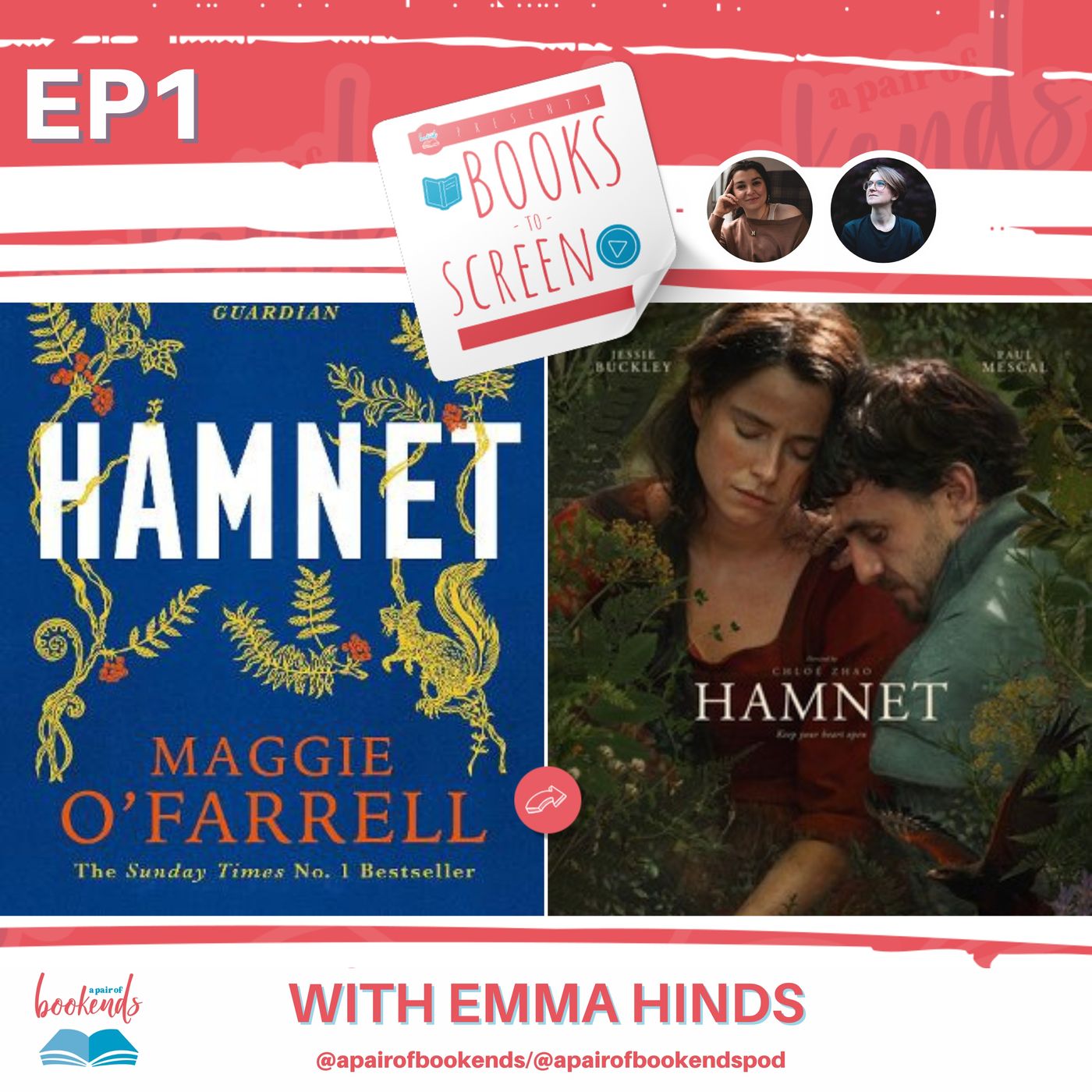
Books to Screen: Hamnet with Emma Hinds
Episode Transcript
Welcome to a pair of bookends, the book Club you can Carry Anywhere.
I'm your host, Hannah Matt Donald and I'll be bookend in the conversation with some of the most exciting voices from the bookish world.
Hello, and welcome to Books to Screen, the series where I invite bookish guests to join me for deep dives into my favorite topic adaptations.
This is the first episode in the series, and joining me today is longtime guest of the pod, often co host of our Patreon episodes, best part of mine, and of course the amazing author.
Let it be known, it's Emma Heins.
Hello, we have to talk about history exactly.
Today we are diving into one of the most anticipated movies of twenty twenty six and arguably one of the mostticipated adaptations, which is Chloe Jao's film adaptation of Maggia Farrell's twenty twenty novel Hamnet, which is starring Paul Mescal and Jesse Buckley.
The novel Hamlet was, as I said, published in twenty twenty by Tender Press in the UK and by notf in the US.
It is a historical fiction novel about the death of William Shakespeare and Hathaway's son, Hamnet Hamlett died at the age of eleven in fifteen ninety six, and this novel explores the life of this family before, during, and after his death and how they navigate grief and loss.
It was reported that by twenty twenty four, this novel had exceeded two million copies sold and had been translated into forty languages.
The film adaptation was released earlier this month in the UK and has already been nominated for several awards and has won the Golden Globe for Best Picture.
Before We Dive in though, Emma, are you ready for some quick fire questions on adaptations?
Speaker 2I feel like I'm at school, But I'm as ready as ill ever be.
Not very ready.
Speaker 1What is your favorite adaptation?
Speaker 2I think my favorite adaptation is the BBC War and Piece.
Speaker 1Wow, I wasn't expecting that.
Speaker 2Yeah.
Speaker 1I was thinking you'd go for like wolf Hall, or like Pride and Prejudice or something like that.
Speaker 2I do love those things.
I do love both of those things, and the BBC wolf Hall is incredible.
But I really love the BBC War and Piece, and I think I love it because it sort of I tried to read War and piece and I got really stuck.
And then I tried again after watching the adaption and it was so much easier, and it just really like helped me do it.
And I think that's the point, is like, if an adaption is good, it gets a person into the book, right, that's the point.
It's not substitute, it's it helps you get it helps, it helps two pieces of culture work together to make this one thing.
So yeah, I love it.
It's brilliantly cast.
James Naughton is amazing as I'm day breaks my heart every time James Norton.
Speaker 1Yeah.
Speaker 2I think even has Jesse Buckley in it, which is ironic.
Yeah, I think it does have Jesse Buckley in it.
Speaker 1Oh, I'm kind of sold on that now.
I never thought i'd just watch that, But here we are great.
Speaker 2It's great.
Like you think like, oh, I'm not going to love it, and then you sit down and they're like it's high society Russia and they're swelling around.
Lily James is like swolling around in her beautiful dress, and then suddenly it's like war and everybody's being blown to pieces, and it's just like it's it's such high drama and so good, and there's yeah, and there's an affair or as close to an affair, you know, to sell it to me, there are two affairs.
Speaker 1Great, So I was going to ask you do you read before you watch?
But then you've just kind of come up with a really great argument for why it might sometimes be beneficial to watch before you read.
Speaker 2Yeah, I like to read before I watch.
But I think the point of adaption, hopefully is that it moves people towards the material.
And sometimes you can watch a movie without realizing that it's an adaption, or you can watch a show without realizing it it's adaptation, and then you move back.
So, for instance, like All of the Strangers, which we loved, is an adaptation of a novel that is actually very different from All of Us Strangers, but it took me to the material anyway, So yeah, I love that.
Speaker 1I still need to read that book.
What is your favorite character casting?
Speaker 2Okay, this is like a person who's perfectly cast, right, that's what this Vigo Mortism as Aragon and Lord of the Rings for all time.
But also yeah, now I am sticking with it though, But Timothy Dalton as mister Rochester and the BBC Jane Ayir from like the nineties is peak.
So that's a battle that I'm just going to have to have in my head.
But those those are pretty high on my list of perfectly cast characters.
Speaker 1And I know that we could also bring up Gretagwigs little Women, which we both love.
Speaker 2Oh my goodness, yeah, Timothy say.
Speaker 1Such a good casting.
Speaker 2Such a good casting.
It's that's a chef's kiss.
It's a chef's kiss casting.
Speaker 1This is not This was a terrible idea to get us to do this because it's not going to be a quick fire an adaptation you would love to see happen.
Speaker 2Oh, I'm going to put.
Speaker 1It out there right now that any producers, directors, anybody listening to listening to this.
The Knowing by Emma Hines would be so good on screen and it needs to happen, and police ask me.
Speaker 2That would be great.
Yeah, I would love that.
I would love that.
Speaker 1Thank you.
Speaker 2Okay, So I'm a big you know.
Oh this is so hard.
I'm sorry, but I'm just gonna go with Like, I think something like PERNESI would be really fun.
Speaker 1Yes, and it's.
Speaker 2Okay, Well it's happened.
It feels like I should choose something that like people aren't doing.
Speaker 1No, this is only like this.
This news came out like within the last fortnight.
Oh okay, so ahead of it, you know.
Speaker 2Aside from that, my friend Nat Reeve writes the funniest, silliest, queerest, most trans Victorian detective romps.
And I just feel like we're in our a Nola Holmes era as a society anyway, and this needs to happen.
NAT's work is essentially his work is like a Nola Holmes but much more chance.
And I think that would just be like I can just imagine like Early Fate and Nettleback being like a perfect TV series.
Speaker 1It would be so fun but fun.
David from Serenity Booksellers has been begging for a musical of that.
Speaker 2Would also be cool.
Be cool.
Speaker 1Frequently posts tagging is it cyper Press.
Speaker 2Cyper Press, Yes, cyper Press, nat Reeve, cipher Press.
If you have been watching a Nola Homes and being like, why are there just not more gay characters and trans characters in this?
Then that that's where you need to be.
Speaker 1An upcoming adaptation that you're excited for.
I know which one you're not excited?
Speaker 2Okay, so I know hus for Hawk is coming out.
Speaker 1I think it is out now.
Speaker 2I think it's just and that is one where like I am actually quite excited because I never got into the book and I haven't read it, and I really haven't been that interested in it.
But I really liked Claya Foi as a performer and I like the work that she does, so I think I'll beat into I think I will watch it and then read it.
Probably.
Speaker 1We did see the trailer for this, didn't wait?
Speaker 2We did?
Speaker 1It looks excellent.
Speaker 2I am excited for the Odyssey.
Oh my god, sorry no, if like they I will put this on my adaption and like, I know this is a segway, but like, if someone can adapt the Song of Achilles, please, oh my god, yes, like mega mega mega feels I will die.
I was like obsessed not read it as a kid, have you not?
Speaker 1I need to break And you're like, you're not the first friend that has said that it's incredible, and a few of my friends have said you need to read it.
Speaker 2So yeah, well maybe maybe a movie will come out.
Speaker 1Maybe, yeah, an adaptation?
You hated?
Speaker 2I had one in my mind.
Okay, I'm just going to I hated the most recent persuasion.
Speaker 1Yes, I remember you tell me this with.
Speaker 2The the fourth wall fleabag breaking thing that that wasn't That wasn't the one for me.
Other adaptations that I've hated, I had a really good one.
There was it gone.
It's like all the adaptations that have ever existed have just fallen out of my head.
Speaker 1That's understandable, That's okay.
Again, that's okay.
Speaker 2Maybe it will come back to me.
Speaker 1Well, I was going to ask you an author you think would be great at writing fulfillment, but you've just kind of given a very good pitch for nat Reeve.
Speaker 2Yeah.
I think there are some very naturally cinematic writers, but like people who I'm sure will end up writing already do kind of lear the edges and will end up being some writing amazing stre in place of their own work or other people's work.
Julia Armfield will ye, those will Yeah.
I think Brandon Taylor probably will.
Aj West.
So the betrayals are almost true.
I feel like that's coming.
I think that's only a matter of time in terms of people whose work I read, and I'm like, I think this is already very cinematic and what you and I don't know whether that means that they would be a great screenwriter, because I do think it's a different skill.
But I like Ak Blakemore who wrote The Manning True Witches.
I think they have a very cinematic kind of visual landscape.
And yeah, Sarah Perry as well, I think, although I never saw the Essex Serpent adaptation, so I don't know, like if it was actu any good or not.
Has in it and Tom Hiddleston, so I mean it should be good.
Why haven't I watched it?
What's wrong with me?
Speaker 1Maybe that could be another one.
Okay, let's get into what you came to talk about, which is Hamnet.
I have been so eager to talk about this, and I hadn't read the book yet, so I'm really glad that this has got me to read the book.
I did read the book before watching the film, thankfully, I managed to squeeze it in and I loved the book so much.
I was so mad at myself that I hadn't read it before.
When did you first come across it?
Speaker 2I haven't read a lot of Maggie O'Farrell and I bought this in a charity shot, probably like not that long ago.
It's been since we lived in this house so within the last five years, which is strange because you'd think for me that as soon as it hit the market, I would be right there.
But yeah, it just it just didn't.
It just didn't kind of, I think.
I think for a long time I didn't necessarily realize what it was about out Yeah, I'm not going to I think also before I was in before I was really in publishing, I wasn't a person who was very interested in publishing.
Like I was very interested in writing the craft of writing, but not very interested in the publishing world.
Like I would read what I want to read.
I would go to the library and pull out books that I wanted to read, but like the interests me.
But I also wasn't really online in an online space.
So I think I've just seen it and been like, oh, that's a weird word.
That's a weird word for a book, And then you know, picked up in a chat shop one day and was like, hang on, it's about Shakespeare.
It means Hamlet.
Speaker 1Oh I love that.
So you said you've not read anything else by Magio Ferrel.
Speaker 2But I've not.
I've not checked her bio, So I don't know what I read let me look.
Speaker 1The Marriage Portrait was a more recent one.
Speaker 2No, I've not, I've not.
Speaker 1I have read.
I think it's called The Vanishing Act of Esme Lennox.
That was the first one I'd read, and I absolutely loved that.
And I think for anybody that loves reading a Sisto dynamic, that is a book to get on your list.
It's a really, really good one, and it was just like a really unexpected favorite.
I am like I think the cover as well.
I just wasn't expecting it to be my cup of tea, and then I fell in love with her writing as a historical fiction expert, loll out.
Of the two of us, you definitely are, Yeah, I would.
I mean, you know your historical fiction.
So I think I'm making a fair point anyway.
I'm not going to argue with you on that.
But why do you think this works so well as historical fiction?
Oh?
Speaker 2So, I think for me, something that really gets me excited about historical fiction, and I've talked about it a little bit in the past.
I think is examining a moment, either examining a moment in history that hasn't necessarily been examined in a particular light before or looking at a moment in history, you can clearly see the seeds of something being planted that then produced something later on.
In this case, the death of Shakespeare's son Net Hamlet produces one of the greatest pieces of literature of all time, Hamlet the play.
And that is just as a historical fiction writer, that is so much fun to be in, to be in like a moment, to take yourself back in time to a moment of history and kind of give it flesh and ask yourself, what's actually happening in this moment beyond the bare fact of and in fifteen ninety six his son died of plague, what does that create in their household?
And I can see why it was just such a juicy moment for her.
That's what my agent, Alice, always calls things juicy when we talk about historical fiction.
And that's how it feels, is like that a historical moment is so ripe for the picking and it hasn't necessarily been examined too greatly or in too much detail.
And I can see that she looked at it and went, oh, I'm going to talk about his wife.
You know, I'm going to I'm going to build that house.
Yeah, break by bit timber by timber.
I'm going to make my reader live in it with this family, and then I'm going to wrench this death into it and see what it produces.
And I think that's it's really clever, and yeah, that's why it works.
I want to know as well, Like.
Speaker 1Yeah, and we know so much about Shakespeare, you know, there's so much more information available to us about him than there is about his family, and I think it's just really magical the way that she's sort of expanded on the what could be of his family.
You know, I really love that she never names him, you know, she never names him as will or as Shakespeare in the book.
In the film they name him once, from what I can remember, they name him Wants.
But in the book they don't name him at all.
He's just referred to as the Taylor's boy, is the tailor's boy, the glover's boy, the husband, the husband, the father.
You know, it's all those kind of you know, references to him.
And I think that's so cleverly, Dawn, And.
Speaker 2It's also it's so delicious because it's all the ways that we don't know him.
Yeah, as a historical figure.
We can never know him as father son, brother, Glover's boy, you know, we can't know those things about him.
We know him as his name and and his his title.
But I also think something that she feeds really nicely into the book, which is a fact about this historical time period, is that names were a lot looser.
So you know, in the book she's written, her name is written as Agnes.
In the movie they pronounce it Annius.
Historically she's known as Anne.
The child who dies is Hamnet, but Hamnet is also a Hamlet.
Speaker 1It was changeable.
Speaker 2Yeah, And we also know historically that William Shakespeare signed his names lots of different ways, and so sometimes it's Shakespeare Shakespeare like it's it's slightly different.
But it just speaks to how communication was diff at the time.
And one of the bits I love that she puts in the book is when the letter finally arrives telling him that Judith is ill.
Yes, the boy in the place where they're performing calls out an approximation of his name, And that's sort of how it was in those times, is people felt things differently, and you just assumed that if it sounded like your name, it probably was your name, and it also speaks to the different levels of status and the changing the way that printing was changing the world as well, because before this point, printing hand hasn't been part of the universe.
Everybody hand wrote things differently.
So yeah, I just I love that all of those decisions speak to something about the historical time period, which is always something that's going to get me exciting.
Speaker 1I also another thing that I think she's great at is I always I always use this word, and I don't know if it's the right word to use, but I'm going to use it anyway.
I think she's so good at inhabiting the mind of a child.
Is that the kind of word you would use or is there a better writer term for it?
Speaker 2I would use the word habiting.
I think that's that's a great word.
Yeah.
Speaker 1I just think she's so skilled at that.
And his sort of observations on the world around him, and his kind of curiosity about the world around him, and you know, not quite understanding certain things.
And there's a moment when in the book that isn't used in the film where he when he first realizes judas Ill and he runs to the I don't know what word he uses for like the doctor's house.
Speaker 2It might be the physician physician.
I think it is quite a common word.
Speaker 1I think it will be that he runs to the physician's house and he has this whole experience of like trying to get in and then I don't know if it's the physician's assistant or his wife or whatever, but won't let him in the house, and it's all his kind of confusion, and is you know how frantic he is, And it's just such an innocence to it that I think is quite hard to maybe get right.
And I think it's really hard as well when you get older to kind of remember what it's like being a child and how you might perceive certain situations and how you might respond to certain situations.
And I just think the kind of how afraid he would have been, she portrays that really well.
Speaker 2I think she does a beautiful job of a child water and I think it's very brave as well too.
It's a difficult thing to do to narrate a character all the way up to their experience of their own death, yes, because at some point you are slipping the bounds of what people are either going to find believable or not in terms of self knowledge.
Does somebody know when they're dyeing?
How do they experience it?
Nobody can tell us that.
And so the imaginative journey that she takes this little boy on is very I found it very I find it very convincing.
It is perhaps like the one thing you could say about it is it's just like a little bit.
It's a little bit gentle in terms of it's interesting.
It's a very interesting choice, but there is like a gentleness to it in the way that she narrates Hamlet's death from his own perspective, this sense of him being in a snowy landscape and lying down in the snow and getting weary, whereas his mother's narration and the narration of the situation is that he is in tremendous pain and is in tremendous suffering.
And she kind of I think she gives her readers a little bit of softness in that choice, which is that no matter what Agnes Annius is experiencing, the reader knows that from Hamnet's own perspective, he has lied down in the snow and has experienced the softness.
And that's very sweet and very tender.
I wonder if there was a harsher version, if there was a version where it didn't eat, where she didn't write that.
I just wonder.
I just wonder.
Speaker 1Of course you are going to say that.
Speaker 2I just wonder because it's because it's an interesting choice to have those two experiences contrasting.
So I do wonder if an editor came along and was like, God, this is awful.
Can you just can you just lighten it just like a smidge?
Can you make us feel that he's not suffering?
But what's really interesting in terms of an adaptation choice is like Hamlet's death in the book is so sad, but it is it is carried so tenderly with the language right, the way his last the way his last breath is described.
All of that is carried so tenderly, and that is a real comfort to the reader.
In the adaptation, none of that tenderness is there.
It is brutal.
It is brutal, and you have the scene that is described in the book very well, of like how the different characters are reacting to his mother really fighting for his life, But you also don't have that choice of like the softer scene so of the and they do show the internal of Hamlet because they show him kind of like we talked about, you described it as like beyond the veil, this idea of him kind of on a stage, but he's that and they do have an little bit of a moment of him maybe making a choice to go on, but he doesn't have that same softness that it does in the book.
And I thought that was really really interesting that in the adaptation they were kind of like, Nah, we're just gonna we're just going to make it appalling, really experience.
Speaker 1We're on the subject of his death now, so we may as well deep dive into that.
I mean, I think I think you pronounce it Jacob Jacob Dupe as Hamner.
I think he is an incredible actor, and I think he is going to go on and have a wonderful career.
I think he portrays that character beautifully.
And one of the hardest parts of the book to read is him taking Judith's place.
Speaker 2Yes, that's harder to read than his death.
Yeah, from his perspective, Yeah, is interesting.
Speaker 1Definitely, and him saying that we're going to you know, him be saying that you can see death in the corner, And I did think, how are they going to translate that to screen, and I think that was a sort of tricky thing for them to translate.
I think in the film he only kind of does this glance into the corner, and probably out of all of it, that was the one thing that didn't really work for me on screen, Yeah.
Speaker 2It was it was direct to camera as well.
Yeah, like we were death, the viewer were death.
Speaker 1Yes, yeah, But I do think him taking her place is genuinely like one of the most devastating things I've read.
It's really hard to read, and I think that part was harder to read than it was to watch.
But then his death is so harrowing on screen, and it's his mum.
I mean in the book, she's obviously so frantic and she's having all these internal thoughts of how could And I think she even says it to you know, Will's mom as well, like, how how can I have been tricked?
You know, I've been so focused on Judith and I always thought she was the one I'd lose, and you know, that's made me, that's distracted me from the real problem, which is Hamner.
And you know she's so frantic with it.
But you know, on I think Jesse Buckley does an absolutely masterful performance of that sort of frantic energy you would have, and she's, you know, she's got the pestel and is pesl mortar?
Is that what you call it?
Speaker 2Yes?
Speaker 1I always think I've got that the wrong way around, pestl mortar.
And she's frantically with these herbs and you know, rubbing things on him, and she's like nothing's working, and she's the sounds that are coming out of her are just like you really feel like as anxious as she does.
And then when he actually dies, I mean, you do sorry.
You do have this moment where Susanna, his older sister, has this sort of scream at her that I couldn't remember if this happens in the book.
Speaker 2It doesn't in the book.
Susannah thinks it okay, and she's like turned to the wall and she's got like she is, yes.
Speaker 1And it's beautiful.
Yeah, But I do understand that there is certain things that they need to show.
They need to show us that, you know, we can't have all of those internal thoughts on screen.
So I do understand that.
I do think that moment in the book is really beautiful of her with her head on her face, but on screen, she screams at her and says, you know, leave him alone, like you know it's not going to work, or like let him go or whatever.
Speaker 2She says, Yeah, can't you see it's too late.
Speaker 1Can't you see it's too late.
You've got such a good memory.
Speaker 2I reread it this morning.
Let's be I reread that moment this morning, So it's late.
Speaker 1You see, it's too late.
And then when he goes, there's there was this moment of complete silence, and I mean, I don't know what it was like for other people in the cinema, but in our cinema screen it was like pure silence as well, except for sobbing can't do this and yeah, pure silence.
And then Jesse Buckley just kind of lets out this sound from the depths of her soul.
And I just think it is one of the most powerful performances I've ever seen, Like genuinely.
Speaker 2I think it is Jesse Buckley's movie.
Yeah, that's my opinion.
I think that Oscar.
Yeah, I'm not going to shore on your boy.
I think he was fine, but I think it's.
Speaker 3So fine, like he was good, but please okay, for the time that he was on the screen, he was lovely, but it's her movie fair and he does.
Speaker 1There's even a clip that I've seen of part of their press tour where he's holding Jesse Buckley and he's saying, in years to come, drama school students will be studying this performance.
And I do think he's right.
I think she captures that grief so unbelievably well, and that moment will never leave me.
I just think it's it's so sad.
There is a I thing around Hamlet's death that that I want to speak about, and it's when Will realizes it's Hamnet that's died.
Is different in the book to in the film, which of course things are going to be different, but you saying that she will remember the sound that Will makes even in old age, and also him being the one to carry Hamlet through the streets to be buried, I think is also one of the hardest things to read, and he's so beautifully written.
Speaker 2I missed the funeral.
I didn't miss it at the time because we both went into this movie in slightly different states, so you had read it quite recently and we're watching the movie.
I had read it a long time ago.
Just watching the movie, so For me, the movie was kind of like had a lot of grace, you know, I didn't have like the memory of the book kind of imprompted very freshly, so I didn't know what I was missing necessarily.
At the time, I didn't feel like things were missing so much, So I really was kind of watching it as a piece on its own and sort of assessing it how it held up to like the historicity of the time, and how it was expressing those things, and how it held up narratively as a whole piece, rather than necessarily thinking too much about what might be missing from the book, which I think is a cool thing to be able to bring now that perspective.
But then after we watched, I reread and one of the things I missed was, I think you really missed that moment of him carrying his sling and his brother coming to help him.
I really missed the moment of her which I can see very clearly, of her like at the end of the funeral, gripping the post on the edge of the churchyard and not wanting to leave.
While she's still holding the post.
She still has three children, and if she leaves the churchyard then she'll have left a child behind in the churchyard and she can't leave him, so she's holding onto the post so she didn't have to leave, and they pull her away.
And I think that was such a visually compelling moment.
I'm surprised it didn't make it in.
But when I examined it fully, I realized that, like the impact of that moment is really based on the train of her thoughts, that feeling of I can't go from having three when she enters the churchyard, she has three child and when she leaves it she will have two, and she can't make that transition.
Yeah, and I don't think it would.
I can see I can imagine that.
Maybe they shot it, but maybe it didn't have the same impact just visually on the screen because you can't, you know, bring that unless you narrated it or had her speak it aloud, it doesn't have the same impea.
Speaker 1Yeah, I did miss that, and I did, like you said, I missed him carrying it, you know, insisting on carrying his son to be buried, and then his brother joining him.
I was really moved by that.
I also I felt in the film that him when he realizes it's Hamnet that's died and him going to him and sitting with him.
I personally felt that, I know, we cried so much already in this film, but I did feel that that moment was cut too short.
We moved on too quickly.
I feel like we needed to sit with him and that realization that he's lost his boy, you know, he says it like, oh boy.
I feel like we needed to wait with that for a few more beats.
I felt like it was we were pulled away too quickly.
But I don't know if it's because we spend so long with Jesse Buckley and her emotions and then when he come and it's like, oh, maybe we've been with this too long now.
But yeah, that was for me.
I wanted to see his reaction a little bit longer.
But I know what that says about me.
Speaker 2It's a very moving moment, isn't it.
When he comes home.
Yeah.
Speaker 1In the book, he sees Judith, he gets excited that she's okay, and then he sees Anyas and he sees Susannah and he's like there's one missing, you know.
He like goes around the room and like counts the people and then he's like, something still wrong.
And then he realizes it's Hamlet that's in the book, But I just think in the film we kind of left it too quickly.
Speaker 2Yeah, what were you going to say?
I really appreciated the speech by her mother in law, which is kind of a batim taken from the book about not taking children for granted, and in the book it's her internal thoughts when she knows that she believes that Judith is going to die, and she's talking about she's thinking about her own children who she's buried all plague deaths, and about how children are so precious.
Yeah, and it was a really moment in the movie, and I appreciated them taking what was kind of like a little bit of an aside, like it was lovely but it was it wasn't as important in the text and giving it this whole moment that really informed her character, because she's an interesting character in the film.
I think as the mother of the playwright of the Nation.
I guess in terms of her timeline, we see her as this kind of a little bit henpecked woman with this abusive husband.
She clearly loves her children.
Then we see her very against Annius when Annius is pregnant with his baby and wanting to get rid of her and not wanting her to be married to him, and so we develop this as a viewer, We develop this feeling that she is not a kind or compassionate woman, and it's a little bit reinforced because she refuses to let Annius go into the woods to bear her second children, who turn out to be twins, even though she's doing this out of tremendous belief of keeping the children safe, and in the I don't think it is this way in the book, but in the movie they make the point that the river's flooded and therefore it'd be unsafe for Anys to go and deliver the child how she wants to, which I think kind of takes away from some of the rage that Annes feels in the book.
But she is very, very tender and gets Anya's through the birth of her twins.
Speaker 1That performance from Emily Watson is yeah, when she's held dinner and you can see how emotional she's feeling.
Speaker 2But it really it's a performance that really culminates in this monologue about losing children and losing babies that is delivered so powerfully and simply.
It's very candle.
It it's direct to camera, She's sitting at the table.
There's this profound sense of overwhelming grief inside of her, and yet she delivers it kind of very calmly.
And I thought that was a really beautiful use of the source material.
It took a moment that was maybe a little bit on the side in the book and really brought it out and created this really beautiful character in that moment.
I think if they hadn't had that moment, I don't know if I would have loved that character in the movie as much.
Speaker 1I also don't know if his father's abuse was as believable on screen.
Not believable, but it didn't feel as intense on screen as it did in the book.
Speaker 2For me.
Speaker 1In the book, I found it to be really overwhelming, and I found the moment when Will puts him up against the wall and says that you'll never hit me again, or that's the last time you'll ever hit me, or something along the lines.
I found that to be so powerful in the book, and it was powerful on screen, but I felt like there was less of a build up to it.
And I don't know if it's just because you've got less time on screen.
Speaker 2Time, but also that internal space.
Yeah, isn't it, like you just it's very difficult to portray those internal feelings.
Yes, yeah, that he experiences the kind of like humiliation, particularly that he feels from his father, and how that rift is so present and present in his life.
Speaker 1But they also they don't have in the film adaptation.
They don't they have this moment in the book where any watches, like I don't know if it's like a meal time or something, and there's some sort of movement or something that's said and without there being the physical action or like you know, something serious happening, and it's just gains this understanding of Oh, this is what's going on in this family, or this is what's happened in this house.
She would suddenly, you know, she doesn't see the abuse for herself, but something happens that makes her aware of that's what's happened to Will.
And I found that a really powerful moment.
But I don't think she sees it in the film.
Speaker 2No, she has like a sense of she believes that both her and her brother feel that the house is quiet.
And yeah, I think the comment on the quiet house is meant to kind of bring with it the connotations of like it's a it's a house that's quiet because it's keeping its mouth shut.
It doesn't everyone inside it is walking on eggshells around this man.
But something I loved in the book that we didn't get in the movie, and I can see why, because it's kind of a castaway moment is like after Hamna has died and his father goes out just on an errand, and he's so overwhelmed by the children and the presence of them out in the streets, and he bumps into his father, his own father in the passageway, and it's like two lines long, and it's basically highlighting that his father says nothing to him about his son's stuff, has nothing to say to him.
And I think it's a great little line and I could see it so clearly when I read it on the page, and I think that would have kind of given a little bit more of a bookend to their relationship in the movie.
Yeah, because in their relationship in the movie is like he's abusive and Will puts up with it.
He's abausive and Will stands up to him.
He Will is worried about his son in working for his father, and that's kind of it.
Yeah, And I do feel like that moment would have kind of, like, I don't know, given us a little bit of a book nd to his relationship with his father.
Speaker 1Yeah, I mean we do come into the film a lot further on in the story than in the book, because in the book we see so much of their childhood and what, you know, Andie's life was like with her mom, what their dynamic was like, you know, how sort of quirky her upbringing was, and it was especially quirky in like those times.
Speaker 2You know.
Speaker 1I don't think it's mentioned that she was perceived as a witch, but there was definitely a sort of kind of people were wary of her and maybe distrustful of her, and there was a different way that she brought up her children than maybe Will was brought up in lots of different ways.
Yeah, we don't see as much of that side of things.
I think we immediately come into it when Agnes is older and she's in the forest and he's tutor in her brothers, and we don't even see why his tutor in her brothers.
It's just we jumped to that point and it's kind of their meeting not long after.
So I don't know.
Did you feel that we'd lost anything by not seeing their up bring in?
Speaker 2No, No, I don't.
I don't think so.
I think because they had flashbacks for Annis's mother, they didn't do flashbacks for his family.
But because we had flashbacks with Annis's mother, I don't think we lost I think we had all the information that we needed.
And if.
Speaker 1You can see from the way she is what her mother might have been like.
Speaker 2Yeah, yeah, I think this is where like for me, it potentially fell down as an adaptation, but it's a really complicated thing.
So I'm going to try and put words to it in the best way I can.
What was presented visually on the screen was a very kind of like heavy lean on like what we currently perceive as things associating with paganism.
So the interest in herbal remedies, plant knowledge, respect for nature, believing in kind of nature as a space in which surprising things can happen, foresight and fore knowledge that Annius is able to get from touching people or being in people's presence.
Those ingredients in the movie read visually as a very clear witchcraft narrative, and I when we came out of the movie theater, I was kind of like, I don't remember it being this heavy on the witchcraft thing, and I was rereading and I was like, it's not as heavy on the witchcraft thing because of a very important like Marigimi O'Farrell does a very good job in Hamnet of presenting the diversity of thought and the diversity of thought and experience that was happening in the fifteen nineties.
Particularly so this is pre witch trials, which come in hard in the sixteen hundreds with King James, the publication of the Discovery of Witches, which is.
Speaker 1Way your historical knowledge.
Speaker 2But this is not to say that witchcraft wasn't something that was punishable by death, because it was.
The laws are rare on witchcraft in those times.
Were that in order to be put to death for being a witch in the fifteen nineties is you would need to produce witchcraft that killed another person or a pig, a piece of a livestock, live valuable livestock.
Like you know, it's a bit ironic, but like if you did witchcraft that killed a dog, people honestly would probably not give a shit because dogs weren't worth anything, but like a pig, something that a family might rely on that would be a big deal.
This doesn't take away from the fact that somebody could accuse you of witchcraft and you could be tried locally and you might be put in a ducking school stall, or you might be murdered for it according to the law.
But what we also have to take into account is that, like the way we think about medicine today and the way we think about religion today is hugely influenced by the scientific revolution of the nineteenth century, and also by the division that developed between spirituality and science.
Really not until in a very hard way until the like eighteen forties, eighteen fifties, so a long time in the future.
So what I'm trying to get at is that we see in this book on the page there's a church burial.
People are crossing themselves at his death.
At the moment of his death, there is a sense of like the idea of fore knowledge and things like that, of using herbs, that was like everybody was using herbs those kind of things, because that's all there was to be clear.
So this idea of like her tying herbs onto his bubos to like heal him visually.
On screen, we look at that and we're like witchcraft because we've been taught to associate those things with those things.
But at that time, that's that's all there was.
There wasn't another cure for the plague.
Even in the sixteen hundreds.
They were so when we were researching the boundary, do you remember we were talking we would.
Speaker 1Like the difference contact.
Speaker 2Oh yeah, Hannah and I met the way Hannah and I met is I wrote a play about the plague, particularly the outbreak of the plague in sixty oh the sixteen forties in Lancashire and Derbyshire and even that, like so.
Speaker 1Smory, backtrack, what what did you do to my character?
Speaker 2She got stoned to death for having the plague?
Yep, she did.
Speaker 1And best friends tell me how that was.
Speaker 2Yeah, but the treatments were the treatments had really not changed between fifteen ninety three and the mid sixteen hundreds or even the late sixteen hundreds.
The idea you would still put salt on your windows.
It was still considered a good idea to find a toad and tie him, to tie him to the bubaus.
Speaker 1Or there wasn't a toad in the film.
Speaker 2There was no toad.
I think they thought it would be too unbelievable, but it was a real for one hundred years.
For more than one hundred years, this is this was medicine.
Speaker 1And I think film for history nerds like yourself.
Speaker 2No, But I think what it means is like our modern reading is that we read anti Christianity into what we see visually on the screen.
There's an element of that, but it's much more nuanced in the book, which is that Yes, for a lot of people in that day and time, these two things were coexisting.
What we perceive to be paganism anti Christian sentiments, using herbs, like thinking of like nature, being able to see or foresee things.
We think of those as anti Christian things.
Magic, we'll put that in the magic category.
But in fifteen ninety ninety six, magic and Christianity are interwoven together and they haven't yet been separated out.
And that's a really hard thing to convincingly portray to a modern eye on the screen.
So when I left the cinema, I was like, I'm reading all of these visual clues that today aligned to which and they didn't align the same way in fifteen ninety six.
And that's something that I really appreciate about the book is she shows the nuance of that balance, how it really was like a balancing act.
You know.
So a woman who birthed all your babies and cured your husband's cough and did all of those things could on a terribly bad day, the town could turn against her and call her a witch, and you know, maybe they might get away with burning her, or maybe they put her in the stocks for a couple of days and throw cabbages at her head.
I think that's something that she, Maggie O'Farrell, deals with really well.
It's not something that I think was convincingly picked up in the movie.
But I don't know how you would do it.
Yeah, that's the end of my So.
I don't know how you could create this historical moment.
It's so hard to do visually, unconvincingly, because we are so entrenched in our idea of what these things mean.
Like the symbology is too strict.
People think it's church or magic.
People think it's just an a Catholic Catholic.
People think it's Shakespeare was a pagan or he was a reformer, And it has just two nuanced And I don't know how you would do it.
But I did want it.
I don't know how they would do it, but I did want it.
Speaker 1That's fair.
And another thing that I don't know how they would do but I did want it was what I would consider one of the greatest pieces of writing from this book, and it is how the Flea carries the pestilence.
I just think it's masterfully done by Maggia far Yeah.
Speaker 2I think that would have been very hard to do without.
You know.
So we've been recently been rewatching House TV show.
This is a wild segue, but we'll get there.
And one of the things, one of the things it was like one of the first TV shows that it did, is it would do that thing where it like zoomed inside the person's body the one blood vessel following like that blood vessel there and clots and then the person seizing, you know, right, I think, how would you do that without having like the zooming on the flee Yeah, yeah, I think it would have been very visually.
They did that little the Little Puppet Show moment that.
Speaker 1Was that, Yes, they I had forgotten about that.
Yeah, okay, but I don't know if it would have kind of been not comical, but like what's the word I'm looking for it absurd.
Yeah, I think it would have probably leant into that if if they had have shown that.
But I do think in the book it is such a great piece of writing.
The whole book is amazing, you know.
I hope I've made that clear, but I just think, like I couldn't stop thinking about about that particular section.
I just thought it was amazing.
Another thing that was in the book, but wasn't It was in the film, but not We didn't get the sort of I'm just gonna explain.
In the book their first sex scene of our focus is placed on the apples and the movement of the apples and on the hawk, which I don't think is called a hawk in the book, but it's called a hawk in the film, called like I thought it was.
Speaker 2Just called her bird, Like it's a bird.
They conversationally, they come to you understand that it's a bird of prey, but I thought it was just her bird.
Speaker 1I could be wrong, but yeah, the the sex scene in the film, we see them doing the act, but we don't really see that in the In the film we see it, but in the book we obviously our focus is placed elsewhere.
Speaker 2And also the apples are there.
I remember the apples.
Speaker 1The apples were there in the film, Yeah, they were.
But I just think it's really interesting seeing how each sort of artist puts their focus elsewhere.
So Maggie's focus, well, Maggie put our focus on the apples and on the bird in that space during that moment, whereas Chloe Jao was more interested in like their intimacy, and we come to their intimacy much quicker, because you know, we get to their first meeting much quicker.
And you know, they had this moment where they kissed quite quickly and she does the you know, holding the section between in his thumb and is that your full finger?
Yeah, you know, she holds that section there.
And then obviously, after a little while, we then have the sex scene and it's I don't know, it just it just wasn't.
I didn't know how that would translate to screen.
But I do think that Paul mescal and Jesse Buckley do have an incredible chemistry.
Speaker 2Yeah.
I really liked the bit where he comes and says he wants to be hand fastered to her and he just walks around.
Speaker 1Her, and yeah, the Constant Movement really liked that.
Speaker 2Yeah, I think it really it spoke to something that is captured in this book, that the sense that he already has a frenetic energy that needs to be expended, and she quickly realizes that in order to keep them happy, he needs to be elsewhere.
And I liked that, and.
Speaker 1I do think the book has a particular pace and energy to it.
Yeah, that I didn't know how they would get on screen, because I feel like in the book we get a bigger sense of this place they're living in and the people around them, you know, in the village.
Speaker 2Or the Stratford.
Yeah, exactly.
I think some thing she does a brilliant job, and it's something that I really respect in historical fiction writers who bring us abruptly into the world in which you are exploring without losing the character of that time period.
What I mean, I guess is that in the craft, in the way that she uses present tense narrative, the person present tense really gives the reader a sense of living in the moment, but she doesn't lose the texture of the world itself will make it too modern.
And this is something that Hilary Mantel does beautifully, sort of something Joe Harkin does really well, and I really enjoy that in her writing.
And yeah, it's something that really lends itself to the exploration of the internal mind, the minute by minute experiences of living in somebody's body, and she really gives us a wealth of that with all of her characters, and that I can see how that is a challenge to them bring onto the screen.
I think for me, the thing is always going to be child actors.
I think it's a really hard gig.
I think it's a really it's a hard job to get children to play convincing historical children without seeming drama, without pulling you out of the narrative to the point that you go, oh, they're doing quite they're doing quite well for a ten year old, or you you go, oh, I bet, I bet they've been to drama school, or maybe they haven't.
You know, getting to them to that point of like natural ease, especially with the adults that they're working with, means that sometimes you do get a little bit of like a historical sacrifice.
And usually I've noticed this in historical adaptions, particularly around children's scenes, is that what the director or somebody I presume the director has done is just kind of gone just pretend like it's just normal, like these in scene moments where you're just they're playing in the garden or they're planted.
The scene where Jesse Buckley is teaching them how to plant things, she's describing it what she's doing, like, oh, you just need to pat down the grass, but she keeps she uses the word okay, and the children use the word okay back, and okay is not a historical word.
Speaker 1Did you shiver when you heard it?
Speaker 2It just it takes me out of the moment, But I understand how it happens, and I find it very common in historical adaptations that include children, so it's not the first time I've seen it.
But what it always tells me is that this is probably an unscripted moment.
They're trying to capture the essence of this kind of family and show us that these children are really connected to these actors.
But it always pulls me out of it because I'm not in the past anymore.
That word wouldn't have been used, and that's what makes it so hard with kids.
Speaker 1But yeah, I mean, one of my favorite behind the scenes anecdotes that I think, I mean, I thought that families chemistry, those actors as a family.
Their chemistry was amazing, and one of my favorite behind the scenes anecdotes was that they had rehearsed, you know, when they show their mom the play that they working on.
They'd rehearsed that separately, and Jesse Buckley had no idea that they were going to do that.
So she was led outside with him covering her eyes and them doing all of that, and she had no idea what they were going to show her.
So her reaction on screen is like her real reaction, which I just thought was so beautiful.
I do think the kids did a really good job, but yeah, I understand that those types of historical inaccuracies might pull you out of it.
Speaker 2I think some of their best moments were I liked the moment when the bird they did the funeral for the bird.
Speaker 1A lot, Oh my god, the bird.
Speaker 2I think a lot of their best moments were moments where they I'm not being brutal, but where they had like minimal lines.
Yeah, and they were kind of I do think the little boy who played Hamnet was very natural for the most part, apart from the parts that we already talked about with him having to see death and things like that that's maybe a little bit too much to ask of someone I presume can't be more than twelve or thirteen years old.
Very young, I mean he's very young.
Yeah.
Speaker 1Sorry, the bird you just made me think of the sound they do, Yeah, and they blow it up and look up and the repetition of that.
I'm not going to spoil it for anybody that, I mean, we've already probably spoiled aholl of it, but that that particular repetition of that sound is so beautifully dawn.
Yeah, I do think though the casting was great, and.
Speaker 2I think the casting was great.
Speaker 1I can't believe that.
You don't know if you think that.
Speaker 2I thought Jesse Buckley was superb.
Speaker 1Yeah.
Speaker 2I think William Shakespeare is such a hard character to cast, and.
Speaker 1I mean Madam Farrell has said in an interview that she always wanted him to be William Shakespeare.
Speaker 2Yeah.
The thing is in the book he is kind of an asshole, Like he's an asshole to the people around him.
He's he has a lot of anger and.
Speaker 1I did get that in the book though in the film, you know when he's going to when he announces that he's leaving, like not long after Hamlet's death, I was like a piece of shit.
Like I thought that was really like well portrayed because there was nothing on his you know, he didn't seem he didn't seem like he felt guilty about having to do that.
He was just like, oh, well, they need me.
And I do think that moment with them when they literally are wrestling, yeah, was really well translated to screen.
Speaker 2I think the trug like Paul mescal I really respected a night.
I'm not obsessed with him like you are, but nobody could be.
You love him, you adore him.
I think I think it's he has a very there is something about Paul Maskill's eyes that speak to like a softness and a sadness.
He's very good at like playing characters who have got like deep sads and yeah, and for me, Maggie O'Farrell's Shakespeare is not a deep sad character but a deep rage character.
Fair, okay, And so it was just we're talking about that moment where they wrestle.
For me, he just seemed heartbroken.
He was fighting her, but he seemed hard broken, whereas in the book there are lots of moments where like he just wants to rage at people.
And I didn't.
I didn't.
I felt like he was always on the brink of tears.
So it's not that he did a bad job.
I thought his performance was lovely.
He just wasn't.
This is just a subjective thing, isn't it.
It's just how one person reads a book and interprets a character, and it's and I'm being very specific about her Shakespeare right, because like Shakespeare is so broad for the general for the many many Shakespeares that have been put to film or TV.
I enjoy him tremendously.
I think he is top notch.
I think he is, and you know, I've seen a lot of Shakespeare's on TV and I really enjoyed his.
But for an adaptation of the character that I perceived in the book, I felt like he just missed the mark a little bit.
I think kids are always really hard to cast.
I think the fact that Hamnet and Judith in the movie do not look anything like each other was a choice because it's really interesting because in the book, the whole point is they look very identical.
They're identical twins as much as well, they're not.
They can't be identical because they're different, you know, differently.
Speaker 1It looks so similar.
Speaker 2They yeah, they look really similar, and that's the whole point of the book, Whereas in the movie they kind of played it as, oh, they think they look similar, and we go along with it, and we play that they can't be told apart, but we obviously can tell them apart, whereas in the book they actually can't be told apart.
And even after they've swapped places, after Hamlett has taken Judath's place on the palette, when Agnes wakes up and realizes she believes that Hamnet is Judis And it's only when she sees ink on his fingers on her fingers and she's like, why would Judith have ink on her fingers and realize it.
So it's a very convincing thing in the book, and it's played as kind of a joke, a sad joke in the movie that Hamnett believes that he can take Judith's place, Yeah, you know, because he's convinced his family.
But really, in the movie, we have the scene where you know, Susannah is saying, how long do we pretend they look like each other?
You know?
So that was that was a casting choice that I did not understand at all.
Speaker 1Did you know that the actor that plays Hamlet in the end section of the film is Noah Jupe, who is in real life JKB Duke, who plays Hamlet's brother.
Speaker 2Oh that's a nice little thing.
Speaker 1Yeah, I feel like we have been talking for so long, but I really feel like we should mention that the fact of that play and how at the end of the book we don't really get as much of the play, but on screen we.
Speaker 2Do see quite a lot of it.
Speaker 1Well, keep going around that.
Speaker 2I mean, I love anything where I get to see what would be and fifteen ninety six would still be the Rose I think theater.
I love anything when I get to do that because I just like to sit on the sit in front of it and be like, where did they shoot this?
Did they shoot this at Stratford?
Did they shoot Yeah?
They did they Did they shoot it in.
Speaker 1Shut it out the globe?
Speaker 2Yes, I think the So I'm just looking at the end of the book right now, and I think the thing that we get in the movie, which is more and perhaps I mean, we were broken by this point, we were not doing respect.
Perhaps perhaps like a touch extra sentimental Dan made sense necessarily, But so at the end of the book, shall I just read like the last line of the book, the ghost turns his head towards her Hamlet as he prepares to exit the scene.
He is looking straight at her, meeting her gaze as he speaks his final words, remember me.
That's like the last line of the book.
So that is Hamlet having died leaving the stage, right, And the movie is different, We'll say that.
And Jesse Buckley is a lot more involved, So she's not just like seeing her well who she proceeds to be her son on stage, but she is interacting with him as well, which I didn't really have a problem with because it is ment the book that she reaches towards him.
So and audience interaction was a thing at that time.
The audience was right there, so people did interact with the audience.
I did.
Speaker 1But also in the book, her brother doesn't come in with her, and all the stuff is internal.
Speaker 2All it is internal, yes.
Speaker 1And they need to him.
Speaker 2I didn't mind that because Elizabeth and audiences were loud and shouty.
The idea that people were very quiet for performances is just ridiculous.
The thing that I was weeping at the time, but in retrospect, I was like it was the point where it pushed me from like, oh, this is really sad into a little bit like I didn't necessarily believe it as much was when so she reaches for him on the stage, and that's very moving because she gets to touch him and he is kind of connecting with her and giving us that moment that we get in the book of that feeling of connection.
Yeah, then everybody else in the audience reaches out a hand towards him as if they're doing some kind of like and it is like a megachurch prayer.
Momently what megachurch congregations do.
I found that to be unconvincing for an Elizabethan crowd to be so universal, so equivocally universally responsive.
I found that interesting thing without any necessity.
They were like prompting if it was prompted in the same pantomime and the Elizabethan theater have a lot in common basically, so like, you know, the villain comes on stage and everybody would be like, you know, somebody gets slain, and everyone would be like, So they were responsive unilaterally.
But this idea that because she has touched him, everybody wants to touch like, it didn't translate as a real I think I.
Speaker 1Do think it would have been more effective if it had just been her hand that reached out.
But I still cried all the same, So I know.
Speaker 2I mean the school was like really working.
Speaker 1Yes, yes, to give a shout out, it was Max Richter rich beautiful, beautiful.
Speaker 2It was really it was really you know when you like come out of the movie and you start thinking about it a little bit and you're like, was I sad?
Or was the music just really sad?
And that is a real thing for me because I am very like, I'm very effective by soundtracks.
And when I examined the whole movie and the pieces where I cried, I was like, the very end with the reaching out of hands, that was soundtrack.
The bit where he actually dies that was the performances of Jesse Buckley, Like that was that was not soundtrack.
So yeah, there were moments where I think the performance genuinely moved me.
And there were moments where the collusion of like the imagery with the music produced something inside of me that was maybe a little bit more made.
Speaker 1I don't know, but yeah, So on this occasion, what are your overall thoughts?
Speaker 2Overall thoughts as an adaptation.
I think we should do it's two things so like as a movie.
Yeah, I really really enjoyed it and I thought it was beautiful.
There were some gorgeous shots.
I think Jesse Buckley deserves to win something.
Speaker 1I mean she has won something.
She won.
Yeah, I think she won Golden Globe for Best Actress, but I could be wrong.
Speaker 2The costumes were lovely, The real sense of like the lived world was gorgeous, and I think the pace was right as well.
It felt like it was it was all working at the correct time and place.
If maybe a little bit weak on the back end.
I think it was stronger at the front than at the back.
And yeah, all really working as an adaptation there, I can really appreciate what they did in terms of the script and bringing parts of the story alive that I really liked.
I think they fell short in being able to conjure the spirituality, the unique spirituality of the Elizabethan mind, which was a mesh of of old law and the the the superstitions of Catholicism and the broadening of the New Church.
Speaker 1Basically, Emma wants to be brought on set as historical expert.
Really you please?
Speaker 2Yeah, I think one.
To be fair, I do think it is possible, because I think it's done beautifully in wolf Hall, which is a very and Promwell is a very Protestant man and is living in a very Protestant household.
But he still sees his wife after she's dead, and he still sees his daughter, and that's never explained, but that is like part of the innate spirituality of the Elizabethan mindset that is at once Christian and magical, and I think this lent a little bit too hard on magical, to the point of her being like, I won't go to church.
That was wildly unrealistic because to not go to church was to end up in prison.
It was illegal, So that was that was an interesting choice, and I'm not sure why it was made.
Yeah, we know, for instance, that she's father was like fined for not attending church, so we know that it's a political issue that would have been very close to their family.
Speaker 1Yeah.
Speaker 2So yeah, those are my thoughts.
Those are the things I liked, Those are things I didn't like.
I think it's a gorgeous book and I think it's a gorgeous movie, and I think both should be appreciated for what they are.
Speaker 1Yeah, agreed, agreed, and give Jesse Buckley all the awards.
Speaker 2I think, yeah, And I did wonder as well.
When I was watching The Little Hamnet, I was like, what fun to potentially see someone who might go on to be a big deal one day.
You know, you never know what someone's career is going to do and what it would be really nice to think that you know his career.
He's going to have a long career ahead of him, full of other Shakespeare adaptations and other Shakespeare and in ten years we might be watching him play Hamlet, Like you know, I think that's that's fun.
Speaker 1Definitely, thank you so much for doing the first episode of Books to Screen.
Speaker 2You're so welcome.
Speaker 1I loved as much as we were sobbing in the cinema.
I loved watching Hamnet with you, and I really really love this book.
I think it's beautiful.
Before we go, this is your time to shine.
We've elevated Maggio Farrell's wonderful book, but you have written some wonderful books yourself.
So would you like to plug away?
Speaker 2Yeah.
For those who are reading and loving Hamnet and are listening because you are a Hamnet person, please pick up a copy of my book The Quick and the Dead by Emma Hines, which is.
Speaker 1A lovely clarify I do it by it's you.
Speaker 2It's by me and is set a year after Hamnet, so it's set in fifteen ninety seven.
It's set in the world of the playhouses and of alchemy and science and magic.
And if you are a historical fiction nerd and you would like to spend more time in this world, then I think you would really enjoy The Quick and the Dead.
If you're a historical fiction nerd, but you like it when they have more amenities like hot water and maybe some electricity, you might like my book The Knowing, which is set in the nineteenth century and is about tarot cards and magic.
Speaker 1So a great book if you like to really get into the sad and feel those feelings of grief and loss that we've really felt in Hamnet.
Speaker 2But there is also a victory in The Knowing.
There is.
Speaker 1Yeah, it's beautiful and.
Speaker 2Sorry for those of you who are listening but are kind of like a historical fiction not really by bag, I really like temporary stuff.
Well, lucky for you, I do that too.
I have a young adult novel which is also suitable for adults you love who love contemporary fantasy called witch Law, which is set in Manchester and is a out queer which is running around Manchester and I have coming next year doing to be available for pre Order's Nightcurse, which is another queer magical.
Speaker 1The showy c ya this year?
Oh my goodness, yeah, it's twenty twenty six.
Speaker 2It's twenty twenty six.
Yes, October this year, available for pre order, I believe soon.
Speaker 1Great, Yeah, that's all the books.
Links to all of Emma's books will be in the show notes.
I will check if pre order is available for Natcus.
Also, I think I can access the pre order link last time I checked for US listeners, but I'm not sure about ukge of shared, but we will keep them updated on that.
I will be share share sharing on Instagram to keep your updated on all of EV's books because I am Emma's number one fun But thank you so much for coming on and doing this first episode with me.
I've loved it and.
Speaker 2I love it.
Yeah, I look at you.
Speaker 1We're gonna say something.
Speaker 2Yeah, I was gonna say.
I've thought of a book adaption I hate.
Speaker 1Oh my god, go on quickly, what is it?
Speaker 2I'm sorry?
But it is the adaption of One Day that was made into a movie with Anne half.
Speaker 1Away, so fair, so fair.
The series was better in my humble opinion.
Speaker 2Yeah, I love that book.
I love it so much.
And it's a torturous movie.
The like gray Wig that they give Dexter when he's like an old man is just appalling.
And yeah, it's just like it's it makes me sad.
And yeah, I still do find myself watching it occasionally because I do think the soundtrack was peak.
So there you go, there you go.
Speaker 1Can you remember that?
But that is all we've got time for.
Thank you so much, listeners for listening, Thank you Emma for joining me, and as always, if you enjoyed this episode, please don't forget two of you and subscribe.
You can follow Emma.
Speaker 2Yes at elfreads e lph Reads on Instagram and at LFI e l P H one three on Tumbler.
Speaker 1And also you have a Patreon yourself.
Speaker 2Oh yeah, I also have a Patreon, Emma Luise Wrights.
Yeah, where I talk about being a writer and also a lot about the fan fit community which I'm part of.
And yeah, I'd love to see you on the socials.
Come and say hi.
Speaker 1Go and say hi to em.
And also you can find extra content from OZ via Patreon, which is patreon dot com slash pair of bookends.
And if you want to give me a follow, you can do so at peplekans Pod, Instagram, at peplekens On, Twitter and TikTok.
Thank you so much for listening.
Come tell us your thoughts on hamnet
Speaker 2And goodbye, bye bye