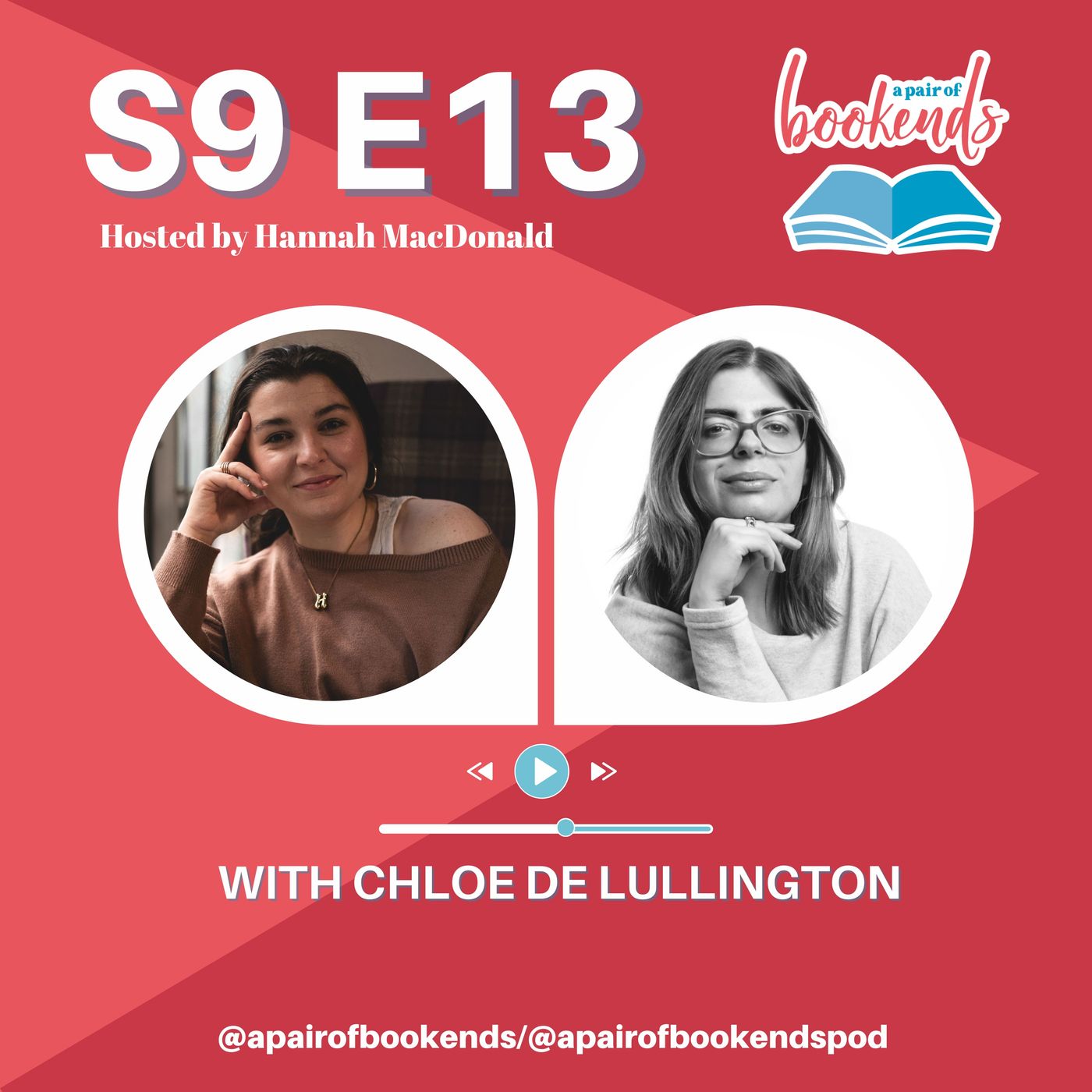
·S9 E13
S6. Debut Spotlight- 8. Chloe de Lullington (Student Life, Bisexuality & David Bowie)
Episode Transcript
Welcome to a pair of bookends, the book Club you can Carry Anywhere.
I'm your host Hannah Matt Donald and I'll be bookend in the conversation with some of the most exciting voices from the bookish world.
Welcome to another episode in our debut Spotlight series, where we shine a light on the freshest authors and their work.
Today that spotlight is on Chloe de Lulington and her debut novel, Kakaethis.
Chloe de Lullington is a novelist and screenwriter based near Manchester.
She studied English literature, film and theater at the University of Reading and was part of Edinburgh TV Festival's The Network scheme from twenty twenty one to twenty twenty two.
Her debut novel, Kakaethis, is out now and published by Northodox Press and here to chat all about it.
Welcome Chloe to a pair of bookends.
Speaker 2Thank you for having me.
Speaker 1Hello, Hello, thank you so much for coming on.
Before we dive into you and your brilliant novel, I do like to start by asking or what you're currently reading.
Speaker 2Yeah.
Speaker 3Currently I'm reading a lot of military history, which is not something I normally go for, although so there is a part of me that has the sort of reading and viewing habits of a man in his sixties.
But I try and like dampen that down because it's not helpful when you're writing commercial, like contemporary fiction for the girlies.
So I try and have I always have like a sort of contemporary relevant book on the go as well.
So I've just finished recently, just finished Blue Sisters.
Speaker 1This amazing.
Yeah, I need to read this one.
Speaker 3Yeah, because I really liked Cleopatra and Frankenstein too, and and I quite like the cover design as well.
Like I know you're not supposed to judge a book by its cover, but I'm quite enjoying.
They are amazing painting style, Like there's quite a lot of goals.
Now I feel like maybe she was doing it slightly before everyone else, so.
Speaker 2That's what I associate it with.
So I finished that recently.
I was reading that.
Speaker 3But yeah, so I'm reading It's a book that's out print and it's called I Was Monty's Double, and it is just to give you World War II history.
There was an operation in World War two that was people realized that there was this guy who was in the army who looked like the spitting image of one of the leading generals, like the war tacticians, who was trying to win us the war, and they thought, what if we misdirect the Germans by putting this guy somewhere else, and then the Germans will think that we're going over there, and they'll go over there, and we'll actually go somewhere else.
I'm really simplifying it, but it's a very very interesting premise.
And there was a film where the guy who was playing the double also played himself in the film, which I find fascinating.
And it's to do with my second novel.
So this is not just for fun.
This is to do with the second novel that I am writing, which is still contemporary contemporary fiction for the girlies.
But this really works as a kind of theme and a part of it.
So I've been doing that, and then I've been reading the memoirs of the actual war tactician, which is a lot.
It's very heavy going, so it's nice to have something kind of girly and contemporary alongside that balance those two, yeah, very extreme ends of the personality spectrum there.
Speaker 1I love that I will be asking you at the end, what is next for you?
So maybe we can have a sneak peek into that at the end.
But why do you think, Because when I listened to another podcast you did, it was the Tarot what is it called Tarot Interviews.
Speaker 2Taro Interviews?
Speaker 3He called the Tarot Cards, and then he asks you a question based on It's such a great concept.
Speaker 1It's such a cool concept, and you.
Speaker 2Cannot prepare for it because, like you know, the car.
Speaker 1In a moment, you don't know what's going to happen.
I will link that episode in the show notes if other people want to find that.
But I feel like you refer to yourself in that podcast as quite an old soul, and you just said then.
Speaker 3That you have.
Speaker 2This is my alternate personality.
Speaker 3I think partly it's I have an older dad, so that's kind of you kind of absorb what they're into culturally as well.
But yeah, it just I just find fogeyishness quite interesting as well.
Like I think there is a part of me that is an old man trying to get out.
Speaker 1I'm obsessed.
I'm actually obsessed with that.
Speaker 3In a hot girl's body, But like ultimately I original commercially the taste of a sixty year old man genuinely.
Yeah, it's a struggle.
It made it really hard actually to pitch Khakathi's when I was pitching it to people, because I just wasn't reading anything contemporary.
Speaker 1Oh my god, and so I had like.
Speaker 3It was really difficult, and I had nobody to blame but myself, because I should have just sucked it up and started reading things.
But as it turns out, I really enjoy this is not it's no hardship to pick up like contemporary feminist fiction.
Speaker 2I enjoy it.
I love it.
Speaker 3But there was just something really stubborn in my brain that I don't think.
I wanted to be influenced by it too much, so I wanted to make sure that what I wrote was just me and not borrowing from someone else.
But it really shot me in the foot not having any comp.
Speaker 1I can imagine.
But I love that.
I think it is a really hard thing to do.
I am not talking about it very much, but I am working on my debut, which is Karry Congratulations, thank you.
I'm just over the twenty thousand word marks, so not very far into it, but far enough to know that, like you know, I want to continue with it and having to when I'm doing research now and having to look at oh, you know, you need to consider things like comparison titles and all that kind of stuff freaks me out.
Freaks me out because I'm like, oh, well, I like really admire that writer, and I feel like a bit of a wonka, like like, oh, I'm defo like this person.
Speaker 3I think that's part of the process is you have to just buy into your own mythos a little bit.
Speaker 2You have to be a bit of a wanker.
Speaker 1I think, yeah, but let's get into your book.
I would love it if we're speaking about how scary it is to pitch to people.
So what is your sort of elevator pitch for the list of what KA is about?
Speaker 3So Kakarethe's is a bisexual, sugar baby coming of age novel obsessed, which is a good way to do it, I think, because it contains a lot of words that are either going to make people light up or their eyes glaze over slightly and they're like, I don't want to talk about this.
So it's quite a good way of It's like a litmus test for finding my people.
People are going to be interested in it, and the people that are just not going to go near it, and so far it's had a really positive reception, but I think that's partly because we've been quite canny with the marketing.
I think it has found the people that are likely to be interested in it, and that's a nice thing about a small press as well, because it's not It hasn't had this kind of massive billboard campaign.
It's not already fallen into everyone's lap.
But the people that have read it have been really receptive and responsive, and I think doing a lot of events and going to kind of indie bookshops and things, it gets out there slowly but surely.
Speaker 1And you launched it one of my favorite bookshops, which is Quilt in Manchester.
Speaker 2Yeah, it was so lovely.
They were so nice.
Speaker 3We heard that place basements based downstairs, and we had it as like a birthday party as well, because this book came out just before my thirtieth birthday, so it was like brilliant double celebration and it was really nice and nerve wracking.
Yes, it was really scary.
I had a cake made.
You know, they do like the classic thing of having your book put on a book cover.
Speaker 2I did that and.
Speaker 3By all accounts it was really delicious, but I was so nervous I couldn't eat any of it, so I just sort of like looked at it watched other people.
Speaker 1No, apparently it.
Speaker 2Was delicious, So this is this is good.
I'm glad people enjoyed it.
Speaker 1And you've got a cake with your book cover on it, so.
Speaker 3Which is kind of a dream come true in itself, to be honest.
There's publishing the book and then there's having your book on a cake.
That's a separate ambition.
So done both of those now the goal.
We all have ticked that on off the bucket list.
But yeah, it was really nice.
It felt very fortuitous actually that it was coming out just before my thirtieth because I started writing it when I was nineteen, so there's been enough time in between starting it and putting it out into the world in a kind of slightly more polished format as well.
Speaker 1Yeah.
Absolutely, I wanted to ask you about that because, like you said, you know, you started it when you were nineteen, it was released into the world around your thirtieth birthday.
That's a big gap, and I feel like we've changed so much good time with their time.
Yeah, so what was that journey like for you and how much would you say the book evolved in that time.
Speaker 3I tried not to edit it too much from a like a dialogue perspective, because it's really difficult to come back to something that you wrote when you were nineteen and not full body cringe.
It's really difficult to let that sit.
But I also think you can't.
It gets a bit like the meme how do you do fellow kids?
Like you can't kind of fit that you want to.
Speaker 1Feel authentic to that age because the character, Yes, there was some stuff in there.
Speaker 3There's like I was very online kind of tumblery at that age.
There's a lot of kind of references and phrases and things that are very much twenty sixteen teenage girls, and that had to stay the same.
And people that are round about my age of responding really well to that as well.
Speaker 2They're kind of like, oh, that was me.
Yeah, you reminded me of yik yak.
Speaker 1Yeah, oh my god.
Do you know what?
When I first read that, I was like, have you just given a different term for tiktoks?
And then I actually googled it and I was like, oh my god, I remember that.
Speaker 3Like it was very short lived, but it was very short, so many arguments because it was I mean, it was completely anonymous, wasn't it.
You'd be sitting like a bar or something at UNI and people would be yik yacking about each other.
It was essentially kind of you know tattle the website, it's kind of like like a unispecific tattle, which is a really bad idea, awful, but it also captures the era quite well, just just as a moment.
Speaker 1I guess yeah, one d percent.
It freaked me out.
I was like, I was like, what what is this thing?
And then I was like, oh my god, I remember that happening and the opera.
It caused chaos.
What would you say was the initial inspiration for this book?
What was the thing that made you go, oh, yeah, this is the idea that I really want to run with.
Speaker 3I tried to write it as a one woman play because I was quite seen.
Yeah, and I still haven't written a play.
I can't do it.
But there was the idea of the train front cover.
Yes, was kind of an idea that I had really early on as being a really easy to do one woman's show where you've got maybe two seeds, like on a stage and they go from being a sofa in someone's house, to being the train seating, to being like your sofa in halls or like you're an electure theater and with just one woman on stage and different lighting and different kind of sounds.
I was going to try and do the story of one woman's sexual liberation going to union.
It was like very basic premise, but I thought it could be quite striking.
Speaker 2But I can't write a play.
I just couldn't do it.
Speaker 3So I got about two pages in I thought, this is this is not working, and it's also not funny, and I don't want to be spending time on something that I don't find funny.
And I think it's really easy to demonize men, and sometimes they are awful, but sometimes there is a lot of humor to be had in the very human interactions you get between sort of awkward middle aged men trying to be something they're not, an awkward teenage girls.
Speaker 2Trying to be something they're not.
Speaker 3There's like everybody is pretending, and so then I thought, let's do sugar baby comedy as you do.
And then from there I was like, okay, what about I'm not going to spoiler it, but what about if there was a kind of journey towards bisexuality as well, and so towards the ending that becomes even more funny because of various characters and their relationships to each other.
And so it started out being kind of, what if we talk about BDSM relationships, then what if we talk about sugar baby relationships, because they're kind of on a sliding scale of the patriarchy broadly speaking.
On they you've got the kind of physical element of like domination, and then you've got the capitalist element of sugar baby dating, where there's this very like, very transactional relationship where there's money changing hands and kind of a lot of social inequality between the two parties there.
And I thought, why not make her bisexual as well?
And so we've got kind of a lot of different relationships going on, a lot of a lot of realizing things over three years, because it takes place over the three years of university and I think.
Speaker 2People change quite a lot in those three years so much.
Speaker 3Yeah, but that doesn't mean that by the end of it you're this fully formed, final version of yourself as well.
So it's it's sort of like a three year snapshot that grew out of me trying to write a one woman play about being a woman, and.
Speaker 1I'm obsessed with that, and I think when I was reading it, I thought it could definitely lend itself to flea Bag esque style screen adaptation if Fleabag was young and queer.
Speaker 2And I would love that so much.
Yeah, this is the other dream.
Speaker 3So that there was the publishing dream, then there was the bookcake dream, and then there was the TV adaptation dream.
Speaker 2So it's gonna happen, Finger's crossed.
Speaker 1You've completed two of the three, so it's on.
Speaker 2Be nice to have a trifector.
Speaker 1Yeah.
Speaker 3But yeah, I'm really glad that you said that, actually, because I think when I was writing it, I was writing it almost as little scenes, kind of vignette that all linked together, rather than one coherent, chronological order bit of storytelling, which actually made it really hard to edit afterwards, because I wrote it all in a kind of patchwork approach, and then I would come back to it and things just didn't make sense because a whole third of the book she was the wrong age, and Maya pointed this out and I was like, yeah, no, you're right, she actually has she should be a year older.
And then at one point she lived and somewhere completely different, and I'd forgotten to move her out of halls, and then I'd moved her back into halls.
So there isn't Yeah, over a long period of time, it's Yeah, it's definitely merit to be to being writing chronologically, and I'm trying to do that a bit more now, but it does not come naturally because sometimes I just want to sit down and write a scene and then it kind of you know, it's laziness.
Speaker 2On my part as well as.
Speaker 1It's because I think it's also the joys of being a creative that also has to work or the jobs like a lot of us have to.
Yeah, it's it's not an easy thing, and it's it's hard to remain consistent.
As much as we'd love to stay doing our creative stuff twenty four to seven, you know, we have to fit in stuff that pays us around it.
And obviously, you know, once this book is out in the world, you can then make money off it.
But the writing process, you know, you're not always paid during so yeah, it's hard to navigate those things.
So as much as I think you'd like to be writing every day and be kind of you know, on it with every little thing.
It's not always possible.
I do want to ask you something kind of linked to that, and it's the class aspect in the book.
And your protagonist Erin is working class, which we love to see because there's not enough representation of us.
Why was that representation important to you?
Speaker 2I think that is.
I have a chip on my shoulder about it, so you me both.
Speaker 3Yeah, it's quite nice when you say that to people and you get like, yeah, so much, and people that you don't always expect as well, like I met I just got talking to this like older lady just was at my brother's graduation.
Speaker 2I was in Durham, and Durham on graduation day is quite posh.
Speaker 3Yeah, yeah, and so you do feel a little bit fish out of water when we got chatting to this this woman.
It was nothing to do with the graduation, but she had a poorly dashing and so I like stopped to talk to the dashing and got chatting to her, and we ended up talking about my book because the hustle never stops.
And she kind of revealed that she grew up working class up north and now lives in the Cotswolds with all the yummy mummies, and it was so unexpected.
It was like a real kind of connection moment.
But yeah, I think it's it's quite good to talk about money, it's quite good to talk about class, and being working class is something I know, so that was quite an easy way in.
And also I think it was Erin is working class.
But I didn't want it to be that she was coerced into doing this transactional sex work type stuff because of a need to, because that's a whole other conversation that's not funny, Like it had to be funny, and so it had to be a rebound thing where she had complete agency and she was just making bad decisions.
But she is also a working class girl as opposed to sort of poverty porn where someone is compelled to, you know, be a fallen woman or whatever.
And that was I think she had to be.
She had to be relatable, and that sort of came from me because you know, right what you know, so if you grew up being poor and having a bit of a chip on the shoulder about it, it's quite it's quite cathartic as well.
Speaker 1I think, Yeah, I can imagine, and she is a really relatable character.
And you know, like we've made very clear, it's set around the period of life of UNI.
I do altot know why you think that is such an exciting period of your life to write about.
Speaker 3I think it's being let off the leash.
It's that classic thing of reinvention.
I think university everybody reinvents themselves.
And I don't think you know who you are when you're reinventing yourself.
You go through these kind of phases like I don't think I settled into who I was, like who I was comfortable being and how I was comfortable dressing and stuff for a while, because it was just like there are some things that are very inherently a person's identity.
And I think I've gone back to how I was as a teenager a lot more like the older I've got, so I've kind of come home to myself.
But there was there's definitely a tendency when you're at unique to try and all the personas and kind of all the fashions and all the It's like joining societies, isn't it.
But your entire personality can kind of become a bit changed by that.
Speaker 1I wonder if there's something as well in being a working class young person and getting to fly the nest for the first time.
I don't know if it's in working class households, whether you all kind of live on top of each other, and then being able to spread your wings and go somewhere else and be in that space.
It just feels so exciting.
I don't know if there's links there.
Speaker 2Yeah, no, that makes sense.
Speaker 3That does make sense, because I think it's not a huge detail.
But Eron does have a couple of sisters and they're all kind of she has memories of them, like crammed into this really small car where they're driving together and she's in the back with the sisters and her parents are in the front, and it's this car that keeps breaking down, and she's when her mum picks her up from UNI for one of the holidays, she's like astonished that it hasn't broken down.
And then because she spends a lot of time in her sugar Danny's car being kind of driven around and he's obviously got this really swanky, wanky four by four Chelsea, I think, And so there's that contrast there where she kind of gets to experience how the other half live while still going back to, as you say, that working class house where you are kind of on top of each other.
Yeah, and yeah, it's a very different lifestyle I.
Speaker 1Think, yeah, one hundred percent.
I Like I said before we started recording, like I loved getting to escape back into it.
I'm such a nostalgic person, Like I'm always looking back at like pictures from when I was at UNI and just like it just feels like a whole other life, and like, you know, you were living inside this bubble and it was just such a wonderful time and just so exciting.
You felt like everything had possibility and didn't really matter that you were making, you know, bad choices or you were you were going out and drinking until whatever time, and then you were coming home and ordering Like we used to leave the student club at like two forty five am because the cot point for Dominoes was three, and we'd order a Dominoes on the way home.
It would arrive and we would be sat in the in the hall's kitchen eating dominoes at three in the morning and we just thought it was the best thing ever.
And we'd have lectures at like nine am.
And I don't know whether they did it, no idea and then I was still working in that time.
I was waitressing.
Yeah, but somehow like doing that going to UNI during the day and then going to work a shift in the evening, and then coming back and doing it all over again, like I wish you would capable.
Speaker 2I don't know where the energy comes from, genuinely.
Speaker 3I think there is something about the maybe the freedom and the need to do as much life as possible that just kind of spurs you.
And it's just adrenaline and dominoes and booze, and it's it's not helping.
I think doing it in a three year burst and kind of maybe getting it out of your system is good.
Maybe.
Speaker 1Yeah, No, definitely.
And I loved that her friends, they would have any kind of conversation and it would be like, oh, should have a drink, sho a drink.
It was it was no none of that I mean did me wrong.
Like we loved a brew and biscuits, but it was usually the day after women hung over.
We were looking for that and then we'd get back on it in the evening.
But yeah, the amount you'd be reaching for the drink and you were never considered like, oh, this is kind of boding bothering on.
Speaker 3It's not it's you don't really think of it as being that deep, but if you were to try and do that with an office job, that would be a really big concern.
Speaker 1Yeah, massively.
And I don't I think they drink a lot in America, but I know that, like I've heard about American like American people coming here to go to Union in the UK and being like, oh my god, like next level, they drink, like.
Speaker 2A really big culture problem.
Yeah, really, And then you've got in France.
Speaker 3They introduced children to wine very young as well as they have like a glass of dinner, and so they kind of socialize them to be a bit more normal about it.
We're kind of like, you can't have any alcohol until you're eighteen, and then all of a sudden you live by yourself and you can have as much alcohol as.
Speaker 2You want, and we're just feral with it.
We are a little bit.
Yeah, it's it's not a good look for us now.
Speaker 1I love that, And I will return to the friendships in her Uni House because there's so many of them that I absolutely loved.
But I want to talk about the relationships with men that she has in this book, Like you said before she enters the world of BDSM with a man called Aidan, and she later has a relationship with a man that's a lot older who pays her, and she has this sugar Daddy sugar maybe relationship.
And I think the common thread between those two relationships, although they're very different, is that there is a power dynamic at play in these relationships.
I think, would you say, that's fair to.
Speaker 2Say, I think that's very fair to say.
Speaker 3Yeah, that was quite deliberate because I did want to do both types of power in balance.
I mean, there's loads more, but I think those are the kind of obvious ones, and I think they are both so clearly linked to a gap because there's an inherent life imbalance with people people who are at union, then people who are middle aged.
That's an interesting one to look at because I'm not demonizing age gap relationships like not Tyrent the same brush.
But I think a nineteen year old and anyone that's out of their twenties is very different to somebody that's older and someone that's even older than them.
So I think it was important to do both of those and make them distinct and then have a little bit of interplay between them, and you can have a lot of arguments, you can have a lot of feminist arguments around age gap relationships and sugar baby stuff, and I think it all comes down to each person's individual reasons for doing what they're doing as well, so Erin can kind of defend everything she's doing.
She's like, I'm just you know, it's cool girl shit.
It's superficially, yes, it is.
But I think there's a lot of societal actors that go a lot deeper that she's not necessarily aware of or maybe willing to interrogate until a little bit later.
I like to say that she's always kind of two steps behind in her own character development.
She kind of realizes stuff, but we the reader have realized it maybe two chapters previously, and we're kind of trying to shake her into realizing what we know.
Speaker 1Yeah, one hundred percent.
And I think there was an interview that you did with Diva Magazine which I found There's something that you said about your writing of BDSM specifically that I found really interesting because I think the relationship in this book where you explore that isn't necessarily the standard of what a BDSM relationship would necessarily look like, you know, it's not this person that she's entering this dynamic with doesn't necessarily have her sort of safety at the forefront of his kind of concern.
So would you mind talking a little bit about that, Yeah, about the dynamic iming, Sorry, I don't know.
Speaker 3Yeah, I'm again not demonizing BDSM relationship.
It wants to be very clear about that, because there's that kind of tagline, isn't there, like safe sailing, consent sure, and that none of that applies here.
Speaker 2But I think it's really easy to look at something that is like kink is still quite edgy.
Speaker 3Is like it it's gone maybe a little bit more mainstream, but it's still quite taboo in a lot of places.
Makes it really hard to market this novel online as well, because you can't say certain words, and you can't talk about sugar daddies without getting bots.
Speaker 2And your mentions going.
So it's an.
Speaker 3Interesting one to try and as a marketing exercise.
But I think the BDSM stuff is such an obvious abuse of power.
But it is also because there is a version of it that is healthy, and if you are very inexperienced, it's really difficult to know that you're not having a good time until you've sort of continued having that not good time and been sort of like gently berated by your friends who point out that your partner is not actually that great, Like.
Speaker 2Does he text you?
Does he look after you?
Does he actually do you communicate?
Speaker 1It's a very basic communication so important.
Yeah, yeah, yeah, I mean especially in those relationships.
You know, I've got friends that you know very much in the kink BDSM world and communication is the biggest thing for them, and that is just not something that this man is looking to do.
And you're like, why do you keep going back?
And you know it's yeah, she doesn't understand that the way.
I'm so interested in that as well.
When we're at that age and we haven't had many relationships before, we don't necessarily know what the blueprint is for a good, healthy relationship.
We think if somebody shows interest, then they must be interested, you know, but it's not necessarily the case.
Speaker 3I think it's also it makes a lot of well, it makes a lot of sense in my head why you would rebound from that situation into one that you maybe control the or superficially control the power and balance a little bit more, because I mean, she wasn't coerced into the BDSM side of things in the first place.
Speaker 2I think it's it's.
Speaker 3Just that kind of teenage curiosity but got a little bit out of hand.
And then after that it almost makes sense to go, well, I've done that, so I'm really cool now, so I know about the world, so I'm going to do I'm going to do sugar babying as well, because I think then there's a little bit more control possibly over the power in balance, and you're making some money out of it, which is great when you're a student.
So in my head, it was a very logical progression from rebounding from a really crappy BDSM relationship.
Speaker 2Not even a relationship, it's a situationship.
Situationship handcuffs.
Speaker 3It's not great, like nobody should be taking this as a template for how to live your life.
But it makes sense to then go and get into a relationship where you are being literally taken care of, financially, taking care of that's almost it's kind of an over redressal of the balance, if that makes sense, over correcting your course in a way with that kind of horny nineteen year old brain that hasn't finished working out the world yet.
Speaker 1Definitely, And she she spends so much of this book, you know, exploring her sexual identity, which is actually a really positive thing, and you know, I think that should be celebrated more than anything it is.
You know, it's a thing that a lot of young women are shamed for and erin while she's exploring these relationships with men.
She does I don't really give any spoilers, but you said that it's yeah, but she I mean, I don't feel like it's a spoiler considering that it's how you market it is that it is a book about bisexuality, So maybe that's the best way to say it without spoiling anything.
What was important to you about the way you represented bisexuality, And I want to know if you felt any kind of pressure around the way you wrote about it.
Speaker 3Not really, because I wrote this whole thing so much in isolation that nobody really knew that i'd done it until it was finished, and I sent it to my boyfriend and then sort of shot myself in a room while he read it because I was so scared.
Speaker 2I was like, this is the first time reading it.
Speaker 3And he sent me a word document with itemized headings that said it was called praise for closed novel, and every chapter he would write down all the things that he liked about it.
So I didn't need to have worried, but I was.
I was very concerned when you know, the first person to read it.
But I wanted it to be I wanted it to be something that I would read, which meant I wanted it to be something that wasn't patronizing.
I don't like to be patronized by a book like I do.
Like there to be kind of authenticity.
And that's not to say it can't be sappy or romantic in places as well, because that is very much a part of life.
But I didn't want it to be tokenistic.
I guess like I wanted it to be.
This is a character who is bisexual, but not she's not.
She's not aware of it for a lot of the time, and she's also not running around with a big flag the whole time, kind of saying I'm doing this bisexually.
But everything she does is obviously colored by those the colors of the flag, including the front cover, which is why I really wanted.
I said to the publishers that I wanted a sad girl on a train with the bisexual flag, and you know they deliver.
Speaker 2It was amazing.
Ten out of ten.
Speaker 1My friend at work saw the corvat and she was like, bisexual.
She was really excited.
Speaker 2This is the reaction we want.
Speaker 1Oh no, she was obsessed.
She loved it good.
I'm glad she was ready to read it and snatch out on my hands.
So she said that one side finished, she is going to be taking it off me.
Speaker 2So excellent.
I hope she enjoys it.
Speaker 3Yeah, it's quite a good way to signpost it to the people that want to read about bisexual stuff.
But it's also not It's not like a big explosive revelation.
It's quite natural.
I guess it happens gradually over time.
And there's sort of a long running joke that she has got a real sense of a real case of like compulsory heterosexuality for a lot of the book and all of these things that.
Speaker 2She experiences with maybe women in her life.
Speaker 3Kind of when you look back, it's really obvious, but at the time it's not, because I think there's this thing, isn't there where women are socialized to be so much more intimate with their friends and you don't always notice that you've gone from being like really good best friends with somebody to being sort of passionately in love with them.
And it's especially as we were talking about the kind of drinking culture around university.
It's very easy to do stupid things when you're drunk and then dismiss them in the cold light of day, and you're like, oh no, it's just it's just what everyone does.
And so maybe it takes a little bit longer in that kind of fog of alcohol and like very intimate female friendships to realize that one, maybe one or two of them aren't quite the same with the others.
Speaker 1Well, I mean, yeah, female friendships are very intimate and very intense by nature, and I love talking about that.
I'm so fascinated by how different female friendships are in terms of the way men are with their friends.
It's just like polar opposites.
And yeah, I think when you're exploring your own sexual identity, like it must be really difficult to kind of realize, oh no, actually this is more than a friendship.
I feel differently about this person.
And I think societally or socially, we're conditioned to believe that since the beginning of time, we've been conditioned to believe that, know that the norm go on quote is a man and a woman, and that obviously isn't the way that we work as human beings.
So I think, you know, it is something that as young people, so really difficult thing to explore within your identity.
But I thought it was really great the way that, like you said, it wasn't this explosive realization.
It was just something that gradually came to her and she was like, oh, sure, yeah, yeah, thank you.
I love that.
And now I do want to get into the other relationships in the book, specifically because we're talking about female friends.
The friendship that most interested me was Erin's friendship with Molly because they fall out often, they disagree with each other's choices, and they're described at one point as magnets.
Can't stay away or get too close and the polls reverse and you can't stick together either.
Why did you want to write about this type of friendship?
Speaker 3I have never actually had a friendship like this, So it's people have been asking friends of mine which one of them is, Oh, I hate that, and I'm like no, because it's not actually any of them.
But I'm taking it as a compliment because it but also like it's not anyone I think on a really practical level, the three friends that Aaron has sort of arose out of me having arguments with myself because it is it's really hard being a baby feminist and you're getting bombarded with all these messages and you don't really know what's the quote unquote right way to think about things and interact with the world, and so on a practical kind of writing exercise level, they each arose out of a different, slightly different angle on feminist topics, and Molly is sort of the extreme version of I guess.
She's sort of quite radical feminist, and she gets a bit swarthy.
It's like sex work at exclusionary radical feminist.
She goes down that path towards the d She's very much kind of like a militant lesbian.
I mean, she starts out where she's bisexual and then she gets quite militantly anti men, and you can kind of see why, like I wanted a lot of it to be, I wanted a lot of their arguments with each other to be.
You can kind of see where each of them are coming from.
But Molly is she's the extreme sort of like lesbian separatist version, and it doesn't like she is quite incompatible with the world around her, I think, whereas Alicia is much more oh it's not that deep, it's fine, Like she's very kind of superficial, go with the flow, and then Bo is a lot more thoughtful and kind of If this is working for you, that's fine, But is it working for you?
Speaker 2We love we love good.
I'm glad.
Speaker 3Yeah, I think she's It was a bit tricky not to make her too much of a you know, the fan fiction term Mary Sue, where you like this perfect angel that everyone loves.
Speaker 2Tried not to make her like that.
But I do think she is the nicest out of.
Speaker 1Yeah, she's a great character.
Speaker 2She's just really sweet.
Speaker 3Like I think she's quite a nice respite from all the other crazy shit that's going on in this book.
She's quite like you come back to and she'll give you a biscuit and she'll she'll chat to you.
But I think Molly needed to be extreme because otherwise Erin's decisions wouldn't have been there would have been no pushback against them, I think, and it wouldn't have been You can't necessarily interrogate ideas to quite such an extent if you don't have two really oppositional characters to literally give voice to them.
So Molly was quite useful.
She's really frustrating, though, I did when I was writing her, it was very much I guess, like, I'll just shut up, like.
Speaker 2It's not that deep, but sometimes it is.
Speaker 3And I think there are, like I know, people that do approach the world very kind of politics first and very much through a lens of various kind of feminist dialectic, and that's absolutely fine.
But I think Erin's sort of somewhere in the middle where she kind of pingpongs between these these versions of feminism.
Speaker 1I guess, yeah, absolutely, she was an interesting character, and I think at times I was also I rolling at the stuff she was coming out with.
I was, oh, god, shut.
Speaker 3Some people said they really see themselves in her, which has surprised me.
Not in a bad way at all, but I really wasn't expecting people to be like, oh, yeah, I'm Molly, and then they were saying A couple of people have said as they got further through the book.
Speaker 2They were like, oh no, I'm Molly.
Speaker 1So that was.
Speaker 2Really interesting.
I wasn't expecting her to be a like, a relatable character at all.
She's kind of it's just me having an argument with myself.
Speaker 1But I mean, I don't think you demonize any one character, like even like Aiden like is a massive dick.
But likely you can see, you know, at times you do get a flicker of what might have attracted her in the first place.
You know, you're get a glimmer of it.
I'll say it's not more than.
Speaker 2No, it's really not.
But I think that's probably all you need when you've got a kind of overactive tender account.
Speaker 3And I mean, she shouldn't have heard her filters up that high, and he shouldn't have had.
Speaker 2His filters down that like.
Speaker 3They are both sort of in the wrong, but he's just worse.
But yeah, I think I wanted to make it.
I was quite conscious about not demonizing the men in particular, because it's it's really easy to do kind of two dimensional cartoon villain yea guys, and that's not what they are, I don't think, no.
Speaker 1And it sort of closes off any kind of positive dialogue that could come out of, you know, exploring relationships like that and why you know those men might be problematic.
But if you know that a man like that might read themselves on the page line, that they might be like, oh, like, I'm not listening to this.
Speaker 3Yeah, I think if it's not, if it's not kind of human and humorous, then people are much less receptive.
I wanted to make it understandable as to why she would go there in the first place.
Speaker 1Yeah, I think you do for sure.
I want to go slightly off topic here and mention a part in the book where David Bowie's death features that is, no, that's not a spoiler.
Speaker 2That's spoiler.
Speaker 1A spoiler, and Eron takes it quite badly.
Now, I really wanted to know if there was a celebrity death or whether it was that you found particularly difficult.
Speaker 3So I genuinely woke up first thing in the morning and saw the news of David Bow's death, went back to sleep and thought I dreamed it, and then woke up and he was still dead, and I was like, no, this can't happen, because do you know, twenty sixteen was the year where all the celebrities started dropping like flies.
I think as Alan Rickman as well.
There was I can't remember the rest of them.
That those are two kind.
Speaker 1Of quite a few.
Yeah, there was a lot.
Speaker 3Yeah, there was definitely people say that we entered the bad timeline because then Brexit happened, all the good celebrities died, and then now we're in this situation.
Speaker 2But that was that was.
Speaker 3Quite an easy way in for me because I was genuinely quite devastated, not to the obsessive level that she is, but if.
Speaker 1She takes it so hard, blessed she does, it's horrib There's.
Speaker 3Some parasocial relationships are fascinating to me.
And I mentioned before that I was very kind of online as a teenager, very like tumblery, very fan fictiony, very not to the point of developing like strong parasocial relationship.
But it did hit hard when lower celebrity deaths, and it was like, well, obviously it's sad because it's the death of somebody that you admire and you've got a lot of them on your Spotify playlist.
But it's not like your grandparents.
It's not you don't know them as a person.
Yeah, and I think it seemed like a really good way because she's with how her sugar daddy and he's like, oh, yeah, you know, he's being all kind of worldly wise about it, but he's obviously upset as well because this is somebody that he's a fan of, and so it seemed like a really nice conduit for their relationship to kind of develop and deepen.
I guess they see each other in maybe not a justified state of grief because they are just both fans of his.
It's not like there's a personal loss there, but it maybe humanizes somebody even further to see them in a state of grief, even if she deals with it in an insane way.
Speaker 1Yeah.
No, absolutely.
I thought it was really devastating and actually had touch woard.
I've not had any celebrities that I I mean, there's been celebrity deaths that I've been really sad about, but like not the extent of like a word be devastated, you know.
But there's a handful of people where i'd need like a day off.
Like if Beyonce goes, I'm not surviving, I'm going to be so real.
Speaker 2I think that's worth the day off.
Speaker 1We did a national day of Mourning for that International Day of Morning for Beyonce.
Speaker 2I think it could be on the card, you know.
Speaker 1Yeah, yeah, I would be devastated, but yeah, I hadn't yet experienced that, and I was like, God, when you aid, like the certain things that you just don't consider, and that is one of them.
That like, these people that you've had parasocial relationships with that you believe that you know, but you don't, like, how do you grieve that person when you don't actually know them?
Speaker 2It's really weird, isn't it.
Speaker 3I think David Bowie was quite an obvious choice in a way as well, because his whole deal over over the decades was constant reinvention.
I think every album he is essentially a different person.
So you had like the kind of Aladdin says that you starred usked Thin like they were all very different, so like physically and creatively as well.
And for a book that is about people putting different versions of themselves forward and interacting with other people who are also putting different versions of them selves forward, it seemed like I don't spend a huge amount of time on it, but it is very much there as a plot point, and it seemed like a nice way to bring together some of those themes.
Speaker 1Oh she's good, she's good.
There's plenty more that I could speak to you about.
But I'm going to squeeze in one final question about this book, and that is there's a conversation with going to get sentimental here, but there's a conversation between bo and erin where they imagine what their life is going to be like after UNI, and I thought it was such a gorgeous conversation.
What did you envision your life to be like?
Final?
And do you think graduate?
How do you think graduate you or just about to graduate you?
Gratuate you?
I'm making up phrases.
Now, how do you think she would feel about the fact that you've now got a published novel in the world.
Speaker 3I think she'd be a bit surprised, considering she would have only just started writing it and had never never shown it to anyone.
I never really did any writing groups or anything, which is it's quite impressive to have done an English degree and not really shown anyone you were writing.
Speaker 2But I think she was.
Speaker 3Very shy, and she was very awkward, and she didn't want to do any I didn't want to make mistakes in front of people, I think, which I'm a bit less sort of precious about now, which is.
Speaker 1Good to learn over time, isn't it you do.
Speaker 3And I think I mentioned earlier that there's because there is practically ten years between starting it and then this book being out in the world in its finished form.
There's a bit of distance in between, kind of emotional distance as well, so you can be a bit more what's the word objective about it.
So there are things, I mean, there's whole characters that I took out of the first straft, and there's whole kind of plots subplots that I took out, and it still came in at like eighty four thousand words, So clearly I could have edited it a bit more.
But I think the stuff that's in there is very cohesive as opposed to when I was writing it, because I was writing it just for me.
It was like, and then we put this character in who is a thinly veiled version of someone I find annoying at union, and it got quite quite petty.
Yeah, So I've taken out that stuff, like stuff that doesn't actually serve the story.
And I think I'm a lot calmer now than I was, because I think it was very easy to start writing it because I was a nineteen year old who used to hang out in the smoking area all the time.
Speaker 2Just talking absolute bollocks to people.
Speaker 1It's a part of the UNI experience now, it is.
Speaker 2Part of it is, and I think I do.
Speaker 3I did have to get it out of my system, and I think I had to get this novel out of my system.
Speaker 2And now it's kind of you.
It was almost.
Speaker 3Exercise it and you put it in a box and then I can come back and read it whenever I want and go, well, yeah, I don't think I agree with that anymore, but it's it's kind of packaged off, which is a really nice way of processing and kind of immortalizing.
I guess those three years as well, because that's kind of my own personal little time perhapsule, which is, yeah, it's a nice thing to have.
Speaker 2It's very self indulgent.
Speaker 3It is an incredibly self indulgent novel, but I think it's hopefully that's what gives it the authenticity.
Speaker 1Definitely, I don't think it's self indulged at all.
I really enjoyed this book and I'm so excited to chat to other people about it.
Before I ask you for your recommendation, Chloe, I do want to ask, going back to what we were talking about the very start, what is next for you.
Yeah, it's a So it is another contemporary messy girl novel, which we love them, apparently the only thing I can write.
So it's it's quite easy to sort of pick a theme or a sort of bad trait of somebody and then you turn it into a novel.
So this one is a bit of a weird one because it is it's nepo babies.
And I mentioned that I have a chip on my shoulder about the working classness of life and kind of the inaccessibility of the world when you are a working class person, And so this is what if a working working class person suddenly became a NEPO baby through their parents suddenly becoming very successful, kind of like an overnight success type thing, which then changes their life overnight from being working class kid on a counsel estate to being sort of quite lauded and quite in the art world specifically.
And I think if that had happened to me, I would have completely crushed out.
I think I would have been like insufferable.
I think my ego would have been off the charts.
So it's quite a good it's quite fun to write it.
This was quite horrible because it's all my worst traits going into this one character.
Speaker 2And the way that the military.
Speaker 3History thing comes into it is because the character is very much she kind of emulates a lot of this older masculinity that she sees around her.
So the kind of her father is older, and she's very much kind of trying to be him, but not trying to be him.
So she wears a lot of sort of like military greatcoats, and she strides around and she's sort of like knows all this random shit about military history, but in a very kind of oh, you don't know that, what's wrong with you?
So whatever she knows, however random or kind of meaningless, it's very meaningful to her.
And if you don't know something, she's going to make you feel really bad for it.
And if you try and understand her work, she's going to make you feel really bad for it.
If you try and understand her dad, she's going to make you feel really bad for it.
And so I won't give too many spoilers, but ultimately she works out, or she realizes that her dad isn't one hundred percent who he says he is, and given that she's built her entire identity on being this famous artist's daughter.
She then loses the plot in about three different ways.
So I'm still kind of finishing it off, but I'm trying to immerse myself in that quite warlike men's world.
I guess through the stuff that I'm reading, and there's a lot of kind of doubling and a lot of duplication, and a lot of people pretending to be other people in it as well, which is something that obviously I'm fascinated by because I keep coming back to it without realizing it.
And so that's where this is Monty's double which is genuinely quite a fun story, but it makes a lot of sense in the context of the book that I'm writing.
Speaker 1That's so exciting.
I can't wait to read this and we'll have to have you back.
Speaker 3Yes, Yeah, this is an incentive for me to finish it now because it's been about seventy five percent for about two years.
So the more people I tell about it, the more I have to actually like.
Speaker 1Yeahlity is King, Yeah, I love that, Nepo Baby's Art World, Father Daughter Dynamics.
I'm sold.
Can't wait.
Lastly, before I let you go, Chloe, I do like to finish by asking for a recommendation.
So is there anything that you'd like to recommend the listeners.
Speaker 3Yeah, So I was thinking about this, and I feel like it makes sense for it to be kind of.
Speaker 2Topical or thematic.
Speaker 3Amazing, And so I'm going to recommend a book that I didn't realize existed until i'd already written, and I think i'd already signed the publishing contract for Kakarethe's by this point.
But it's a book called The Old Man and Me and it is by Elaine Dundee, who is a writer that I've never come across before.
I think she's quite prolific.
And it is set in the nineteen sixties.
And if I was a writer in the nineteen sixties, this is the book that I wish I had written.
So it's a young American heiress, except somehow, through a really weird twist of fate, her fortune that she was supposed to inherit from her dad has ended up with an old British man who I think is possibly her mom's second husband.
Like there's some weird chain of inheritance that means that she gets no money, this old British guy gets all the money.
So she sets out to seduce and possibly kill him.
And it's really really good.
It's absolutely insane, and I didn't know that it existed until I picked it up in a charity shop.
Speaker 1We love a charity shop for it is so good.
Speaker 2Yeah.
Speaker 3Literally, there's one near where I live that is bright yellow.
It's all secondhand books, bright yellow bookshop.
And this was just standing on the shelf.
And because it was called The Old Man and Me, I thought, well, that seems like a bit of me.
So I picked it up a book and it was.
Speaker 2A bit of me.
Speaker 3So I can highly recommend that if you want something that is sort of Kakoth.
Speaker 2He's adjacent but in the sixties.
Speaker 1Amazing.
Speaker 2It's not very bisexual, but it is.
Speaker 3There's definitely some kind of age, dynamic, class, dynamic, money, dynamic things going on.
Speaker 2Love vibe with Yeah, we love.
Speaker 1I'll pop a link for that in the show notes for the listeners.
That sounds great and I very much want to visit this book shop.
So I'm coming your way, Chloe, and we're excellent.
Speaker 2We'll get a coffee, go and do some books.
Speaker 1Love it, love it.
Thank you so much for coming on a power block NDS, and thank you for this wonderful book.
Speaker 2Clothe thank you so much for having me.
Speaker 1Where can the listeners find you?
On social media?
Speaker 3So I am on Instagram at Life in the Clothinge, which I am almost legally bound to tell you my boyfriend came up with the name for that, because every time I get a compliment for it, so I tell them, I told them, tell them I came up with it, and he did come up with it, and it's a very good name.
So I am at Life in the Clothlane Instagram.
I'm also on Blue Sky under c de Lull, which is obviously nicer than Twitter, so come and find me on there as.
Speaker 1Well, amazing.
I will link those in the show notes.
Also links for Kakoi.
These are in the show notes.
Go Grubby Cells a copy, Go give Chloe a follow, and hopefully we can have her back again for the next book.
Lastly, if you've enjoyed this episode, please don't forget to review and subscribe, And if you want to give us a follow, you can do so at pair of blekans pod on Instagram and at a pair of bookends on x even though we don't really use it anymore.
Sorry and TikTok.
And that is all we've got time for so thank you so much for listening, and thank you once again, Chloe, thank you