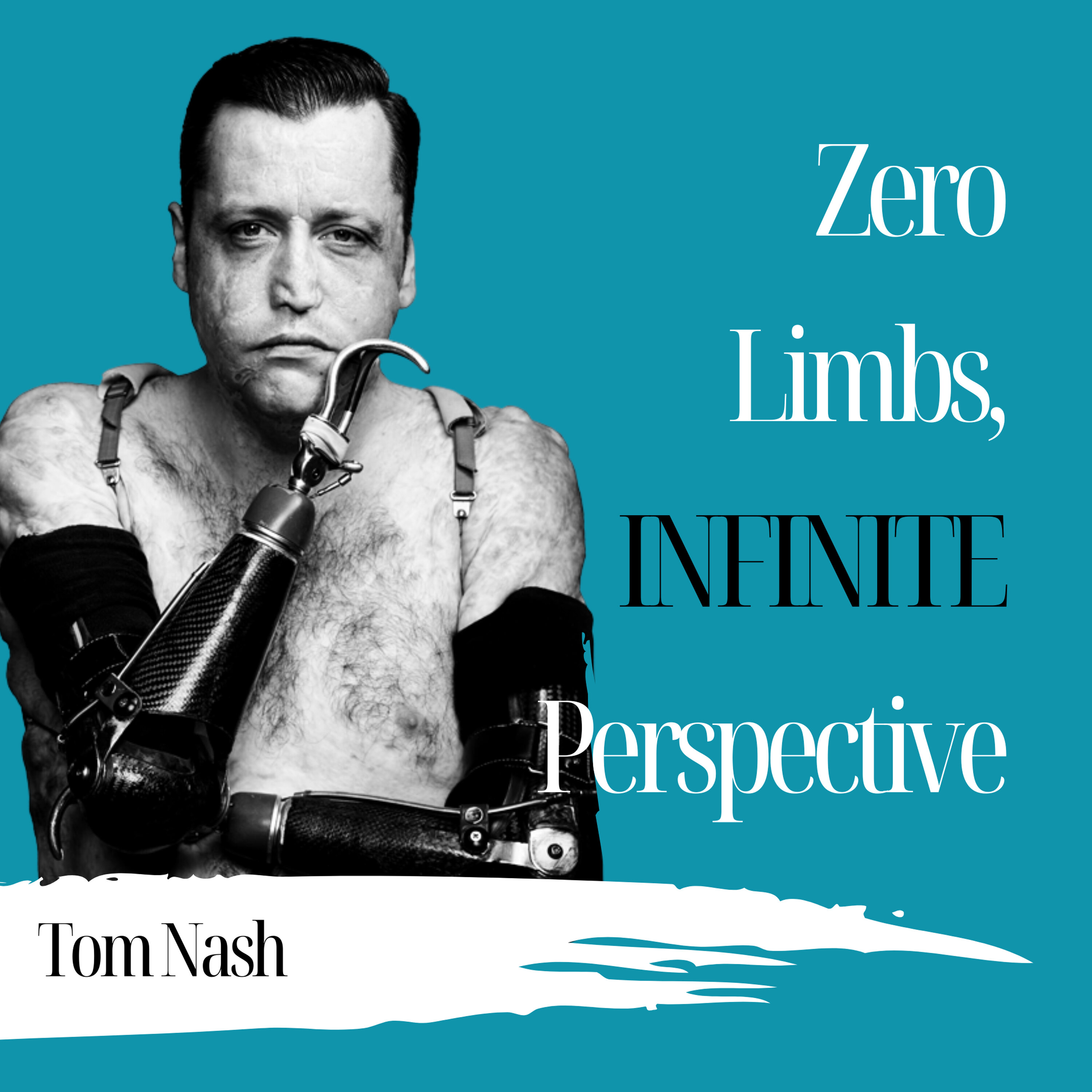
Zero Limbs, Infinite Perspective | Tom Nash - 972
Episode Transcript
She said, it's now never.
I got fighting in my blood.
Speaker 2I'm tiff.
This is Roll with the Punches and we're turning life's hardest hits into wins.
Nobody wants to go to court, and don't.
My friends are test Art Family Lawyers.
Know that they offer all forms of alternative dispute resolution.
Their team of Melbourne family lawyers have extensive experience in all areas of family law to facto and same sex couples, custody and children, family violence and intervention orders, property settlements and financial agreements.
Test Art is in your corner, so reach out to Mark and the team at www dot test Artfamilylawyers dot com dot au.
All right, don't let me down.
Don't let me down.
Tom, Hey, Tom, welcome to Roll with the Punches.
Speaker 3Thanks.
It's ironic that you have someone with no hands on a podcast called Roll with the Punches, but we'll leave that aside for the moment.
Speaker 2No, don't leave the side, bring it right to the table, because not only do not have hands, you have hooks like some sort of awesome pirate.
Tell me about that.
Speaker 3Yeah, so I lost both my arms and also both my legs.
I don't take half measures, so I lost all four limbs when I was nineteen years old to mininger cockle disease, which isn't that interesting to talk about, but it's basically just something that kills most people.
But if you do survive, you rarely remain unscathed unless you catch its super early.
And so the result of my sickness was I was in hospital for about eighteen months across various different hospitals in Sydney by the way, and lost both my legs, first just below the knee about six inches, and then subsequently a couple of weeks later, had to lose my arms as well.
The disease SAI itself causes septicemia, which is like a blood poisoning effectively if if somebody doesn't know what that is, yeah, and to stop that from spreading, you need to start chopping off limbs.
And then all of my scarring and deviated septum on my nose and cartilage that I've lost on my ears, and that's all from a ninja coocla as well, so that sept to seemia can affect effectively anywhere of your body.
I lost the I lost the use of one kidney, half my liver like it's pretty devastating.
Although there's those things regenerate, not not a huge deal, but the arms don't regenerate, as I found out the hard way.
Speaker 2Did you remain optimistic throughout that, look, they might grow back.
Speaker 3I'll tell you what.
I once went to a hospital.
It was like, I think it was Westmeat or something, and I was there to get a script for new arms.
Like whoever thought that you needed a script for that?
But apparently you do.
So I'm like, okay, fine, is go get a script.
So I'm going.
I'm in the waiting room and the nurse comes up to me, very well meaning, and she like, we've got some first year psychology students that need to chat to some people.
Would you mind being one of those people?
And I said, yeah, absolutely, no problems.
I'm in the waiting room.
I've got time to kill now.
I'd actually done a psychology degree before I was getting six, so I know what these first years are going through.
And I get put in this room with this young kid and he's asking me, you know how am I mentally adapting to having lost my arms?
And the first thing I said to him, I said, well, it's going to be pretty tough for the first seven years until they grow back.
And I said it with a dead pan in our face that he sort of looked up from his page and you know, squared me off, and I just kept a serious face, and he just started writing something.
He's right, fascinating, fascinating.
He's like, how, how what makes you think that that's what's going to happen?
And I said, well, I know that lizards regenerate their tails.
I'm about three hundred and sixty five of times the size of a lizard, so I figure, you know, sixty seven years from now, I can expect a new pair of hands.
I refuse to break character for the entire interview, and my only hope was that he presented that to his lecture or whatever it was.
I met a guy who thought his arms were going to grow back.
Speaker 2Oh.
I don't know if it is hilarious or cruel or I don't know how you could loop and find it.
I need to ring this guy and be like, hey, you know how old you right?
Speaker 3Yeah, he might be watching this right now.
It was a long time ago, so he's probably if he continued with his studies.
He's a clinical psychologist now, and he's been telling a completely different story for like fifteen years and he's just finding out.
Speaker 2I wonder, though, how that what you've done to his brain and his thought process over that, I wonder how that has shaped the way he deals with what people tell him.
You've probably vastly changed how he works interesting career.
Speaker 3Yeah, I don't know.
I'd never thought about it that deeply.
It was just funny.
I don't know why.
I don't know why you're over complicating it.
It was a funny Sorry, who gives a shit?
But this is what I do.
This is what I do in life.
Nothing is simple.
Nothing is just simple and funny.
We have to go deep.
Okay, well this will be an interesting podcast because I'm the opposite.
Nothing is deep.
As soon as you scratch the surface, you've reached the end.
That's it.
That's it.
That's all I am out to.
Speaker 2That and dogs.
Speaker 3Yeah, we were having a great chat before I didn't I thought were rolling.
We were rolling.
We're having a great chat about dogs.
And for anybody who is listening to this who obviously didn't hear that, we were both talking about how we're great dog lovers.
But also because i'd had this conversation with Laurie Santos, who's a Yale professor earlier this year at south By Southwestern Austin, who was talking about the happiness that our dogs in part on us, and not just for obvious reasons that you think, but also because of the social connections that they provide.
You know, when you're walking your dog and you you meet other people that are walking their dogs, or even if they're not, they'll stop and say hi to you.
But the point that I didn't bring up actually was that the third way that they can increase their happiness is by watching how they interact with the world.
And I always remember this time I was having a really bad morning and I took my dog for a walk.
I was just frustrated about a whole bunch of stuff, and you know when you got too much going on and you can't concentrate and angry about a bunch of things.
And I'm walking Caesar and he literally stopped to smell the roses, and I'm like, this dog is now speaking to me in metaphors effectively.
But it's just what dogs do, right, It's because they're slow, they sniff, they notice, they really they're in the moment all the time, and it's something that we just failed to do as people because we've always got our face in our fucking phone or in a computer or like whatever we're doing that we miss moments as they happen.
And so I think there's a lot of wisdom that we can draw from dogs, apart from their ability to increase our social connections and just be cute as well.
Speaker 2That's so true, And like, they don't hold on to bullshit the way that we do, Like they let it go.
You do something they don't like, they don't hold it against you.
You come home.
They're the happiest thing in the world.
Speaker 3My dog then he does a crude.
Speaker 2Sody cats recent.
Speaker 3Yeah, they do.
They do that, But the thing is that they don't hold it long term, right they You're right in a sense that like that.
You know, my dog has separation anxiety because he's an Italian Greyham and that's a trait of the breed.
Speaker 2I've got a whip it.
Speaker 3Absolutely love those dogs, but they do have separation anxiety.
If you I go out for like a couple of hours for drinks or something, I come home and he's like, where the fuck have you been?
Like the attitude is real, but you know, after a few hours, they just fit gat that that was their disposition and it's over.
And I like that.
That's good.
I think there needs to be some kind of like disincentive of punishment mechanism in built in the dog, so you're not going to leave them alone for too long otherwise they'll break, you know, break hell loose on your house or whatever.
Speaker 2Well, I was recently up in Queensland for an event and I had a pet city here.
I got a dog and a cat, and the cat goes into hiding.
She's scared, she's scared of strangers, and she goes full hiding for a day or two.
And I got an update a few days in saying I got I got to meet bear.
She came out, she gave me a little head boot.
You know, she's really stoked, had some food.
It's really good.
But then when I got up, like she's really she's really pissed at you, and I'm like, oh, she goes so she opened a drawer and she pulled all your clothes out, and then I went to the bathroom and she knocked a whole bunch of your shit off of the shelves.
Hadn't touched any of my products.
And then when I went to the kitchen, she's she's pissed on the mail in your fruit empty fruit bowl on the dining room table, and there's male sitting here.
She she's pissed on your mail.
She has never gone to the toilet anywhere but the liddle box ever.
And I was like, that is the most vindictive, deliberate act of ctism.
Speaker 3Yeah, it's surgical as well, you know, like she's she's selected your clothing, your mail.
Yeah, highly surgical.
Speaker 2And there's things like this room I'm in right now is her bedroom.
I shut her in here so she doesn't annoy me of a night, and there's you can see all the equipment that's in here.
There's a banner behind me, there's the microphone in front of me.
She never touches any of it.
But if I'm in here on a podcast or ignoring her, she digged her claws into that pop filter on my microphone and scratches it so it's got all DNT in and out, and she pushes the banner over onto my head mid podcast.
Only I can work at my computer.
But if she knows I'm interacting, astounding.
Speaker 3You know, I'd be really impressive.
Is if you went away for a few weeks, and she started her own podcasts with the equib in the welcome back to where the fuck are you?
I'll be your host.
I don't know what you Cant's name is Bear Bear?
Sorry, yeah you did say that, all right?
Speaker 2Why did you choose hooks?
I'm still fascinating.
Speaker 3Yeah, sorry, we got a bit, we got a bit sidetracked.
Jesus Christ, that's a really good question.
So I chose hooks?
Well, actually I didn't choose them in the beginning.
They were they were given to me, and I just thought they looked a bit weird.
And I was like, you know, because everybody who knows anything about prosthetics only knows a tiny bit from what they see on like a Instagram video or something of some person in Japan who has a bionic can, and so I like that.
It was like, you know, don't they have bionicns?
Like, can't we sort something like that out?
And I was given one.
Well, it wasn't like an electronic one.
It was sort of a body powered one, and it was the most useless piece of shit I've ever put on my body ever.
It was just that the forefinger and thumb would pinch together and then it would open slightly and then close.
They were really cumbersome, extremely heavy, and I couldn't really use them for anything, and so I said, well, give me the hooks back.
I want to try and make that work, and I chose these.
I mean, they look pretty bad, so I quite like them.
But also more importantly, they're really lightweight.
So this one's titanium, this one's aluminium, but they're pretty similar in terms of weight.
But I just find them really easy to wield when they're lightweight, and I can manipulate them a lot better and I could do more things with that as a result.
So I mean, I try to live by that philosophy in life as much as I can.
Just try to be as lightweight as possible and rely on as few things as you can.
It's a really interesting lesson that I learned about adaptation, which is that you know, when you there's two ways to adapt, right, there's adapting your environment to you, or you environment in adapting to your environment.
So yeah, but you could think about it just simply like a beaver and a chameleon is the example that I always give.
You know, beavers adapt their environments to them and chameleons adapt to their environment.
So if you're being a beaver, you might be you know, adapt to your home environment to suit your needs because you needed a podcast studio or a study environment or a workplace or whatever.
It is.
The problem within adapting your environment to you is that then you're imprisoned within that environment.
Right, So if you adapt to your environment, you build like a skill set where you can exist or work or operate in under any conditions.
You're actually creating skills that allow you to adapt in any environment because you are adaptable.
But your environment is always transient, right.
And so what I like to do is, rather than have a house that has a lot of different modifications for a person with a disability to use, I want to be able to do anything that a person with hands can do, such that if I'm staying in a hotel or an airbnb or a move house, I don't have to rely on all of those adaptations.
Right.
It's a long winded way of saying that I need for whatever is attached to my person that will be traveling with me, I need that to be the most functional it can be.
And the hooks give me the best sort of ironically simulate krim of what it would be like to use hands than actual hands.
Do set of cancer mean?
Speaker 2Yeah?
For those that can't that can't see them.
So they're like a hook, like a pincher hook.
There's two hooks that how do you how do you make them move?
How do you operate that?
Speaker 3Okay, so I put this up in front of the I hope that gets focused again.
So it's bought a new lens, so that's you can see the two hooks.
They're held together by rubber bands.
Speaker 2Yep.
Speaker 3You can see that they're too because I just separated them.
Yeah.
You'll also see down the bottom that the one that's closest to me has a cable emanating from it.
Speaker 2Yep.
Speaker 3And so that cable actually goes all the way around my back and it straps up.
And so if I push my arm forward, it actually effectively pulls the cable and it separates the two books.
Speaker 2Oh wow.
Speaker 3And then when I retract the arm, it closes it.
So its default position is closed, which is really handy because andy, because if you're because if you're holding a glass, you don't have to keep constant pressure on it a its default is closed.
But if I want to let go of this glass, I put it on the table.
I actually have to push my shoulders forward to pull that cord.
Really you can't see it, but just trust me that's what's happening.
You have to put you know, to pull the cable to release the hook and move it out of position.
Speaker 2That is so fascinating.
I am fascinated by that.
Did it take a little bit of like learning mechanically to kind of use your shoulder and use your arm differently?
Speaker 3Yeah, it does.
But I mean, the the upside of losing two arms rather than one, which is a sentence you'll probably never hear again, is that.
I just thought, like, as I heard it, as it was coming out of my mouth, I'm like, that sounds stupid, okay, But truly the advantage of having lost both arms is that you're forced to do everything with hooks.
And I've met so many people that have lost one arm and they have another prosthetic and they use their good arms to just do everything, and they don't develop skills with their prosthetic, and so it just becomes like a supplemental appendage.
I guess, mm hmm.
Speaker 2What was the process of like mentally adapting to oh, this is life now, like this is happening to me, This has happened to me.
I'm losing both limbs, arms and legs.
Speaker 3Hmmm, yeah, I mean a lot.
Yeah, it's it's it's almost as much as you can much for what else can you.
I think there's a guy who's lost his arms and legs up to like shoulders and like above knee or something like that.
I saw once.
Yeah, I don't.
I think he's Australian.
Actually, m hmm.
I want to say, look, we need we need one of those like who's that dude?
Speaker 2I don't need Jamie.
Speaker 3That's what I was.
Joe Rogan has a guy.
It's just like pull that up on the fucking whatever, like, yeah, it doesn't matter.
We don't have that guy anyway.
This dude who's lost a little bit more than me anyway, but it's almost as much you can dose.
So your question was mentally, how do you get through it?
Yeah, it's quite obviously an iterative process.
It doesn't sort of happen overnight, but it will happen.
It's something like Okay, a lot of people when they asked a question like that, what they really want to hear is was there a turning point that you had a mental shift, and I can tell you about that because it's a more poignant, less iterative anecdote, I guess.
And it was around the time that the doctor asked me about losing my arms.
So I lost my legs first, and it was a few weeks and I thought I was going to be able to keep my arms.
And he came into my hospital bed room, didn't come into the bed that would have been inappropriate, and I've just this is how I choose to tell that story.
Speaker 2My mind went there, but I was like, hold, stay on.
Speaker 3Sorry, I can't not say it when I hear it, so I'm just going to interrupt any story.
Ortell.
He came into my hospital room and he had to basically tell me that I had to lose my arms.
But he also knew that I had a really dark sense of humor.
So the way that he did it was he said, you have two options.
He said, you can lose your arms.
We can cut them off at the elbow.
People do live with prosthetic arms.
Two is rare, but it can be done.
And I said, I don't really like that.
What's the other option?
And he said, well, you can keep them, and I said, what's the catch and he said, the catches you'll die.
It was pretty funny, but so as some would say, more an ultimatum.
But anyway, but I appreciated the fact that not only was he tapping into my dark sense of hum of it, he was also giving me a choice at that point.
So if I didn't want to go on, if I if I really didn't want to live, that was my opportunity to say so effectively, because I could refuse the operation if I wanted to, and I would have died.
Now obviously, I said yes.
I said all right, let's just do it.
Yes, see exactly.
Yeah, but I mean, yeah, spolally.
Yeah.
But also like I'm the type of person that it would take a lot for me to decide to want to die.
Like I like living.
It's pretty good.
I know some people are kind of like I could take it to leave it, you know.
I I love being alive.
So that's going to be like the headline for this whole thing, Tom Nash, I love being alive.
It's taken out of context, but yeah, so I said yeah, I said yes.
And something that I didn't realize at that moment, I realized that he was giving me a choice.
But what I realized later on, more iteratively, was that with that choice comes responsibility, right Like, once you've actually made that decision to move forward, you know there is this new future into which you're drafted and you have a great responsibility.
And honestly, like, I think responsibility would be one of the things that got me through the hardest times in my recovery, not just that kind of responsibility, but also the kind of responsibility that I felt imbued with as a result of the amount of support that I had.
So and I mean in terms of like friends and family, I've found that I was extremely fortunate.
I had some great close friends that would come in every day that I was in hospital for a year and a half, my parents' family, like, I had a really good support network.
I was very, very lucky.
And you know, that could be beneficial in some ways.
But and people say, you know, for providing you with emotional support or physical support where needed, But I think in retrospect, the way that it actually helps me was irbuing me with a sense of responsibility, because it's like these people have given up effectively a couple of years of their life to support you.
It doesn't matter if it's all going bad, just get on it, like fix it.
So yeah, I did different levels of responsibility being imbued upon me.
I think was the best medicine to get over anything.
Speaker 2What were you active?
Were you physical before that?
And how did it change?
We don't like who and what you wanted to be and do.
Speaker 3No, I was the least active person on the face of the planet, and I remained to be.
I I refuse.
There's certain things that I just don't I'm not like exercise is one thing that's where you and I are very different.
I'm also not a big fan of nature, Like I don't know, fuck off, I'm not like I.
I'm like I like to be in a big city having like a gym, Martini.
I don't want to be like I'm not going to the gym, and I'm not going to like New Zealand or something not New Zealand as a country, but just like the whole Oh, you've got to see the nature like I can appreciate it.
I like it's beautiful, Like I look at it for one second, but then I just need to get back to like civilization.
And I'm just that I'm just that way.
Inclined, and I remember it was really funny because you know, I was always in the music industry.
I used to play guitar before I got sick, and I was studying university.
That might you don't really have a personality when you're nineteen.
You just whatever you know your your parents' genetics are.
And so I was at university studying and playing guitar, and then I got sick and was in the hospital for eighteen months.
And then when I was on the other side of it, I had all these people that were approaching me, asking me if I wanted to do all these activities like golf and sailing, like for some reason that were really like hybrow sports.
I don't know how that came about, but I got approached by a dude who did like golfing for amputees.
There was a sailing for amputees like wheelchairs whatever.
But like, I just, I mean, I never did that stuff before.
Why would I start now?
And where would I start once I lost four limbs?
Like I'm just obsessed with playing life on hard mode, so I should just fucking lean into you, Like maybe I should joye saleing with no limbs.
I mean, it would have sold the Captain Hook thing a bit better maybe, but a parrot would be cheaper and less effort.
So yeah, no, I haven't really ever been into anything physical.
Speaker 2So you've got the best sense of humor, like, do you do comedy?
Have you done comedy?
And why not?
Speaker 3Oh?
I have a good reason for that.
So I'm a keynote speaker.
Sorry.
I speak at corporate events all the time, and I try to be funny in those.
And the great thing about that is that people's expectations are really low.
So if you get on stage at a comedy club, everybody's expecting to be entertained and expecting to laugh, but they don't in corporate environments, so you only have to be a little bit funny and you get bigger laughs.
Speaker 2That's true.
I think I feel like I want to push you into the situation.
Speaker 3I did something at the Comedy Store last year, but it's just a storytime thing.
Oshakinsburg runs this night where it's like store, like you go and tell her fifteen minutes.
And there are limitations like it it has to be a certain amount of words, and you have to it has to be written down and you have to read it.
And I told the story about how I once convinced a Northern English couple that I was mauled by a shark.
And while we were on a boat, like we were on this boat from like Hull to Rotterdam, and I met up with this couple who were really interested in what happened to me, and I told them that I was maulled by a shark.
But it turned out that they'd sort of divided and conquered my friend and I and the guy that I was telling this bullshit story to his wife had already asked my friend what happened to me, and he told the truth, and so I had to go right, Like, I doubled down.
I didn't, okay, because I could.
I could have just been like, yeah, that was bullshit.
Sorry, but I doubled down, and I was like, oh no, he sometimes lies to people because I'm really sensitive about the shark, especially when like I'm at sea, and they bought that.
It was great.
Speaker 2Oh all right, what's the best What's what is your favorite experience?
What's the best thing you've done.
Speaker 3What's the best thing I've done.
Yeah, I've never been asked that question before.
That's fascinating.
What's the best thing I've done.
Speaker 2What do you mean thing, can you just life experience?
Speaker 3Yeah?
I don't have an answer for that yet.
Can I think about that as we keep talking.
Speaker 2You definitely can, You definitely can.
Speaker 3That's a very fascinating question.
I think it's like the reason it's really difficult to answer is because of how broad it is as a question.
Speaker 2Yeah, well, I feel like I would assume someone like yourself that has had experience like you do when you work in corporate keynote speaking, so you'd be speaking about resilience and you'd be telling your story, and you'd be helping people overcome challenge and talk about mindset.
And I feel like that becomes quite an identity, whether you like it or not.
And I imagine at times you don't want to be that guy.
Do you want to be the guy that well, I this is well I went and did this, I went and traveled, or I went and learned something, or I chose to do something on the other side of the world, Like.
Speaker 3Yeah, I mean that kind of stuff I do now.
Frequently I think what, Okay, one of my answers would be and it's not a specific it's not a specific event, but you know how you have times in your life when you have a little bit of a shift, perhaps it's like relationship or vocationally or like whatever it is, but you just sort of embody a different modality, and so there's like a transition period in your life and things are sort of fresh and new and things like that.
I think I've gone through one of those fairly recently, and I started this show called Last Meal at the beginning of this year, and it was it's just a passion project type thing.
It's a question that I used to ask people when I interviewed them, which was, if the world was any tomorrow and you could have one last meal, what would it be.
It's a common question that is asked around a lot of chefs, asking of each other and stuff like that, and it's typically a lot about the food.
But what I found from asking people this question when I was doing it like seven or eight years ago, was that actually revealed a lot about a person, like who they were, their history, and their lives.
And so a couple of years ago, I got together with a friend of mine who's now actually my manager, and we decided to develop a concept for a series around it, speaking to a bunch of sort of public intellectual scientists and things like that, and trying to extract sort of life wisdom and self reflection around this concept.
And then we broadened the concept and made it that I was actually cooking for the person.
And so we started that last year.
I spent my whole year traveling the world interviewing people and cooking for them and filming it.
And we launched it south By Southwest in Texas in March, and have just been releasing it over this year.
And we're like, I've just had the pleasure of cooking meals weirdly for some of the most interesting people, like I did Neil deGrasse Tyson, I did Richard Dawkins.
We just a couple of weeks ago, we're in New York doing Stephen Pinker.
We just did a whole bunch of really really fascinating individuals from all sort of walks of life, where I would cook them their last meal and then talk about all of the like wisdom that they decrued over their lives and turning points in their lives and what they think makes for a meaningful life.
And so this whole experience for me has just been something that is really new and it's not something that I you know, it's not a job.
It's a passion project.
And I think that there's something that's so special about that, because you know, whenever you're relying on something for money.
And this happened to me in music as well.
Like when I started out in nightclubs, I was doing it as a fun type thing, and then it just became a business, and then you know, it was a company and a record label and events and all this sort of stuff.
And before I knew it, like DJing was a career, music production was a career, and that puts a different lens on what you're doing.
You don't enjoy it in the same way as you do when something's a passion project.
So having something really, you know, new and fresh that I was just enjoying and not relying upon to make money, but I could just treat it how I wanted it to be treated.
That's I guess the most recent great experience that I've had.
Speaker 2I love that.
It's so true, And like I'm someone that tends to do that.
I fall in love with something, I get obsessed with it, I do it, and then all of a sudden, you know, like I did a boxing fight, fell in love with it, happened to do my certificate and fitness happened to say yes.
Clients then became a pt like everything I do, then I commercialize it.
Speaker 3You commercialized that, yeah.
Speaker 2And then it's like I remember in twenty twenty when we went into lockdown, I started, I picked up pencil and sketchbuk and started sketching and realized that I wasn't too terrible at it and got skills pretty quickly.
Yeah, and people post the photos.
It was really funny.
I spent my whole life I would look at people's sketches, like just black pencil sketches and be like, I don't get anything to draw, Like that'd been amazing.
And then when I sat down and actually had a crack, I was like, oh, we had to do was pick up penciled here.
Then I would post photos of some of my stuff, and people really quickly asked me to do commission pieces, and I had this visceral response.
I was like, no, I don't want to do that.
You can't take this one from me like you and you can't pick the picture that you want me to draw.
So even if you wanted me to draw a picture.
You can't choose it because you can't see what I can see.
Speaker 3Yeah, so it's really important, like having a creative outlet, you know, for certain types of people, and obviously your one as well, is just really important.
I think you sort of you hinted at something really important there, which is like, there needs to be at least one of those that is not commercialized.
Speaker 2Yeah, yeah, yeah, I did say that's a good point.
Yeah.
Earlier this year, I watched Whiplash.
Speaker 3This was a Oh that's a great movie.
Speaker 2Oh my god, isn't it.
I'd never heard of it, right, So I just picked and when I picked it, I thought, what's this?
Didn't look special?
I was like, oh, what's this?
Well, I might watch this.
By the end of it, I'm sitting forward on my seat, I'm watching it.
That bloke reminded me of my boxing coach, and for.
Speaker 3Some reason simmons, Yeah, fantastic.
Speaker 2Yeah, oh my god.
And so within a couple of hours I decided I'm going to buy a piano and learn piano, not at all musical.
By the next day, i'd gone out, I'd found myself a digital piano, hooked myself up and and it was that it was like, I want a creative outlet that is not fitness, that is not tip the box of tips, the PT something completely different, something that's gonna help cultivate creativity in my mind, because I just was I was overworking.
I'm always working.
I'm having great conversations on podcasting, but I'm just thinking every second of the day.
And I was like, I just need to be able to do something that allows me to not be productive, but lets my mind do things differently than it has been.
Speaker 3I think it's a really good I think it's a really good rule to live by.
And yeah, that's interesting you bring up that movie because I watched it only fairly recently or recently for me, which is like a year ago.
But it's got a really good expectation to reality ratio.
Yeah, do you have any other favorite movies that had a really good expectation to reality ratio?
Speaker 2Not that I can think of.
Speaker 3I'm obsessed with a movie called Sharknado.
Shark Nado, Man, It's okay.
It may be the worst movie you'll ever watched in your entire life.
They made like eight of them, or so, maybe six or I don't know.
It's like a series.
The thing that I love about it is that so it's just it's a bullshit.
It's kind of like it's a it's I think it's a joke movie.
It has to be a joke movie, right, It's about like a tornado that's hitting Los Angeles and like, but the tornado has sharks in it or something like it's it's it's just fucked but like but it's it's got like like Tara Reid and like it's got some names in it, right, like right, but it's just sort of throw away like joke shit humor, and they just keep they just kept making them and making them worse and worse.
But the thing I love about it so much is that I love things that can sell an idea in one or two words without you having to know.
Like if I said to you, if I showed you the word shark Nato and said what's this movie about, it wouldn't take you more than three guesses to actually figure out exactly what it is.
That's some of the best marketing, you know.
I see people talking online all the time about like, you know, get your elevator, pitch down pack, you know, like be able to say what you do in like ten words, it's like fucking shark Nato.
Shark Nato is marketing genius, all right, if not a big stuff on that, no one appreciates it.
But in terms of it, actually, I just thought of a serious response to that question.
There's a movie called Coherence that's on Netflix.
I think it's from about ten or twelve years ago or something, and it's a pretty low budget movie, or it was a low budget movie, you should say, but the direction it's really clever.
It's about I haven't watched it for a while, so I might butcher this.
But it's about a group of friends thirty somethings that get together for a dinner party on a specific night where there's a commet flying over the country that they're in, whatever it is, and it's said that that comment, that comment is supposed to have like I don't know spiritual properties or be able to fuck with the space time continuum or whatever.
They don't really explain what that is, but whatever happens, they become like their existence has become multiplicative.
So they go outside and they run into themselves as a group, and if they walk down the street, they see another house that's exactly the same and then they get mixed up in the different houses and say, like, it's kind of brilliant because with a low budget, you have a few actors, you only have like two or three scenes that you just have to you have to write it really well to make it seem like they're all different locations in different people.
But yeah, that's one that I remember seeing the cover for and being like, low budget, this will probably be shit.
And now I was completely captivated within the first twenty minutes.
But I love those types of movies that over deliver.
Speaker 2Yeah, I reckon, that's big.
You know your expectations on what you're about to watch.
Speaker 3Expectations is life, okay, like your entire life, because we don't live in reality.
We live in worlds where we tell stories to each other and we choose whether we accept those stories or not right, And much of what we choose to accept or what we like is based on expectation of that story.
Right.
So I always tell people like, I tried to keep my expectations as low as possible with respects to anything positive happening at all.
And the best example I can give of this is when I go to stay in a hotel or an airbnb before I walk into the room, I go and read the negative reviews, like in order from like worst until they start to get good, right, Not because I think that I'm going to have the same experience, but I want to prime myself mentally with people who have had an awful experience, such that when I get into that hotel room, it's either going to match my expectation because of the negative reviews that I've read, or it's going to exceed it if it's better than that.
So you just manufactured a better story.
Love that.
Speaker 2I love how we're not just thinking of Whiplash before and probably other movies, but that one just felt really prominent because it happened so out of the blue.
You go one one great story, same on the podcast, One great conversation, One great movie can actually change your life.
Like h I had not a musical bone in my bottle the body.
I had not ever thought I might play an instrument.
And I sat there and I made this association.
In the middle of this movie.
I thought it was going to be a crap movie that I couldn't decide what to watch on Netflix.
Didn't realize it was an iconic movie that heaps of people going to be like, Oh, that's an amazing show.
And then I made a decision, and I think about that with I know that when I started this show, it was a passion project in COVID in twenty twenty and I and three months in I was like, shit, I'm not the same person and this world that I'm living in it's not the same place as it used to be.
I wish I could go back and talk to that girl in that life and see what she thinks about this world, because it has changed.
That's why I'm doing it.
It's like I have these conversations, they sit in my mind and in the world changes.
Speaker 3Yeah, And I think I have a similar experience, in particular having conversations like this with people, which I've been doing on my show as well.
And one of the things that I think I've learned from it is that not only are you a different person to what you were before you started this, but expects to be a different person again a year from now, two years from now.
Like try to take that retrospective lesson and project it forward upon yourself as well, and you get a certain level of It makes you humble in a way, right, because I think I've become less sure of myself and my beliefs as a result of learning more things about them.
I changed my mind on things a lot, and they're not in huge directions all the time, but my understanding of a particular topic or a different perspective or an angle that I hadn't considered before.
And I think to myself, if all it took for me to change a little bit of what I thought about something is to have a conversation with somebody who was really convincing about it, then I'm really not sure what I believe at all, and I can't say that I can stand with conviction in almost anything I say for the rest of my life.
Speaker 2It's kind liberating, isn't it?
Like how we develop our beliefs and the attachment we have to our beliefs.
Like I'm fascinating buy that.
I'm fascinated by what I think my relationship with my beliefs is because I have I have conversations with people on this side of a topic, and then I'm like, well what about that person?
And I'll listen to them both and I don't have a bias, and then it's like, well, what is the impact of me and my life and my choices and all of the things, all of the ripple effects if I choose to be to agree with or believe in side A or side B of this philosophy that we've just unpacked, you know, get we get this choice, and the choice has to be what how do I change?
How does my experience change?
Because nothing's wrong or right, both things are valid.
It's really annoying but interesting, I think.
Speaker 3Yeah.
I mean the way that I kind of see it at this point in time is I do my best in any given situation to try to understand why a person thinks what they do.
Yeah, that's it, because I like, there's a very good argument to be made, and some people make it quite convincingly for beliefs to be completely bullshit, not really based in anything other than I would like to, you know, fit in with my in group, or I want to be more like the kind of person who believes X, and therefore I believe X, and that's not really based on anything other than you know, like the identity that you want to pursue, which fuck off, Like that's not a good and then it's not worth me arguing with someone who is motivated in that way either, like you're just you're just going to end up.
Yeah, you're not going to get to the bottom of anything really, So, like, it interests me more why people believe what they believe in trying to understand how they can to certain conclusions, because that gives you a more well rounded view of the earth you're living on.
But I completely reserve the right to not have an opinion on various different topics.
I think one of the strangest things about the society we find ourselves in is that everybody feels like they're obliged to have an opinion on stuff like why Like I don't understand, Like it's almost like, imagine you asked me a question about boxing or an opinion on a particular regulation within the boxing industry, and I said, well, I have no idea, not a boxer, I've never even watched boxing, right, And you said, well, no, it's I can't believe you wouldn't have an opinion on this, Like it's insane to think that you wouldn't.
It would be insane for you to say that, right, And yet we're more than happy to say it with moral issues, political ones, you know, philosophical ones.
So yeah, generally speaking, reserve the right to have no opinion in many cases in society, and if I do have an opinion on something, it's also really loosely held, and I can be convinced otherwise within twenty seconds, one hundred percent.
Speaker 2I think about that, you know, even with politics, which I refuse to talk about, but you know, Nive brought it up.
But I remember when I first was old enough to vote, I was like, I the enormity of the decisions you're asking me to make.
I don't know the impact.
I don't know the impact of this one choice.
All I know is that people who get who get a positive impact from a small decision, they selfishly choose that and they don't think about the broader ripple effects of the choices we make.
And I just my brain would always just like implode and go.
But I don't have all of the answers.
I've just got a bunch of people telling me one part of a story, trying to convince me so they can you know, it bothers me again.
Speaker 3It's story, right, and what story do you choose?
To believe?
Everything can be reduced to that?
The more you got it, That's what I said.
Yeah, I was having this fantastic conversation with Scott Barry Kaufman.
If you don't know who he is, you have to look him up.
He's a psychologist out of New York.
And one of the things that he said to me that stuck with me this year was, you know, so much of life is just the stories we tell ourselves.
And it's not just the stories you hear from other people, which were just talking about, but it's the story you tell yourself.
And the quote that he brought up, I think from someone else, was that sooner or later, you have to give up hope of a better past.
Oh it was a great quote.
I forget, I forget who who coined it, but but he was the one that introduced me to it.
And it's just such a you know, when I meet people who their entire identity and belief system quote unquote is formed as a result of not just their past, but the story they tell themselves about their past.
They're free to switch that story up at any point that they would like h and many people refuse to do so at some point that's your responsibility.
Speaker 2Mmmm.
Yeah, That's that has always fascinated me, and that like what creates that tipping point what you know, I look at times when I've had a realization or made a choice or you know, seeing what I'm in the middle of, and gone, this is like, this is your responsibility, mate.
But then you and then in those moments, I go, why does it take so long?
You know, like I know that I could tell you for the for a few years, I would complain about how busy I am and how little I get for it and all of the things and life so like, this is not fair because I fucking work all the time, and and like a year or two ago, I just changed the way I did things.
And then I was like, oh, I'm so blessed, I'm so free, I'm so like abundant.
My life is so abundant.
I have so much.
And it was like nothing in your life changed except your shitty attitude, Like nothing, and you were in charge of that the whole time, but you held onto it and resisted and resisted and resisted.
And then I don't know, I cannot tell you what made me change to take the action.
And then it was like the world was again, the world was a different place.
What the hell is that?
It's bullshit?
Speaker 3Yeah, I mean your ability to remind yourself of how good you've got.
It is something that is really difficult to do.
I mean, you've almost got to habituate it on yourself, and I can force it because you know, you're always living within the reality of you are in comparison to those around you, in comparison to the the asshole that you just spoke to on the on the phone, you know for twenty minutes that you're trying to argue, well, whatever it is, right, like, you don't exist in a vacuum, and so you kind of have to keep reminding yourself that, you know, if you were living one hundred years ago, you wouldn't have medical aid, you wouldn't be able to get dental work done, you would probably have no food on the table.
You certainly wouldn't have a house like you know, all of those types of things that we you know, humanity has existed for you know, hundreds of thousands, if not millions of years, and it's only really recently that we've had an iPhone like you now within the past few years.
Now we can bank online.
I mean, these things sound trite to say, but in reality, it's like there's any which way you can stack up as part of your life.
How lucky we are to be living in this moment in this country, right, having the amount of sovereign wealth that we do, or whatever you want to call it, right, we still find ways to complain.
And I think that that's just a natural human instant.
I don't think anyone should feel bad for doing that.
I just think it's what naturally comes to us.
I have found a way for me to subvert that practically, and I'll share it with you.
I never complain about any of the large scale stuff.
I never complain that I haven't got enough money, that I don't own property that I don't and have kids, that I have no arms, legs, you know, like, I have never complained about any of that once in my entire life.
What I do complain about standing in a Q too long, being on hold, right, it raining as soon as I walk out of the fucking house, the uber canceling on me.
Right, So I okay, anything that is just like really small scale.
You know, they say, don't sweat the small stuff.
I don't agree.
Sweat the small stuff, right, and then the large stuff kind of takes care of itself, because you need that outlet to complain about your at least I do.
I don't know.
Maybe it's just me, but I love complaining.
I complain all the time, but I only ever complain about small things because I know that at the end of the day they're inconsequential.
I get it out of my system.
But generally speaking, at the end of the day, literally at the end of the day, I think I'm the happiest personal life.
Speaker 2It's genius.
It is genius.
I feel like I don't know what part of the work kind of mind sty stuff or self talk shifted for me, but I know at some point when bigger stuff happens that's annoying.
I go to all places.
I'm really lucky because there's people that could.
Like I remember in COVID my car got towed from a fifteen minute zone when we had a five k limit.
Right So here I am in Melbourne.
They've towed my car to some other suburb.
I've got to pay five hundred bucks.
I've got to get there.
And the first and it was like a bit of a shocks.
I come out, my car's gone yeah, and I'm making no money and we're in lockdown and I'm like, shit, I've got these two gyms.
We're probably going to go bankrupt.
This thing is already bad, and now you take my car.
Speaker 3This is shit.
Speaker 2But the like, I kind of immediately went to this place of ship.
There's been all these posts in the in the community facebook page about people looking for work because they can't afford their rent.
Like, how lucky that I have the money in the bank and I can just ring a TAXI, get in it, pay the cash and nothing else in my life has to be sacrificed.
Yeah, this is annoying, but you know, and I was, and it interested me when that happens.
I was like, oh, I go to this place.
Now, I didn't always go to that place, so I went to.
Speaker 3You know, life is yeah.
Yeah, but I mean that the thing is you do need to habituate that on yourself, because it's not a natural instinct that we all have.
I mean, I think that some people and I have had some luck with like, I do think about it more now than I used to, and so I suspect that it is a skill that you can develop, is reminding yourself of things like that.
Yeah, but I think it's important to note that it's it doesn't come naturally to all of us, and so like if you're listening to this and you're like, oh, you know what, what good is that going to do?
It's kind of like that do you ever hear that really annoying statistic of like what's not so not statistic?
It's like people who who post like it's not even posting, but just like gratitude what are they called fucking gratitude?
Speaker 2Nitude journals?
Speaker 3Nah, so a journal it's like a as a word proclamations or the words of vading me now forget what it is, but something like you know, they'll wake up in the morning and they'll say these things to themselves or whatever, and it just sounds like this person will be a lunatic, right, which like that there might be like in the Venn diagram of people who do that in lunatics.
I'm sure there's a huge crossover, but like, but it's the same statistic as like, you know, if you force a smile, you you end up happier at the end of the day if you keep doing it.
Yeah.
Yeah.
The annoying statistic is that that works to a certain extent, probably not as much as the people who purport the idea would like you to believe, but still to some extent, I think it has an effect.
And I think habituating you know, those thoughts on yourself would work over time and it would increase, but you know, due to the fact that it doesn't come naturally to any of us.
Like sometimes you need a bit of a hack, and yeah, that's what I like to use, is just complaining about tiny.
It's like it's like my hotel hack.
You know, there's some way like mental gymnastics.
Speaker 2I think it's a great hack.
And I think that whole, the whole positive affirmation thing can be I think there's merit to a part of it, right, cognitive bias like affirmation.
Speaker 3That's the word, thank you, that's the word.
It was a proclamation.
What was I talking about?
Like I was drafting the Geneva Convention, I used.
Speaker 2For a little while of practice similar to a gratitude journal, but not right.
So gratitude journalis I think if you're not really great, but you're sitting there and you're like, oh, I'm grateful for that.
You know, it's really nice.
Speaker 3Gratitude journal is shot Nato.
I know exactly what it is great for.
Speaker 2Yeah, and so I did this.
I don't know whose podcast I heard it on with someone maybe doctor Amen or someone I don't know, but what went well today?
And it was like, just just what went well today?
At the end of the day, write three things.
And what I found was two things happened.
One, I start listing stuff with genuine gratitude, like the stuff that I genuinely was like, oh, you know, and a small shit, small shit.
But then also how fucking productive I was.
I started going, oh my god, I get a lot done and I wasn't recognizing that because you're always looking at the stuff you don't get done.
Yeah, And I was like, well, that's bloody great practice and it's not wanky, like oh, I'm really grateful for and you keep writing the same shit, going well, I'm not feeling any more grateful, even pissed off because this gratitude affirmation isn't working.
Speaker 3Yeah, yeah, that's really interesting, Like, Okay, there's gonna be a bit of daylight between you and I demonstrated here because my version of this is I'm currently like I say, I'm writing a book, but I'm just coming up with ideas for a book.
I already have the title.
It's called one hundred Things I Hate and why I hate them.
And anytime something pisses me off, and if it's enough, I'll put it in that Like I've got a Scrivener app and I'll just I'll list it and once I get to one hundred that I'm going to start writing the book.
Speaker 2I love that.
Speaker 3And it's things like like anything that's not like three ply toilet paper, Like why does that exist?
Like who is that for?
Ye?
Who is two play toilet paper for?
I just I have no answer for that.
It's just but they proliferate that everywhere, Like you can't You could go into like a five star hotel in Chicago and you get a box of tissues out and you pull out a tissue and it's two plate.
It's I don't know.
Only they exist in houses if you buy anyway.
Anyway, there's just little things like this that piss me off in society.
And so I'm listing them and I'm creating a book called one hundred Things I Hate and Way I hate them.
I'm going to send it to Penguin because I think to have option on my next book, and they're just see in it tell me to get the fuck out of the room.
Speaker 2Oh bloody love that.
I love that idea, so please let me know when you've written it.
I'll be keeping an eye out.
Reminds me of Oh is it Kitty Flannagan her book?
Speaker 3Oh yeah, I haven't read a book.
Speaker 2What's it called twelve something or twenty one Rules of a Life or something?
Just really fun like and it was written like to look like Jordan Peterson's twelve Rules of Life or whatever his book is.
Speaker 3Oh yeah his is twelve, is it?
Or yeah?
Yeah, I think it's twelve.
Speaker 2She had a different number, but really funny, like just really funny shit.
I reckon you like that.
So I read hers two or three times in a row like it just will go to bed and laugh because it's short, it's funny.
It's like, yeah that ship.
Speaker 3Yeah that's great.
Speaker 2Yeah, it's really really funny.
Speaker 3So mind's the inverse of a gratitude journal.
It's just me scribbling what pisces me off?
Speaker 2That will sell, mate, that will sell I'm lining.
Speaker 3You gotet frustration out on a punching bag or presumably another person.
I get it out with pen on paper?
Speaker 2Perfect?
Perfect?
Speaker 3Do you do?
What's your fighting schedule?
Are you still?
Are you fighting a lot?
Speaker 2Do you know, in fact, this is the first year I have hardly even put on the gloves to train.
Okay, right, old mate.
Perimenopause, if I'm being honest, kicked my ass really not recovering.
Body, didn't like it, started hormone replacement, started weightlifting, doing a lot more just strength training.
And yeah, it took me way too long to pull back a wood train.
Feel burnt out, exhausted, hit the wall, not sleeping hmm you men, yeah, yeah?
Speaker 3And are there many places facilities for you?
Do you have an interest in it as well?
Like do you do you go to boxing matches?
Speaker 2Not a lot?
Speaker 3Not a lot?
Speaker 2Like I had three fights and I remember toddling back to my corner to my trainer and going, I don't even know how this sport is scored, Like did I just win?
Like I did not know how to score it?
And people would and still do, like they would always ask, oh, what do you think about the fight on the week, like who's gonna win?
I'm like, I don't know.
I don't watch it.
I don't watch it.
I'm a doer, not a watcher, no interest watching.
And if I did watch it, it would be going to see my friends when they fight, and I was well aware that don't ask me about the fight because I'm just watching them with a very heavy bias.
I'm not really watching both fighters, watching my mate.
And yeah, so it was interesting, I remember them morning.
Speaker 3Kind of interesting.
Yeah, they I mean, I don't know anything about it, but all I know is that nobody seems to talk about it.
And then once a year there'll be a fight between two people that I've personally never heard of, but everybody treats you like an idiot for not having heard of and then all of a sudden, every person that you meet is an expert in boxing.
For forty eight hours, yes, and then it goes away again.
Speaker 2It's not the forty Grand Final.
I'm like, I used to get really shitty that no one gave a toss about it football.
Then Grand Final weekend will come and all my friends would have want to be doing.
I'm like, you don't.
Why do you have to get on board for this one day?
You don't care about football?
It annoys me or even just.
Speaker 3I mean like put yeah it doesn't.
Yeah, that would be you got to start your own boo that like, it doesn't necessarily bother me, that that they like, I understand the idea that we don't really like horse raiding racing, but we go we like the Melbourne Cup because maybe what they like about it is the festivities that surrounded or the fact that everyone's involved, Like I get that, whatever, but it becomes an exercise in everyone being an expert about that thing immediately.
That's what baffles me.
Speaker 2Oh yeah, especially boxing, it's very very intricate sport and a lot of armchair experts.
Speaker 3Yeah, okay, I could give it a go.
I'd have a pretty mean left hook as good as my right hook.
Speaker 2Yeah, I ain't getting in a ring with your left hook, mate, that is for sure.
That is you know what.
Speaker 3Last year, I could get into boxing and then they're just like, no, sorry, you can't, and I'd be like, that's disability discrimination.
Speaker 2So earlier this year, one of my former podcast guests called me up and he said, I'm I'm having a boxing fight.
Can you do I've never sparred.
Can you do a couple of sparring sessions with me?
He's blind vision.
Yeah, So I was like, sure, I've been training this year, but if I'm going to get in with it anyone, I'm getting in with the blind guy.
I tell you what he was.
The lack of vision was made up in a lot of other senses and a lot of things that were a positive in boxing and learning to box.
Speaker 3I was like this, Yeah, they say that, don't they That the other sensors are heightened.
Yeah.
Speaker 2Yeah, and just you know, like when you throw a punch and you have vision, you look up, your chin goes up, you drop your hands, all this stuff.
His hands straight back to it because he's he's just got the senses, the feeling right, so his chin didn't raise, kept his head down.
He said he broke a guy's ribs in the fun I was like, that's my boy.
So yeah, but I'm not getting in with you.
Speaker 3Hook had trouble finding the ring, but once he was in there, Oh.
Speaker 2Your bloody fun mate.
Tell people where to find you anything you want to promote all of the things.
Speaker 3I really hate promoting myself.
I'm not very good at it, but I am usually found at whichever bar serves the best martinis.
Speaker 2Espresso martini's.
Speaker 3No, oh, actually, espresso martinis feature in my book One Hundred Things I Hate, Dude.
What Yeah, And it's not as much that I hate the drink.
I hate the fact that it's called martini because it resembles nothing of a martini.
First of all, martini is a gin, not vodka, right, Voca martini is not a martini.
Fuck off.
Secondly, you've taken that that vodka and then you just added coffee and mister black.
It might be a great drink, it's not a martini.
That's why I hate them.
And also because, like you know, I hate things that become really like popular with particular groups of people that just I just yeah, I'm okay, yeah, okay, well stop doing it.
So jin mazites.
Oh yeah, sorry, it wasn't where to find me any yeah, any whatever?
The best bar is here or I've been spending a lot of time in New York and Austin, Texas, and where to find me online?
I guess just Instagram is the one that I use the most.
At DJ hooky oh yeah, by the way, I'm a DJ, I didn't even say that.
No, I didn't talk about it.
Still, I just get sidetracked.
No, I don't really DJ that much anymore.
But my whole career, so since I lost my arms and legs, I went into the music industry and so I became a DJ, and I only really stopped doing that, well, I didn't stop doing it.
We still played from time to time, but as a career type thing a few years ago.
And so I still have these monikers attached to my social media accounts that are DJ Hooky huak Ie.
So if you have you need to find me, you don't google Tom Nash because if well, you can try.
But there's this weird I don't know where he's from, perhaps Eastern Europe, but he's a he's a finance guru.
There's a finance guru called Tom Nash, right, and yeah, so if you google me, that's what comes up, and I'm not him.
So just type in DJ hockey and I'll probably get you closer to what you're looking for.
As if anyone would look me up, No one cares.
Speaker 2They totally would.
They will.
They're waiting for the book, bro, They're waiting for the book.
Speaker 3They're waiting for the one hundred things.
Speaker 2Okay, yeah, we're all waiting.
We're lining up the dimicks.
Speaker 3Yeah right, come on board.
Yeah, make sure you bring snacks.
It'll be a while, all right.
Speaker 2I'll have links to that in the show notes, so they will follow you.
They will look you up.
Thank you so much.
You've been an absolute blast to chat with.
I've loved it.
Speaker 3It's been a pleasutive appreciate it.
Thanks lot.
Speaker 2Thanks mate.
Speaker 1She said, it's now never I got fighting in my blood.
Speaker 3Gotta Taquitocaust, gotta true, gotta te monocust.
Speaker 2Got it.