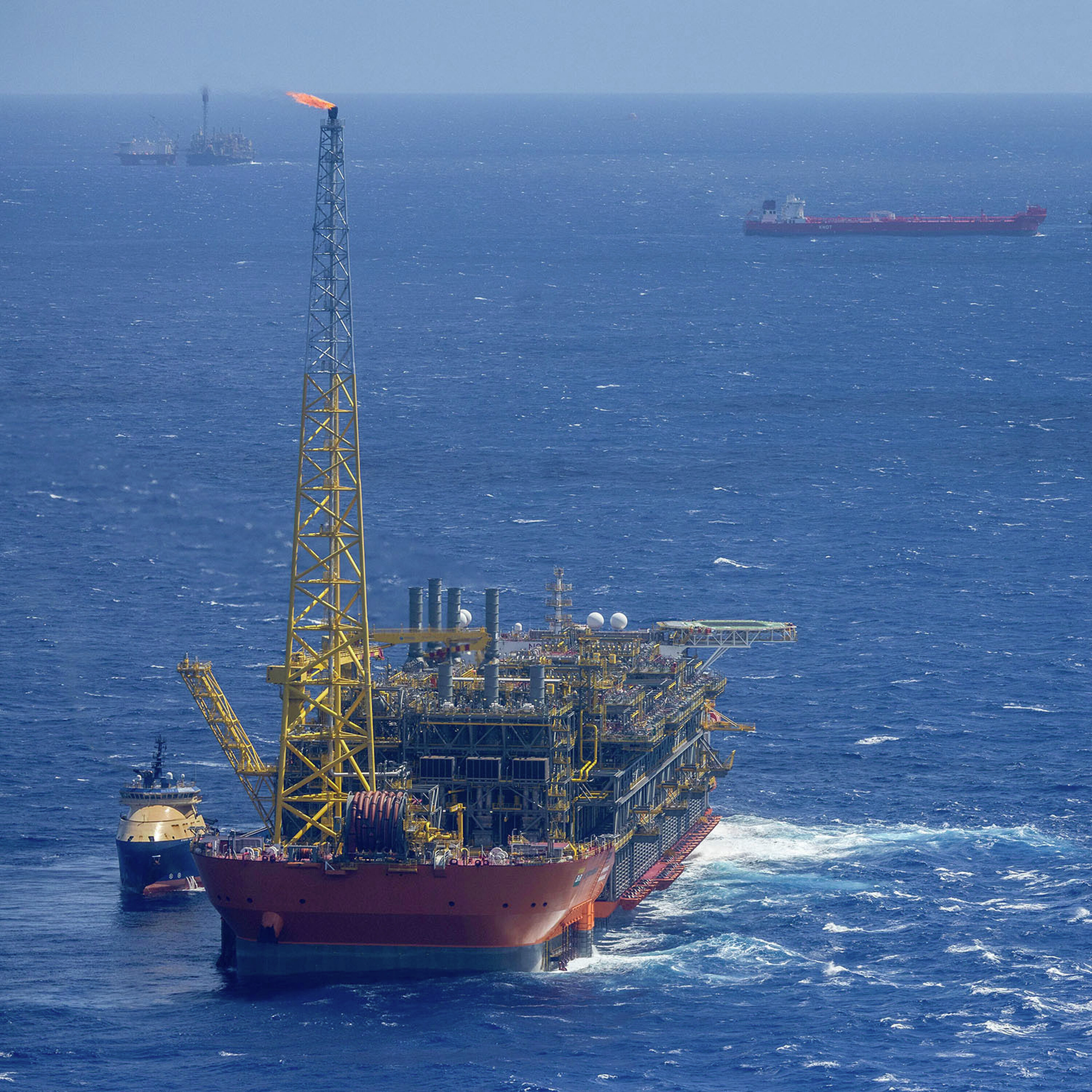
Even a US Blockade of Venezuela Isn’t Spiking Oil Prices
Episode Transcript
Bloomberg Audio Studios, podcasts, radio news.
Speaker 2The US has intensified its blockade of Venezuela by trying to intercept a third oil tanker off the country's coast.
These actions could put pressure on President Nicholas Maduro's government, as Maduro faces calls to step down.
At least ninety five percent of the country's overseas revenue comes from oil sales.
Whenever there are winds of conflict involving oil producers, oil markets tend to react strongly, but on Monday, Brent oil prices rose only moderately, from over sixty dollars on Friday to over sixty two dollars on Monday.
That's in part because these days, Venezuela's exports account for less than one percent of global oil demand.
There are many other countries flooding the market.
Speaker 3With oil, whether you look in the US, whether you look at OPEC produces in the Middle East, whether you look at countries you don't necessarily think of it sort of long storied oil producers like Guyana.
The general story of oil production over the last couple of years has been that it has grown incredibly quickly.
Speaker 2Alex Longley is an oil reporter at Bloomberg based in London.
At a time when affordability has become a political watchword and it feels like everything is up in price, Alex says, oil is a notable exception.
Speaker 3And that's sure if dasoline prices at the pump, that's sure, if crude prices traded by oil traders or derivative traders across the globe.
Speaker 1Three years ago, we were trading above one hundred dollars per barrel.
Speaker 2That's heavier Blast, a columnist for Bloomberg Opinion, who writes a lot about energy, we.
Speaker 1Are trading now.
If we look at the US benchmark, a West Texas intermediate around fifty five dollars per barrel.
So the price of oil has has gone down by fifty percent over the last two and a half three years.
Speaker 2These days, gasoline at the pump is less than three dollars a gallon in the US on average, the first time it's been that low since twenty twenty one.
Speaker 1And if we look at adjusted by inflation, what is really what matters.
The price of oil is not very different to what it was around twoenty twenty five years ago.
It paints me almost saying because I make a living writing about energy and oil prices and how important they are to the global economy.
But at current prices, central banks don't need to think about oil, governments don't need to think about oil.
To be honest, drivers and families can't really go on that business without having to think about oil because it's cheap.
Speaker 2I'm David Gera and this is the big take from Bloomberg News today on the show, what's behind this glut of oil which has led to lower prices and how conflicts involving Russia and Venezuela could impact them.
When you see oil around fifty five or sixty dollars a barrel, you might wonder about demand, whether electric vehicles and clean energy might be driving down prices, but Bloomberg Opinions Heavier Blast says that's not the case.
Speaker 1The reality is that demand is actually not bad.
It's an all time high considering what is happening in the global economy is growing as much as we will expect.
What has been the main driver of the price weakness is the supply, and that is coming from everywhere.
It's coming from Texas and New Mexico in the United States and new shale regions it's coming from opic countries like Saudi Arabia and Iraq, and it's coming from new big players in the market like Guiana and Brazil.
After a period of very high prices around twenty twenty one twenty twenty two, we are beginning to see the market reacting.
And the market is reacting the way it does, bringing a lot more supply, and that's what's really driving the price down.
Speaker 2Alex You've written that supply could exceed consumption by four million barrels a day, and I wonder if you could help us think about that quantity.
How much oil are we talking about?
How would you explain that to somebody who isn't following this day in the day out.
Speaker 3Perhaps the simplest way is, think of the biggest ships that can carry oil in the world.
They carry two million barrels.
If supplies exceeding demand by four million brows a day, two giant supertankers of oil.
Imagine those rocking up off the coast of Texas or off the coast of the UK.
Here two of those appearing every day for three hundred and sixty five days in the year.
Firstly, it's a physical impossibility, but it tells you something about the scale of the numbers.
Now, if you talk to oil traders privately, they have smaller numbers than that.
For the most part, I think four million brows a day for the whole year would be the kind of the high end of what people are expecting.
But even the lower end of what people are expecting is in any market a very very oversupplied market, still.
Speaker 1A lot of it.
It is already in the water, it is already in oil tankers, and is heavy in front production area as to consulsian areas.
It takes only about less than a week for some of the oil from the North Africa to reach Europe and refiners rus But if the oil is going, say from Brazil all the way to China, that's gonna take forty to forty five days.
But what we don't know is what is going to happen when that oil reaches destination.
Is it going to be consumed or is it going to go straight into a storage?
And the most likely situation that we're going to have is that come January February, that oil is going to go straight into a storage, and is when we are going to see a price that it's gonna have to go down because you need to incentivize that historian process, and for that we need lower prices than today, Alex.
Speaker 2I remember during the pandemic, oil prices went up, and when they came back down, the prices at the pump what I was paying for gas didn't come down as much.
Release It didn't seem that way.
What's different about this.
Speaker 3Time, Firstly, it depends on where you are in the world.
In the US, the response at the pump is much more reactive.
It takes a bit of time, but you'll still see it come down.
Here in the UK, for example, and in many European countries, a giant amount of what you pay at the pump is of course tax, rather than the actual price of the barrel itself.
I think the other things that we have to keep in mind this time that are different is how far oil could fall in the coming period.
And twenty twenty was a period when we all worked from home for at least a few months, and in some countries years we all stayed at home, no one flew, no one drove, and that was what kind of took the floor out of the oil market.
This time is very different.
This is an oversupply, but there is a natural flaw here, and as Xavier has talked about previously, oil prices are already very cheap, so you can kind of start to ask the question of how far as we fall into the fifties, how much further can we fall.
Yes, we might see oil with a foe handle, but you don't hear people talking about, for example, the twenties or even really the thirties.
Speaker 2Let's talk a bit about winners and losers.
Who's benefiting from these lower oil prices?
And Alex I'll turn to you first, Tavier, moment to go mention Guiana.
Who is winning out here?
Who's this good news for?
Speaker 3Well?
I think there's a few things, and perhaps the best place to start is sort of the buyers of sanctioned oil.
You mentioned before that kind of twenty twenty two price shock that we in the West felt very acute, But there were countries continuing to buy oil that is now sanctioned where those inflationary pressures were nowhere near as large.
So the country's continuing to take oil that is under some form of restriction, whether it's India buying Russian oil, whether it's China buying Venezuela, or Iranian oil.
They have long been feeling the benefits of lower prices in this higher level of supply.
We've already touched on drivers at the pump.
That's another clear area of wind and as time goes by, I think you're likely to see that in things like airfares as well.
Add in to that as well, struggling emerging nations finally starting to get a benefit of lower prices for their economies.
And on top of that, you have, as you said, the new producers countries where there is an oil windfall that didn't previously exist.
That's a slightly more nuanced case.
But if you weren't producing any oil five years ago and suddenly you're producing a million bowls a day, there's a clear benefit to that no matter what, even if prices are falling.
Speaker 2Have your how about losers shed a tear here for the multi billion dollar oil companies.
Speaker 1Well, certainly big oil is going to lose some money.
Anyone that is pumping oil or leave around the regions where oil is thinking about West Texas, Southeast New Mexico, Oklahoma, Alaska, South Dakota, all of them are gonna be suffering.
Open producing countries.
Soudi Arabia, they are tightening the belt big time.
And then all these new American producing countries that they are producing a lot more so they are still they have the higher volumes, but they were not expecting to receive the price of oil just going into the fifties.
So you are Brazil, Guiana, you know, it's not great news for them.
But I think that the biggest loser here is gonna be the countries in the Middle East, Soudi Arabia, Kubei, Qatar, the United Arab Emi days.
They are producing more oil, but the larger volume doesn't really upset the lower price, and those countries are in need of a lot of money, particularly Saudi Arabia.
So I would say that the biggest loser here is Saudi Arabia.
The second loser is going to be Texas.
Speaker 2Let's talk a bit more about Saudi Arabia and Texas and ticking with the Middle East through.
It sounds like when prices are this low, it kind of sets off a chain reaction that has a kind of profound effect on investment and production.
Can you just describe the way that customarily unfolds and we see prices as slow for such a sustained period of time.
Speaker 1Well, companies start cutting everything.
They're gonna start spending less on drilling, less on building pipelines, less on exploring for new oil fields, and they're gonna start firing people at the office.
They're gonna cut the amount of traveling, They're gonna cut the paper clips that the personal assistants are using.
You start really as rink in the oil industry.
And a lot of that is a one off.
It can be reversed.
So you are doing less drilling, you could increase drilling next year.
You can't reverse that very very quickly.
The problem is when oil companies start to cut into what I would say the bone, firing geologies, firing the people who are gonna find the next oil field five ten years from now, which is going to bring the supply in the twenty and thirties.
If we see that, then we are going to damage the oil industry for the years to come.
Speaker 3It's also interesting, I think we've seen the first wave of those cuts.
Have kind of done everything they can, particularly in the majors, to shield their oil and gas businesses.
They've moved money away from things like renewable and power.
As Haavier says, to kind of prevent that cutting down to the bone.
But logic dictates that once you've stripped everything else sits, it's the oil and gas that comes next.
Speaker 2Alex As we move from the Middle East to Texas to US shale, what are those shale producers saying about their prospects here in the medium to long term?
Speaker 3I would say different things depending on whether you talk to them publicly or privately.
We have sort of comments that there's a lot of lobbying going on to the US administration about how far prices are going to fall and what that could mean in the long term in terms of getting crews back onto fields and how quickly you can do that.
If and when prices rallied down the line after this drop, you have an entire tariff environment, right that is affecting the price of steel.
The fundamental costs of the things that help you reoil out the ground.
You need to drill it and then put it in pipes and then exports it.
And if the cost of doing all that goes up materially, so does your break even cost.
And that means you're well struggles to be profitable as price is full.
In the same way it would have done a few years ago.
Speaker 2Coming up, we go back to Venezuela, how global conflicts could impact oil prices going forward, and what it would mean if prices get even lower.
The story of the current global market for oil is one of both oversupply and unpredictability.
From Russia and Iran to the US, China and Venezuela.
Geopolitical conflicts involving the market suppliers have created a climate where major disruptions can arise quickly and without warning.
Case in point, the US blockade against Venezuela.
That blockade refers to sanctioned oil tankers coming in and out of Isela.
US official telling ABC News the Coastguard tried intercepting a vessel that's part of Venezuela's quote illegal sanctions of asion.
Speaker 3There are a number of dark fleet vessels that have not been sanctioned by the US.
Now over the weekend, the Trump administration boarded a vessel that was not sanctioned.
Speaker 2Here, I'm curious about countries that are facing international sanctions.
There are these hidden oil shipments, and I'm curious if you could explain to what they are and how they factor into this broader energy picture.
Speaker 1It's quite amazing, because when you are talking about hidden oil shipments, you are still talking about an oil super tanker which is about three hundred and fifty meters long by sixty meters wide.
So it's not the kind of thing that you could hide.
And obviously it shows up on every satellite a picture that you know, different governments have taken at at all times.
But there are bezelts that they have changed hunts multiple times that we don't know who the ultimate owner of those oil tankers are.
They are bestelts that at times are using flag that doesn't even exist or is not really registered on the country that they pretend to be flying the flag.
They don't have insurance, they have a lot of fake paperwork, and those tankers are used to shift oil out of the way from Venezuela, Iran and Russia into the global markets, and by that I mean mostly China.
China is the big buyer of those barrels.
Speaker 2Have you're picking up on geopolitics, We've got the conflict in Ukraine continuing, Russia under sanction as a result of that.
Then off the coast of South America you've got now a blockhade in place.
How do these stand to affect the price of oil here in the months to come.
Speaker 1Well, I mean that is the big headline race that oil traders talk about.
You could have your best modeling of the global economy, your best modeling or supply and demand, but you cannot really anticipate what President Trump in the US, President put In in Russia and Persida Maduro in Venezuela are gonna do and how that's gonna play out.
If we think that the situation between Russia and Ukraine, the world is going towards a solution.
Perhaps no immediately, but there is at least a process that is going on and negotiation.
I think that the market is expecting that probably we are not gonna see any more sanzios or any enforcement of sanzios, and therefore supply from Russia should probably be as as it is today, up and down a bit.
Venezuela.
The production is so small in Venezuela's about a million dollars a day used to produce three and a half that even if Venezuela was to go to zero, it will not really change the global market that much.
But Venezuela is a massive race long term for more oil.
If Maduda goes and there is no damage to the oil fields, those are too big.
If but let's assume that Maduda goes and the opposition gets power.
Most likely international oil companies get invited into the and over time Venezuela can produce a lot more oil than today.
I think that if we see act in Venezuela in which Madudo goes, the market is gonna sell and he's gonna sell hard.
Speaker 2Alex, let me have you take a bite of that as well.
So if President Trump had this kind of pie in the sky outcome whereby Venezuela opens up, it's producing more oil.
Maybe if there's a deal with Russia those sanctions are lifted, we have this world that's a wash and cheap oil.
It's only going to get cheaper.
Play that out for us if you would sort of what that would look like.
Speaker 3Well, I think when I talk to whether it's traders, investors, people involved in companies in the oil market, there are two things that come up with that.
On the Venezuela side.
The first question is, well, if Maduro does go, what does the post Maduro world look like?
And no one really has an answer for that at the moment, But I think clearly there there is a short term risk of a small supplier squeeze and a long term risk of a large increase in production if there was a smooth transition there.
But again it's a massive if the Russian side.
You ask people, what would you do if there was a peace deal tomorrow?
Would you go back to dealing with Russia?
Again, the question is, well, what does the world look like tomorrow after this peace deal?
Has everyone lifted sanctions?
Has just the US lifted sanctions?
Have the US and the UK lifted sanctions but not the EU?
And within that you kind of get a sense of the difficulty Western companies would have in going back to sort of dealing with Russia.
Very quickly, we had the Total CEO on TV saying, I've diversified my business towards the US and away from Russia.
I need long term stability.
It's unlikely I'd go back there anytime soon.
Speaker 4We were quite in the big universa in Russia almost fifteen billion dollars in this moment.
There was some reasons.
We have made a big write off of four assets there.
So you know, the world is big.
So today we have shifted from Russia through the.
Speaker 3US However, there is a lot of Russian oil on the water, and if all of that oil becomes unsanctioned or unrestricted, what you effectively get is a giant release from emergency oil reserves, which is what happened in twenty twenty two.
Right.
Price has got very high, and governments across the world said these prices are too high.
Will release some urgency oil stocks, flood oil onto the market so that we can lower prices at the pump.
Again.
All this Russian oil at sea, if sanctions are lifted, is effectively a giant version of that, and I think that's the interesting thing to watch in the coming months.
It won't be a wholesale the deal is done, we go back to life before the invasion of Ukraine, but it will really create the possibility to kind of remove some of the sand in the gears of the Russian oil machine and get that oil flowing to market a lot quicker than it had been previously.
Speaker 2Have your last question to you President Trump at the White House touting cheap gas prices, saying he wants gas to get even cheaper.
I'm curious if this pricing dynamic holds, if oil remains cheap or gets cheaper.
How does that play out for the US and for other consumer economies.
Speaker 1While it's relief for consumers, relief for families, it really ease, particularly in America.
Is different in Europe and in the European Union and the Eurosone and the UK because of the role of taxation in gasoline.
But it will really unblock a path to lower interest rates, which is what I think ultimately Trump is interested.
Trump only wants cheap oil because he thinks that as one prerequisite to get lower interest rates at cheaper price of the money.
And I think that he's fixated on that.
He has put a lot of emphasies on trying to control the Federal Reserve, and I think he's going to keep pushing until he gets exactly what he wants, and for that he needs to sustain the prices at current levels or even push it lower.
Speaker 2This is the Big Take from Bloomberg News.
I'm David Gerra.
To get more from The Big Take and unlimited access to all of Bloomberg dot Com, subscribe today at Bloomberg dot com slash podcast offer.
If you like this episode, make sure to follow and review The Big Take wherever you listen to podcasts.
It helps people find the show.
Thanks for listening.
We'll be back tomorrow.