The American Toymaker Caught in Trump’s Trade War
Episode Transcript
This holiday season, families around the US are grappling with stubborn inflation and higher prices on virtually everything, including holiday gifts.
President Trump's tariff policies have hit a broad range of industries, including toymakers.
But earlier this year, one Chicago based toymaker with manufacturers in China decided to hit back with a lawsuit, and that case has found its way to the Supreme Court.
Arguments in the case started on November fifth, and the Supreme Court's decision, when it comes down, could support or upend a key piece of the Trump Administration's legal justification for many of the tariffs.
In the meantime, the Big Take Asia team has been tracking this story closely.
We've reported out how the tariffs have impacted learning resources on the ground in Illinois.
Wears headquartered in China, were produced toys for decades in Vietnam, were setting up a new manufacturing hub, and back to the US to small town Indiana to meet a family that can't afford to buy from this American toy company.
Over the next few days, we'll bring you our reporting on this high stakes lawsuit, the company's battle to hedge tariff risks, and consumer frustration with rising prices.
Speaker 2Bloomberg Audio Studios, podcasts, radio news.
Speaker 1On a summer morning, a group of US Americans, Chinese, and Vietnamese are packed in a van.
We're moving fast on a brand new highway that slices through Vietnam's Red River Delta.
We're on our way to a toy factory, but just a few hundred yards away from the factory gate, we've come to a dead halt stem meet by an unexpected obstacle.
Huge puddles.
Speaker 2Apparently didn't identify the that's.
Speaker 1The road leading to the factory gate is pocked marked with water filled potholes as big as truck tires.
The only option is to get out and walk the last hundred yards.
Speaker 3Okay, just this theory.
Speaker 1It's barely nine am and it's already ninety degrees.
My travel companion is ready to face the heat.
Speaker 4It's hard to dress for these factory tours.
I've now just basically green and a tire of a t shirt and some sort of very light white pants.
Speaker 1I'm here with Alana Woldenberg Ruffman, vice president of marketing and product development for Learning Resources, a family run toy company just outside of Chicago.
She's a mechanical engineer by training and helps run the family business alongside her dad, CEO Rick Woldenberg, and her two brothers.
Speaker 5You know, some of my earliest memories with toy as would be like the Learning Resources cash register, or like the Pretend phone, which is a little dated at this point.
You need the Pretend iPhone.
Speaker 1The company traces its roots back more than a century ago to Lana's great grandfather.
These days, if you have young kids, there's a chance you know their products.
Botley the coding robot, and Pretend cash registers are hit with consumers.
Speaker 6Hey do you see money?
Yes, this is the pretendent plane, Learning Resources cash registered.
Speaker 1Most of these toys are made in China and sold through major retailers like Target and Walmart.
For years, it was a winning formula.
Efficient Chinese factories produced low cost goods and American consumers benefited with affordable prices.
But President Donald Trump's returned to the White House, an escalation of the trade war that he began in his first term has upended that formula.
On April second, Trump announced the steepest American tariffs in more than a century, with a ten percent minimum tariff and even higher duties on some sixty nations, starting with China.
Speaker 7So if you look at that China first row, China sixty seven percent, that's tariffs charged to the USA, including currency manipulation and trade barriers.
Speaker 1For Learning Resources, this was a gut punch.
The company had already started shifting production out of China during Trump's first term, but at the beginning of the year, about sixty percent of its toys were still made there.
Here's Alana at one hundred and forty five percent.
Speaker 8It's a van on our products.
People didn't know what was going to happen to our business.
Speaker 1Within weeks, Learning Resources took the Trump administration to court and won.
A district judge in Washington, d C.
Ruled the presidences to were illegal, but the levee stayed in place as Trump appealed.
Now the case is headed to the Supreme Court, with arguments set for next week.
Speaker 8We're the only private company that brought our own lawsuit.
We were kind of faced with the decision of die or do something.
Speaker 1While battling it out in court, the company also began rebuilding the manufacturing network it has spent decades developing.
Speaker 8We don't know what the tariff rates are going to be at any given time on any given day, and so we're proactively out here trying to diversifire our supply chain so that we are able to ride the waves.
At the end of the day, We're just we're betting it is highly likely that some products that we move, we will have to move again.
Speaker 1We're following along as Learning Resources is forced to shift its supply chain to Vietnam, and as the company tries to move forward, it's also confronting a hard truth.
China's manufacturing infrastructure, built over decades isn't some thing you can walk away from overnight.
Speaker 8Because China has been manufacturing hub for so long, it developed a lot of expertise.
That same infrastructure doesn't exist anywhere else in the world today.
Speaker 1This is the big take Asia from Bloomberg News.
I'm Wanha today on the show.
You can move manufacturing out of China, but can you really take China out of manufacturing?
We hit the road with an American toymaker caught in the crosshairs of Trump's shifting trade policy and uncover the hidden costs of trying to stay one step ahead.
Before this trip, I hadn't been back to northern Vietnam since the pandemic.
I was born in Saigon when it was still the capital of South Vietnam, a country divided by war.
After the US withdrew in defeat in nineteen seventy five, the country was unified under Communist rule, but it was left deeply impoverished.
Families like mine, who had fought on the losing side faced bleak futures.
Here's my dad recounting the fears that gripped him after the war ended.
Speaker 3I feel danger.
I don't know when they kept me put to the yale, and I don't know what it can do because I am a soldier.
Speaker 1My dad fought for South Vietnam against the Communist forces.
After the war, soldiers like him were sent to re education camps and their families were branded as traders.
They were denied access to jobs, higher education, opportunities to improve their lives.
Speaker 3Then I don't see a future for me.
Then how about you, guy?
You know no future.
That's the reason we tried to escape.
You know, weder to go leave Vietnam, we go.
Speaker 1We fled as boat refugees.
When I was a child, and we settled in California.
I still remember my parents reading letters from relatives back home.
My mom reduced to tears by the accounts of failed harvests, the lack of medicine, and please for financial help.
In the late eighties, Vietnam began economic reforms, but it wasn't until nineteen ninety four, when the US lifted a decades long trade embargo, that the country truly opened to global trade.
Speaker 7A year after Vietnam and the US signed a historic trade pact, sales at this garment factory in Hanoi have hit record levels.
Speaker 1Orders in twenty ten, more than thirty years after my family left, I was hired as Bloomberg's Vietnam Beer chief in Hanoi, where we chronicled the country's growing manufacturing prowess.
I followed Vietnam's rise since then, but nothing prepared me for the pace of change I'm seeing now while look all of us is how much construction.
We're heading to a factory called dum Fun.
It's tucked inside an industrial park in the town of Fuli, about an hour's drive south of Hanoi and roughly one hundred and thirty miles from the Chinese border.
The industrial zone was approved in twenty seventeen, just months after President Trump first took office and began threatening China with trade actions.
Within two years, rice fields were transformed into a sprawling complex of factories dum Fun stretching nearly two football fields.
Long was started by a Chinese entrepreneur who ran a manufacturing plant in eastern China for fifteen years.
Speaker 9They are tiny, like got a big palm in the front.
Speaker 1That's Jimmy Lee, a manager from Longshore.
The company makes toys in China and is a longtime partner of Learning Resources in Vietnam.
They're helping to connect the America Company to factories like this one, with Jimmy often on the ground to oversee projects.
He's talking about the pond at the factory gate.
In Chinese culture, having water near the entrance is seen as a sign of good luck, and if you add a north facing gate even better.
Speaker 9It seems like they had a yeah, one hundred percent north door with a pond in the front.
Speaker 6You know, it's a typical set up.
Speaker 1Elana and her team are visiting Dumbfung for the first time.
It's one of a dozen factories they'll visit this week to assess production and find ways to control costs that are already rising.
We begin our tour in the warehouse, where bags of raw materials, including plastic resin, are stacked five feet high.
Speaker 10So one of the things that we've been working through with our factories is literally where they get the raw materials.
That's a big element of controlling the cost.
So, like this is ABS.
Speaker 1Alana leans over sack of glossy plastic pellets, scanning the labels.
She's inspecting ABS, a common plastic used to make legel bricks as well as learning resources toys.
Speaker 10Yeah, so do you know if all the ABS comes from China for those factory or are they getting it from other countries too?
Speaker 9I think the import out of China also, but plain sauce to be in China.
Speaker 4Yeah, and ABS is a particularly challenging type of plant.
Speaker 1It turns out only two types of plastic the factory needs can be sourced locally in Vietnam, and we soon realized the trucks pulling into the factory earlier were loaded with raw materials from China, making routine deliveries of imported parts.
We passed the warehouse and step onto the factory floor, stopping in front of an injection molding machine.
Speaker 4So there's piping in here that's feeding in the plastic pellets that we just saw, and it's going to melt them into a shape of the steel mold.
Speaker 1The plant is currently making more than fifty learning resources toys, with more come in.
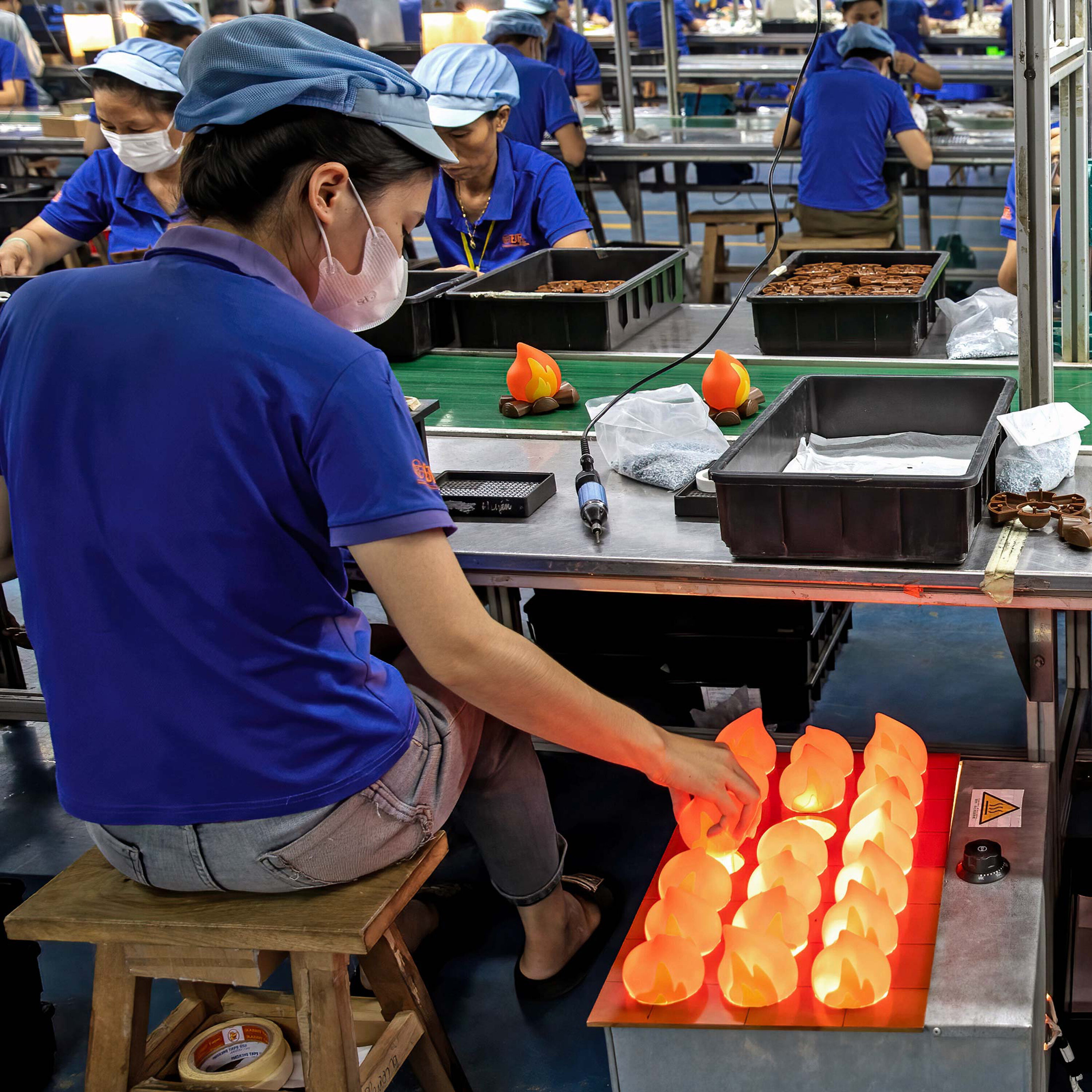
One of them is Campfire chat Mellows, a product that's being made in Vietnam for the first time.
It's a storytelling toy designed to spark conversations.
Imagine a cozy campfire that flickers with led light.
There are soft, squishy marshmallows called chat mellows, each printed with a unique emoji, a magic wand a storm a jigsaw puzzle.
Speaker 5Once upon time, there is one little boy who is playing jigsaw puzzles.
Speaker 1And then these images are story starters.
Kids slide them onto sticks and pretend to roast them over the campfire while telling stories to each other.
At the injection molding machine, a robotic steal arm grabs onto squishy marshmallows that have emerged from the mold.
Elana says that kind of automation is actually missing in many of the factories she's visited this week.
Speaker 4The automation is a period, so like you look around and there's a lot of people, is not as many machines covering the same thing that a person might do, and so that's gonna bring the cost up a little bit.
Speaker 1In Vietnam, factories still rely heavily on manual labor because advanced machinery like this isn't easy to come by.
It's expensive and often needs to be imported, likely from China, which dominates much of the market for toy manufacturing.
And even in factories that do have automation like this one, Alanas noticed something else that affects productivity.
Speaker 10So whereas in China, am I in tape one worker to worker machine, in Vietnam it will take two workers because they don't understand they're not as familiar with the machine for it, so that'll take six to twelve months for them to really learn it and to get it to the same level of automation that exists already in China.
Speaker 1You know you're trying to squeeze, Jimmy says.
This factory has about a third more workers than a similar plant in China, and unlike Chinese laborers who've worked years or even decades at facilities like this, many of these workers aren't new to assembly work.
Some of the staff we spoke to came off farms and are relatively new to assembly lines.
That lack of experience, combined with lower automation, hits productivity.
Alana says some vendors report making four thousand units a day in China, but only twenty five hundred in Vietnam.
We follow the Chatmello's productions through the paint department, where workers manually spray red and orange flames on the toy, then onto the assembly floor, where hundreds of workers in blue company issued polo shirts and caps sit at long metal tables.
Workers on the line split open the plastic logs, insert screws, install battery contacts, and solder the electronics board.
On the assembly line, a Chinese manager is showing a worker how to fit apart together, pointing out where to pay extra attention.
His instructions in and are translated into Vietnamese and the workers questions are relaid back Yo.
This factory has relocated about twenty engineers and managers from China to Vietnam, and that's to help bridge the gap in experience and technical know how.
It's a common practice for factories here.
Jimmy says, Chinese workers have developed specialized skills over decades that are difficult to quickly replicate elsewhere.
Speaker 9Every single Chinese factory moving from here, they will rely on their own team to split up.
I mean the core member of Platino still Chinese.
He posed that is with experience.
Speaker 1The tariffs also bring another risk Learning Resources has yet to calculate.
To explain, Alana picks up the chat Mellow toy the interior.
Speaker 4These chips are made introduced in China and then imported here.
The soldering is done locally.
This product will need batteries.
Those will be imported.
You cannot five batteries lobally in Vietnam.
The metal is imported, so all.
Speaker 1These different That's a big contrast to China, where more than ten thousand companies form an extensive sourcing network for the toy industry.
Vietnam's toy suppliers are in the hundreds, a fraction of what China has.
Speaker 8So within a city center or geographic area in China, you can find a plastic splier, a print supplier, a foam supplier, a wood supplier, and so on.
So all that is available locally.
That same infrastructure doesn't exist anywhere else in the world today.
Speaker 1All these imported materials could spell trouble for businesses.
On top of the twenty percent terrace in Vietnam, Trump has also slapped a forty percent transshipment rate on goods that originate in China but are then exported from Vietnam.
That extra levy is designed to crack down on companies that reroute made in China products through Vietnam, adding little or sometimes no additional manufacturing.
So far, the administration hasn't offered any guidance on how these higher duties will actually be enforced.
Speaker 4So the rules on trendshipment haven't been fully defined yet.
So these are things that we need to guess on and whether componentry which is brought in from other countries might impact the terraffraight.
Speaker 1Elana says.
All these factors add up more workers, less automation, imported components, Chinese engineers.
They make manufacturing in Vietnam ten to fifteen percent more expensive than in China.
Elana says, the entire process scouting factories, moving molds, prototyping adds up to millions of dollars.
Speaker 8They're not recoverable.
There's a lot of costs here that aren't recoverable.
Speaker 5Orders that we've lost, like those will never come back, Costs that are being passed to customer, like all these things are.
Speaker 1Irreparable.
Speaker 5Heart And that's part of why we were motivated to bring the lawsuit, is because there's a lot of damage being done and there's a lot of small medium sized businesses who don't have the ability to stand up, and so we wanted to stand up on behalf of the thousands of companies like our store.
Speaker 8Impactor Venus.
Speaker 1After the break, what does the supply chain shift mean for workers on the factory floor, for families in nearby villages, and for American consumers back home.
The town of Fully, about forty miles from Vietnam's capital city of hanois in the Red River Delta.
It's in a valley surrounded by lush, green, karst limestone mountains, a post guard landscape until you get close and see the peaks being quarried to build roads and industrial parks.
It's a small, off the beaten path town that historically attracted mostly locals, but during our time there, we bumped into Chinese visitors and heard Mandarin at breakfast and at roadside cafes.
Most hotels were nearly fooled because most rooms were now being used to house Chinese workers, a trend that began in the past year.
My own family left Vietnam during a time of high tensions with China, with the two countries engaged in a border war in nineteen seventy nine.
Then Vietnam harassed ethnic Chinese and questioned their loyalty.
It forcibly expelled families with Chinese roots who lived along the northern border regions.
My father's side of the family had immigrated from China to southern Vietnam in the early nineties hundreds, and those discriminatory policies after the war pushed out families like ours.
Speaker 3And we're buy the old bow and we modify the boat, running, you know, on the ocean.
Speaker 1In the summer of nineteen seventy nine, my father and his brothers retrofitted a river boat to make it seaworthy, and my grandfather navigated our way through the South China Sea.
All three hundred of the people who fled on our overloaded boat were ethnic Chinese.
Speaker 3And we take a chance.
Fifty to fifty, you know, fifty diet fifty, you know, a lie, No, fifty to fifty.
Speaker 1Through the years My dad has talked about that difficult decision to risk all of our lives on the sea because he and my grandfather couldn't see a way for his children to have hopeful futures in our homeland.
Because of our ancestry, we brave storms and pirate attacks to become refugees in far away countries.
Countless other didn't survive the journey.
In Vietnam, that dark chapter is all but forgotten.
The relations between China and Vietnam still have points of contention.
They're entwined economically, Chinese investors are embraced more than ever, and Chinese capital funds nearly thirty percent of all new projects.
Just a few hundred yards from the Dumb Fund plant, we stop at a roadside eatery right across from the site of new factories under construction.
Windy Twin is seventy eight years old.
She's just finished lunch and is chatting with her neighbor.
Speaker 6This is my hometown.
These will rice views all the way to the river.
Speaker 1Long before the factories arrived.
Generations of families here, including the Winds, worked the land rice wheat tsava in Vietnam.
Land is sacred after babies are born, their umbilical courts are buried in the fields to ask the land to protect them, and when they die, they're often buried in the same rice fields where they toiled.
Speaker 6All of this area used to be in my family's fields, all the way out to there.
We are farmers.
What do we do without our fields?
Speaker 1In twenty thirteen, the government requisitioned the land to make way for industrial development.
Duyen and her neighbors say they were forced to sell their ancestral farms and compensated about ten thousand dollars, a price they deemed to both.
Speaker 6They reclaimed the land, so we had to sell.
No one wanted to sell, but we had no choice.
You couldn't refuse.
Speaker 3Come what is our lack?
Speaker 1In the end, Duyn's family bought a small plot across the street from the construction site.
They paid nearly seven times the government's compensation price per square meter.
They built a house and opened a small cafe serving construction workers, but she worries it won't last that workers will eat at the factory canteens once construction ends.
During our visit, the air hung heavy with dust.
Duyn and her neighbors worry about pollution.
Both in the air and from the factories.
Given the breakneck pace of development, still she acknowledges the factories have open doors.
Her daughter in law, once a farmer, now earns nearly three hundred dollars a month at the Dumbfun factory making toys for learning resources.
Her husband weilds at construction sites.
Together, they've saved enough to send their son, Lunn's grandson, to study automotive engineering in South Korea.
It's a future, she says, made possible by factory work.
That hope for a better future also lies a few miles away at the Hannam Vocational School.
Here, students as young as fifteen are training to become machine operators and engineers.
The school says nearly all graduates land factory jobs.
Global companies like LG, Hyundai and Samsung send trainers and donate.
Speaker 9Equipment, And what thought, I have a movie through you.
Speaker 1Sixteen year old Duncom is a returning student at the school.
Gum says he loves tinkering with electronics, and he's eager to find a factory.
Speaker 8Am I Garden.
Speaker 9Factories have a lot of equipment and machines, so they need people to fix and maintain them.
Speaker 3That's why I chose to study industrial electricity to.
Speaker 2Fix ma.
Speaker 1GM says a university education might not lead to a career right away, but he's certain he can have his choice of factory jobs.
My conversation with his confident teenager, upbeat about his future, left an impression on me.
After a week in Vietnam, it's clear that optimism runs deep, centered around the factories and foreign investors pouring capital into the region.
The country's leaders are highly attuned to the shifting geopolitical wins and are bent on maintaining growth.
The US, once a wartime enemy turned trading partner, now seems like a fickle friend with its high tariffs, so Vietnam's counting on foreign investors to help ride it out.
Before heading home, I asked Alana for her final thoughts after a week of crisscrossing the country and visiting a dozen factories.
Speaker 8Vietnam certainly has potential.
The products that we saw made here are very high quality.
They're certainly expertise here, and it's growing and changing rapidly.
I think some of the hang ups though, or that there's not as much capacity, so there's just physically not as much manufacturing space here as there is in China.
And then additionally, you can't get a lot of the raw materials locally, and so that is driving cost.
Speaker 1For now, Learning Resources is placing its bets on Vietnam, but tariffs are adding pressure.
The company has already raised prices of its toys by an average of six percent the bare minimum to cover the costs, and Alana says more hikes are on the way if Trump imposes additional tariffs.
But the biggest cost isn't on any invoice.
Because of the tariffs, Learning Resources had to cut its product development budget in half.
That meant shelving over one hundred new products, including an entire line of educational toys for classrooms.
Speaker 8That whole range had to go on hold because it was too big and too complex.
Speaker 5It was going to take too many resources, and we just couldn't justify it given all the other things that we had to do.
Speaker 8So like that's one that just personally for me, that makes me very sad because it's a product that teachers have been asking us to do for years.
Speaker 1Elana says consumers will pay for the tariffs twice in higher prices and in toys from the industry with a little less magic because instead of investing in innovation, toy makers are syncing their budgets into tariffs and supply chains.
Speaker 8Theser costs that have led to us slashing budgets and pulling back on investments that we were going to make.
We are hiring less people, We're coming out with fewer products for the consumers.
Speaker 11This is just going to mean higher prices and less choice.
Speaker 1This is the big take, Asia from Bloomberg News.
I'm wanha.
This is the first episode in an ongoing series on how one American toymaker is grappling with record high tariffs.
Join us as the journey continues.
If you like the episode, be sure to subscribe at Bloomberg dot com slash podcast, offer, leave a review, and even better, tell a friend it really makes a difference.
Thanks for listening, See you next time.