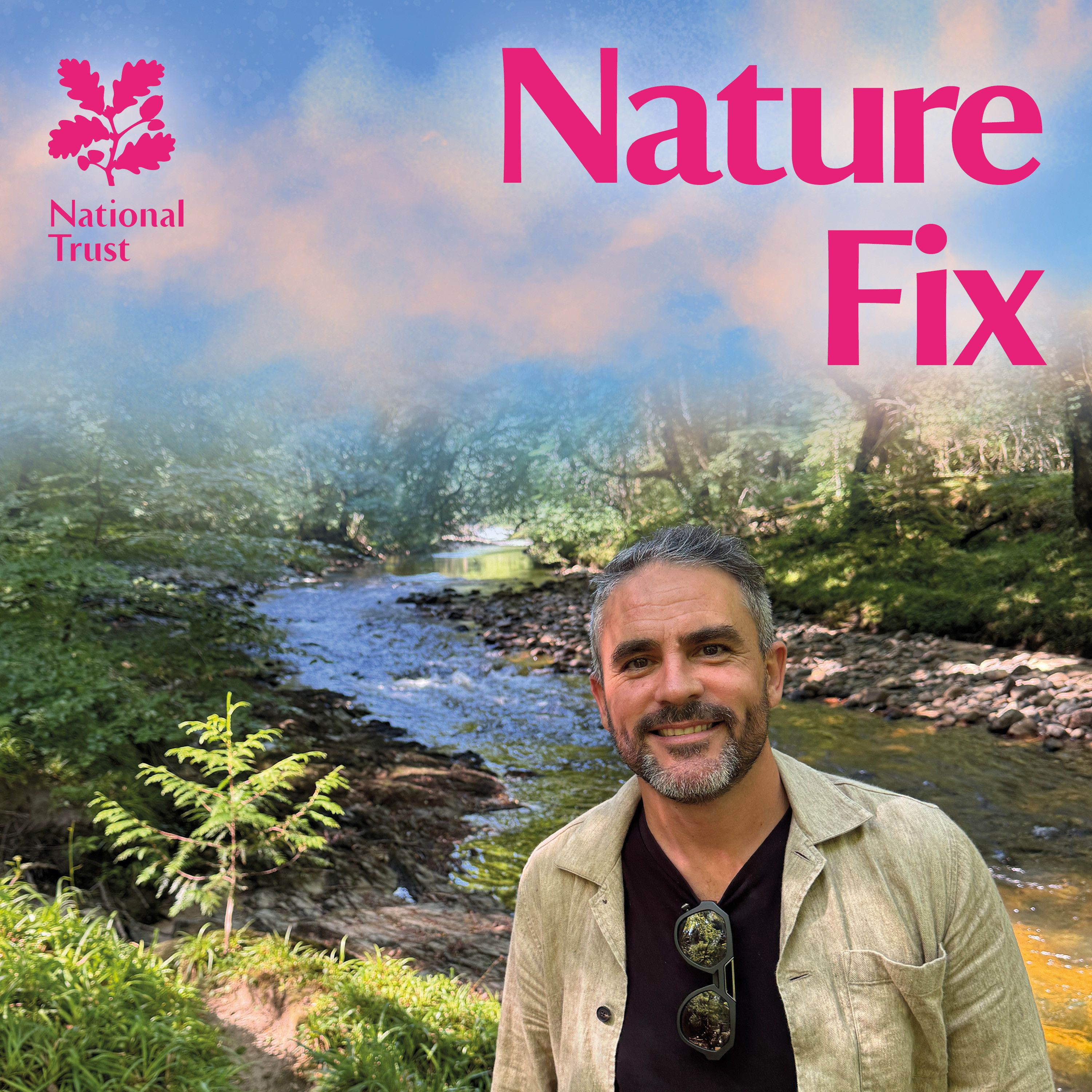
The Secret Story of Trees with Levison Wood
Episode Transcript
CLAIRE HICKINBOTHAM: Hello and welcome to Nature Fix with me, Claire Hickinbotham.
Every month we take you with us to meet the people whose lives have been changed by the outdoors and join them in a place that inspires them.
Today I'm leaving you deep in the forest with host Jo Dyson, who's joining explorer, TV presenter and writer Levison Wood.
Levison's taking us on a walk to an Iron Age hill fort through one of the UK's remaining ancient temperate rainforests in Dartmoor.
We'll be uncovering the folklore, secret histories and stories of trees and we'll find out why you should allow yourself to get lost in the woods.
JO DYSONJO DYSON: Being around trees always makes you feel better and today I'm at Hembury and Holne Woods on Dartmoor National Park in Devon.
Dartmoor's home to some of the UK's rare ancient forests.
These trees have stories to tell.
We'll be hiking up above the tree canopies to take in a panoramic viewpoint.
And to do that, I'm meeting Levison Wood.
LEVISON WOODLEVISON WOOD: Hey Jo, how are you doing?
JO DYSONJO DYSON: Oh Lev, good to see you.
LEVISON WOODLEVISON WOOD: Likewise.
JO DYSONJO DYSON: So this is your new neighbourhood.
You've moved to Devon.
LEVISON WOODLEVISON WOOD: I have.
I've just moved to Devon and it's a beautiful summer to spend in the countryside and I thought i'd come exploring so my first time here in Holne woods.
JO DYSONJO DYSON: So you don't know where we're going exactly?
LEVISON WOODLEVISON WOOD: I've got no idea to say let's go and get lost in the woods shall we?
JO DYSONJO DYSON: Love that!
Okay Lev, I think it's up and over this style.
LEVISON WOODLEVISON WOOD: Do my best
JO DYSONJO DYSON: Here's another wooden sign.
Which way?
Okay, fort, right, so still up?
LEVISON WOODLEVISON WOOD: Still going up, we're in the right direction.
JO DYSONJO DYSON: What are these trees with the really tall tree trunks and the canopy at the top?
LEVISON WOODLEVISON WOOD: Yeah, these are all oak.
Very tall though, these ones, aren't they?
JO DYSONJO DYSON: Think of oak trees as very sort of big, deep canopies, whereas these seem to me something that you'd see in rainforests because there's so much trunk and bark.
LEVISON WOODLEVISON WOOD: Well, don't forget this is actually a rainforest, believe it or not.
JO DYSONJO DYSON: Is it?!
LEVISON WOODLEVISON WOOD: This is a temperate rainforest.
Yeah, a lot of Devon, Cornwall, parts of Wales.
This was all part of Britain's ancient rainforest.
You know, those coastal currents that came off the Atlantic provided a lot of rain.
I can vouch for the fact that it rains a lot here in Devon.
It feels like a rainforest.
JO DYSONJO DYSON: And look how the light falls through amongst the leaves at the top of the canopy.
LEVISON WOODLEVISON WOOD: And the ivy as well, and the moss and lichen, and these little vines coming down.
We don't normally associate rainforests with the UK, but we do have them.
This is part of an ancient ecosystem.
Some of these trees are probably in excess of 400 or 500 years old.
For hundreds of years, these ones we know, this area has been pretty intact since the year 1600.
So that's why the trees are so tall and big and healthy, because it's a very natural, wild area.
JO DYSONJO DYSON: So, Levison, I know you went to University Of Nottingham and read history there, but then you chose to join the military.
What brought you to that decision?
LEVISON WOODLEVISON WOOD: Well, you know, I was always drawn to this idea of adventure, but it was probably my grandfather and my dad who were both soldiers and actually goes back in the family.
And I kind of just wanted to do my bit.
And so I thought it would be a useful thing to do to be able to enable me to then travel for a living.
So it's kind of a stepping stone to becoming an explorer.
JO DYSONJO DYSON: What are some of the main things that the military taught you do you feel?
LEVISON WOODLEVISON WOOD: Well you learn a lot of skills of course you learn how to handle yourself you learn to push yourself you learn how to go beyond anything you'd ever thought possible in terms of your physical and mental limits but I think more importantly it helps you to manage risk.
It enables you to realize that you can do far more than you ever thought possible.
And actually risk in it in many ways it's quite healthy is pushing yourself and it's not something to be completely avoided it helps you get over your fears.
And most importantly of all i think just having a really good network of people friends ex-army guys men and women that are doing interesting things that's kind of set me up to be an explorer and to be able to do what i'm doing now.
JO DYSONJO DYSON: So Levison you have been all around the world, perhaps to more countries than most people being an explorer and adventurer.
What are some of the most memorable moments from your travels?
LEVISON WOODLEVISON WOOD: Gosh, that's a tough one.
I mean, I've been very lucky to travel in upwards of 120 countries now.
JO DYSONJO DYSON: 120?
LEVISON WOODLEVISON WOOD: Yeah, in all sorts of different environments, walking along the Nile for nine months, that was 4,250 miles.
I walked the length of the Himalayas, all of Central America, across the deserts of Arabia.
So some amazing expeditions.
But really what I found most incredible was the people, the communities that I've met along the way.
And I met this old gentleman, must have been at least 80 years old, walking up these mountains with a big bag on his back, one of those big baskets, filled with seeds.
And since his wife had passed away 20 years before, he'd just spent his life walking around the hills of Nepal planting seeds.
So the next generation can benefit from, you know, those trees.
JO DYSONJO DYSON: I mean, it's quite timely as well as you're about to become a father thinking about the next generation.
LEVISON WOODLEVISON WOOD: Well, absolutely.
I'm sure that will be one of the first things that I do when my daughter's old enough is take her out to go for a walk in the woods.
JO DYSONJO DYSON: Oh, so you know you're having a girl?
LEVISON WOODLEVISON WOOD: Yeah!
JO DYSONJO DYSON: Spoiler!
LEVISON WOODLEVISON WOOD: Spoiler alert!
JO DYSONJO DYSON: I think he's going to be an adventure girl isn't she?
LEVISON WOODLEVISON WOOD: She is, she's going to be a little explorer!
My travels have taught me above all else the importance of respecting nature because it can be and is often portrayed to be a dangerous world out there and people always ask me what's what's the most dangerous situation you've been and i've been in quite a few you know, i've been snapped up by crocodile and chased by lions and hippos along the Nile.
And you know walk through very treacherous jungles in Central America in the Amazon where I've come to be close to snakes and all sorts of perilous things but what you've got to remember is that actually walking in a natural world it's as much there for the wildlife as it is for us and if you just have a healthy respect for the natural world then we can just live in much more harmony.
JO DYSONJO DYSON: I think we need to come back through the gate, we must have passed the turning.
We're definitely getting lost in the woods!
Shall we continue our ascent up to the fort?
LEVISON WOODLEVISON WOOD: Let's climb this mountain!
JO DYSONJO DYSON: So, Levison, I know you've written books and created documentaries on your huge expeditions and challenges.
And then the latest book, The Great Tree Story.
Why trees?
LEVISON WOODLEVISON WOOD: Well, quite apart from having an appropriate surname, I thought that trees deserve more recognition.
And I've been fortunate to spend a lot of my time on these expeditions in forests.
And for a lot of that time, I didn't really understand too much about why trees are so important.
And it was only after a visit to the Amazon Rainforest where I started to really take seriously studying just how important trees are, that I learned so many things and I wanted to share that.
I always remember the time I planted a conker tree when I was 10 years old and that tree is still there in my front yard.
JO DYSONJO DYSON: It actually grew!
LEVISON WOODLEVISON WOOD: It actually grew, yeah.
We all have a deep connection to trees and whether we know it or not.
JO DYSONJO DYSON: And so if anyone reading this but could do one thing as a result, what would you want them to do?
LEVISON WOODLEVISON WOOD: Well, there's obviously lots of things that people can do, supporting charities, being a bit more conscious about where your food comes from, what kind of food you eat, eating seasonally, being a bit more sustainable in your mindset about consumerism, all of that stuff.
But more importantly, I think it's just going outside, spending time in nature.
You can only really appreciate and love something if you immerse yourself in it.
Let's go and hug a tree.
JO DYSONJO DYSON: Perhaps we should try it now.
LEVISON WOODLEVISON WOOD: Shall we go and hug a tree?
JO DYSONJO DYSON: Do we think this is a good tree-hugging tree?
LEVISON WOODLEVISON WOOD: I like this.
This is a great tree-hugging tree.
JO DYSONJO DYSON: Why don't you go first?
So you can show me how I do it.
LEVISON WOODLEVISON WOOD: Here we go.
Hug this tree arms right around it's a very big one isn't it?
JO DYSONJO DYSON: It is can you touch your hand?
LEVISON WOODLEVISON WOOD: No!
There we go you can feel the energy of the tree!
JO DYSONJO DYSON: Let me give it a go!
The moss is a bit scratchy!
LEVISON WOODLEVISON WOOD: How do you feel Jo?
Connected to nature?
JO DYSONJO DYSON: I do it feels very sturdy doesn't it?
LEVISON WOODLEVISON WOOD: There we go!
It's important to remember that trees and forests play such an important part in cultures all around the world.
The importance that trees have played in mythology and folklore, storytelling throughout the ages.
For example, here in in Dartmoor, in the West Country, it's well known that prior to the Romans, here in Wales, we're the centre of Celtic and pagan culture, where you had the Druids.
The word druid actually means an oak seer, people who commune and talk to the oak trees.
So oak trees have had this very special role in mythology and storytelling for a very long time.
If you go into your local churchyard and you see an old- Thousand-year-old Norman Church, usually there's a yew tree next to it.
Well, the yew trees were, and still are, known for their longevity.
Some of them date back three, four, five thousand years.
And what's really interesting is that the Celts and the pagan tribes of Britain used to worship these trees and held them as sacred because they did live for so long.
So it's where they were seen as the trees of immortality and so that's where they used to bury their dead.
So you've got to remember next time you see your thousand-year-old church, you've got to remember that that yew tree next to it has probably been there for a couple of thousand years longer.
The trees came long before the churches.
They are symbols of rebirth and symbols of our connection to nature.
I'm sure you've been into a pub at some point called the Green Man.
JO DYSONJO DYSON: I think so, yeah.
LEVISON WOODLEVISON WOOD: There we go.
The Green Man is, again, this symbol of a connection to nature.
And it's not just in the UK, but the Green Man pops up all over the world.
It's in Rajasthani culture in India.
You'll see it in ancient Persia, ancient Greece, ancient Rome.
This symbol of a man or a woman with leaves coming out of their hair.
Carved into ancient temples, churches.
The same symbol, it's a manifestation of that ancient human connection to nature.
JO DYSONJO DYSON: So we've just come through a narrow path with ferns sweeping either side of us into this sort of bigger enclosure, which I think- Are we at the hill fort do you think?
LEVISON WOODLEVISON WOOD: We're pretty much on top of it.
There's no actual- They call it the castle, but there's no castle here right now.
It's just a big mound and this is an Iron age fort so I think it dates back to about 500bc.
And then when the Romans came I guess the Romans might have taken over part of it and then apparently the Normans built something here on top when they landed in 1066 so it's been in use for a good many years.
That's a great view though if you can look beyond over the tops of the canopy there you can see the the forest extending over there towards Dartmoor And then just these rolling, beautiful patchwork of fields and mini forests.
It's magical.
JO DYSONJO DYSON: I mean, looking around at all these variety of trees that we can see in front of us.
I mean, I know I'm feeling good right now because we've done a walk.
But what are the other benefits that trees can bring to people?
LEVISON WOODLEVISON WOOD: Well, trees provide enormous benefits.
I mean, that oak tree just there probably hosts somewhere between two and three thousand different species.
So they provide enormous harbours for biodiversity, which means that they are so important for the ecosystem that we live in.
But as humans, you know, trees play a very important role.
They obviously sequester carbon dioxide from the atmosphere, making the world habitable, frankly.
They regulate the climatic conditions, they transpire water to create rain, which is obviously very important for our life here.
They cool the ambient temperature of the earth as well, so where there's forests, temperatures are much lower than places where there aren't.
Look at a desert, for example, and see what happens there.
They stabilize the soil, so when you deforest, particularly hillsides and mountains like in the Himalayas, for instance, when you start cutting down trees, the soil becomes eroded and it completely disrupts the ecosystem because it reduces the topsoil so new trees simply can't grow.
Which increases things like avalanches or landslides, which in turn can have enormously disastrous consequences for humans in terms of the people who live in those quite fragile ecosystems.
We saw it just a couple of years ago in places like Afghanistan, Pakistan, huge floods, a lot of that was down to deforestation and we see it all around the world.
So trees literally hold the soil and the earth together.
But just sitting under a tree, It provides shade, it provides that space for us to just relax and unwind in a way that we've done for our entire evolutionary existence.
Just sitting under a tree is what we're here for I think it's the best thing that we can possibly do and just meditating and taking it all in.
JO DYSONJO DYSON: So we've left the hill fort where it was getting quite warm out in the open and now we're coming through another fern line pathway down through the trees and already it feels much cooler doesn't it?
LEVISON WOODLEVISON WOOD: A good few degrees cooler down here in the beauty of the shade.
Feels wonderful just like a magical glades down here isn't it the river dart there flowing through this ancient woodland- It's a beautiful beautiful place.
JO DYSONJO DYSON: I've just loved the variety of today Levison the woodland area the views.
LEVISON WOODLEVISON WOOD: Well it's been quite the expedition today hasn't it?
JO DYSONJO DYSON: Well if you think it's been then-
LEVISON WOODLEVISON WOOD: I've loved every moment!
You know what I think just this idea that we've been talking about today of spending time in the woods you don't have to go overseas you don't have to travel to the Amazon or the congo you can go and experience a great british woodland pretty much anywhere in the UK.
And some really beautiful ones out there here Holne Woods and Hembury you've got this whole spectrum of biodiversity you've got this ancient woodland in an ancient temperate rainforest with a historical site.
You know these trees have got so many stories to tell and this has been a very special place for a very long time and it continues to be so and it continues to inspire people and I feel Very inspired just being here and taking it all in.
And we're very lucky.
It's a beautiful day.
And there's nowhere I'd rather be right now than having a good old walk in the woods.
CLAIRE HICKINBOTHAMCLAIRE HICKINBOTHAM: Thanks for listening to Nature Fix.
We'll be back next month with a new episode.
Why not give us a follow on your favourite podcast app?
And if you've got time, leave us a rating and review.
And if you love nature, check out National Trust Podcast's Wild Tales.
Or for little ears; Ranger Rae and the Wildlifers.
Bye for now.