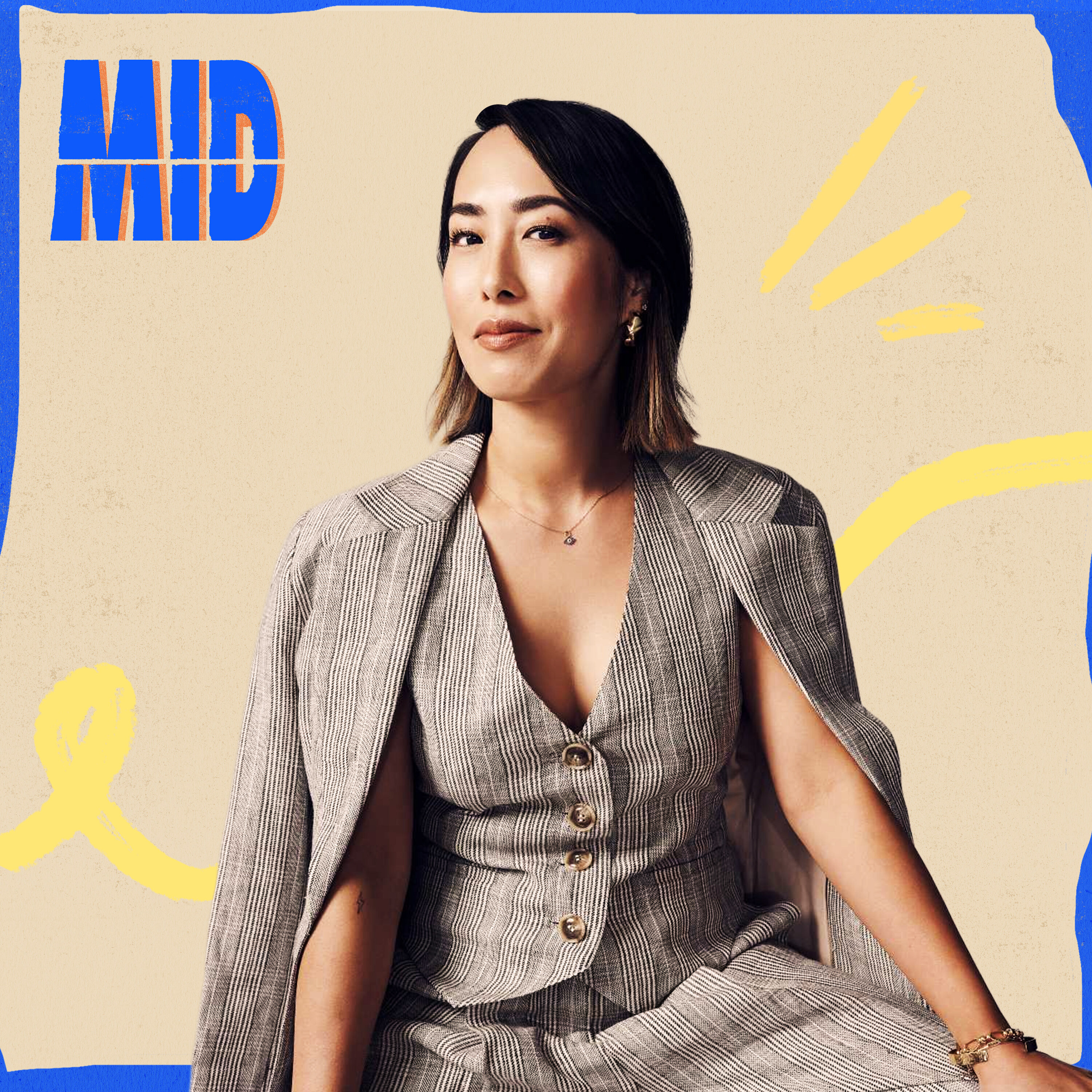
Melissa Leong Knows How To Blow Up Her Life
Episode Transcript
You're listening to Amma Mia podcast.
Mamma Mere acknowledges the traditional owners of land and waters that this podcast is recorded on.
Have you felt the TikTok to get everything done, achieved and ticked off the list by a certain looming birthday?
The pressure to meet expectations that weren't your own, The compromises agreed to live a respectable life, the secrets swallowed to keep the peace.
Trying on different lives, partners, jobs, places to see what feels most like you, and finding that most of them itch or pinch or strain.
Is there a magic age where you just can't fake it anymore?
Is there a finite number of escape hatches you can crawl through just to try to start again again?
Is it possible, friends, to arrive at a point where you finally know your home in a place built for you from the blueprints of someone else's dream, but in the skin you've been trying to grow into your whole life where you are absolutely deliciously you.
Hello, friends, I am Holly Wainwright and I am mid midlife, mid family, mid meal.
Today I'm talking to the Sublime FOODI Melissa Leong about how many lives you need to blow up before you get to live one as unapologetically yourself.
You know, not someone else's ideal version of you, not the version you might have imagined when you were growing up, not the version of you on the Internet or in the mind of an X or an old friend or a parent, but you.
If you know Melissa from her time on Master Chef, then you know one version of her, a graceful, expert, lyrical version who could give us all the adjectives about some delicious mouthful of food while showing empathy to contestants alongside and Frillough and Andy Allen best cast ever in my opinion.
But Melissa Leong is a great deal more than that.
As her memoir Guts spells out, the book deals with some heavy stuff, but this conversation doesn't really.
Melissa has been talking about Guts for a while now, and if you want to dive into some of those dark places, which include childhood trauma and sexual assault, you'll be able to find those conversations.
But what I wanted to do, without sugarcoating anything, was ask Melissa about the audacious hope you need to push through and past the most difficult parts of your life.
And find yourself as she has done, living a new one on her own terms, shrugging off the expectations put on you by society.
Melissa, for example, is a woman in her early forties who doesn't have kids, and we talk about how she feels about that, and how she feels about everyone else's feelings about that.
Learning to deal with the fact that the marriage you thought you had to rush into at thirty four because he imagine being thirty five and unmarried was a mistake, and embracing the freedom of a single, grown up life.
And we talked about a whole lot more, including a step by step guide on how to sit in a restaurant by yourself and eat whatever the fuck you want, settle in with Melissa Leong and I here we go, Melissa, thank you so much for joining us.
I didn't want to jump in and call you mel because I'm always irritated if people call me by a nickname when they don't know me well enough.
But what do you prefer?
Speaker 2Uh?
Speaker 1Mel is fine?
You know.
I at the beginning of my career, I sort of.
Speaker 3Held on to Melissa being the biomrofessional professional moniker.
But you know, because of things like master chef people, you're in people's homes, they feel like they feel like they know you.
And so while the parasocial relationship is a strange concept and we deal with it all the time on social media with the people that we follow and that follow us and all the rest of it, if people have come to feel like they know me well enough to call me Melvin, it is my honor, and you know, it's hopefully a sign of a job well done.
Speaker 1Well.
I think it definitely is.
Yeah.
I've just finished Guts and I loved it.
Thank you.
It's a beautiful, brave book.
It's I love that it's got recipes in it.
I love that it's got all sides of life in it.
Yeah.
And I wanted to start by saying, because reading this book, and obviously I'm reading it thinking, knowing I was going to talk to you, and it feels like you've lived a lot of different lives.
Yeah, I think so.
You know, I grew up in the.
Speaker 3Era of we go to school, you go to university, you pick our vocation, and you follow that track until you retire kind of thing.
Speaker 1You know.
Speaker 3I was at the end of that period where that's the way that the world.
Speaker 1Of work worked to choose a job, and you're right on this.
You're sort of expected, really to choose from quite a narrow range of jobs, a narrow range of jobs.
But you're also so young.
Speaker 3I mean, if you think about kids finishing high school, you're sixteen, seventeen, you know, maybe eighteen.
And I think about my friend's children that are at that age, and while they are, they seem so much wiser now than maybe I felt at that age.
They're still kids, and you're expecting people to decide on their whole future at an age where they're just trying to work out how to drive from here to you know, another state or something like.
It's just give a kid a break.
And I think there's so much pressure on kids to figure it out early and for parents to kind of provide that direction.
And sometimes you don't know what you want to do.
And that was very much for me.
I thought I knew what I wanted to do, and it became pretty obvious that I couldn't do that.
Speaker 1You wanted to be a professional classis I did.
I wanted to work in that world of musical performance, and I am a classically trained pianist, and that's what I really that's all I want it, That's really all I wanted.
But as I developed my injury, repetitive strain injury, it just became really apparent that I would be playing through pain if I wanted to do that.
And you know, at sixteen years old, I mean, that's fantastic news.
Exactly my dream is going to torture me exactly.
So do you want to do that or not?
Speaker 3And at the time, I had to really make a snap decision, and so I chose.
I chose to go and do an economics degree.
Why, I have still no idea, you know, economics and business degrees was sort of the thing de jure at that point, Commerce, economics, you know, business.
So I thought, well, that will give me sort of a broad enough set of options that I can kind of just figure out what I'm going to do now.
And so that was fine.
You know, I liked it fine, It did okay because I didn't really find that much passion in it.
But what I loved was eating out and I went to I went to the University of Sydney.
Speaker 1So I loved eating at.
Speaker 3You know, Thai food and on King Street or going down to Glee Point Road and discovering Chai for the first time, and you know, all the all the satellite suburbs around, you know, the inner city.
I just loved exploring and kind of figuring out, you know, where you go for which noodles and witch dumplings.
And that was so much more exciting to me at the time than econometrics at eight thirty in the morning on Friday.
Speaker 1I mean, come out.
And also, you're obviously a creative person, and I don't know enough about economics to say, like, as you can tell, I write and talk for a living bit to know whether or not that's particularly creative.
But like food obviously, as well as being a big part of your childhood, Yeah, obviously like ignited that part of you too, right, absolutely.
Speaker 3I think it was always that battle of the analytical versus that created and some people very much lean into one or the other, but for me, it's always been the battle of both things.
I love critical thinking.
I love you know, the idea of kind of testing a theory to its sense degree, thinking about things quite scientifically.
Speaker 1But if I embrace that and.
Speaker 3Neglect my creativity, I don't feel like I'm fully alive, and vice versa.
And so yeah, you know, it was a it was a trying time to I wish I'd done a gap year.
Speaker 1Yeah.
Speaker 3I only learned about gap years from my friends that had studied overseas, and that for most kids overseas, you take off that year between high school and university and you work or you travel, and then you then decide is this still the degree I want to go study or should I switch to something else?
Because I've learned something about myself in the twelve months that I've gone from being a kid at school to a young adult.
So maybe that might have changed my course of life.
Speaker 1But we'll never know, will we.
Well, it worked out too badly, but okay, that was one of your pivots.
And then throughout the book you obviously it really I find it really inspiring, and I know that they weren't all pivots of joy.
Sometimes it was necessity.
Sure.
My favorites of your pivots though, is when you go to Tasmania and this woman who at this point you're like this young and please correct me if I paraphrase incorrectly, but you're like that, You've you've worked in the coolest food scene in Sydney, You've set up amazing stuff, you know, like you've thrown these events at the fanciest restaurants.
And then there's another version of Melissa who throws that over goes and lives in the middle of nowhere in Tasmania, learns how to skin and gut a wallaby.
Like I just I'm very impressed by the ability to like tap into your gut and go this isn't working for me.
I'm out because I reckon lots of women at different times in their life find themselves in that moment, but having the guts, which is obviously one of the many reasons why this is the perfect title for this book, is a difficult thing to do.
What do you think gives you or gave you that ability?
R dacity?
I'm very day how damn you what gives me that?
Well?
Speaker 3Firstly, I truly believe we all have that capacity to know when we need to pivot, or we need to switch things up or blow blow up your life, whatever you want to call it, change things because they aren't they don't feel good for you, that it doesn't help you with the feeling of I guess harmony or balance in your life.
And I suppose for me that noise of saying, hey, this doesn't feel right, that's pretty loud in me.
Speaker 1So it's not something that I can ignore easily.
Speaker 3It's always just going to chip away at me until I do something about it.
And so I'm not people go, oh, you're so brave to have done things.
No one thinks they're brave when they're doing a thing.
They just do the thing.
Speaker 1And for me, I don't know.
Speaker 3The way I navigate things is just to go with what feels like the right thing.
Even if I haven't fleshed out all the permutations of what could happen, it doesn't really matter.
I'm just guided by this thing that says this feels right or this feels wrong, and hopefully will always guide myself towards what feels right, because I know when I've sat in things that seem perfect on paper but feel wrong, they still end up not being good.
Things don't work out very well for me.
So it's trial and error, and I'm not saying I get it right all of the time.
There are definitely times when I've ignored the benefit of a doubt and ended up, you know, doing the thing everybody wants me to do, or what I think I should do.
Because society tells me to or it's just an expectation I have on myself.
I'm going to own my own choices.
But yeah, that doesn't it hasn't landed me in places where I've ultimately felt myself or happy or welcome, and so that to me, over time, I'm a slow learner.
Those experiences when they accrue sort of teach me that the next time I'm given an opportunity to just stop and think for a second, Okay, what feels what feels right?
Speaker 1One of the things that there's a chapter in your book Ingredients for a Big Life.
Yeah, and one of them actually is given a minute the way you say, because this is kind of advice for living hard earned lessons.
Yes, which I very much appreciate, because I think that you know, if you're twenty and you're looking at this book and going, you know, and they're looking up to you and admiring you very much seen whether or not it feels like this all the time to you, like you're somebody who is living an authentic, like a version of yourself where you're like, I've learned trying stuff that I need and I'm not going to follow those rules and I'm not going to.
But whether you're twenty looking at that or whether you're forty or fifty, we need those reminders often of like what's right for you, So give it a minute.
Is that the moment that you tune in?
I think so.
Speaker 3But also sometimes maybe it's not about tuning in.
Maybe it's knowing that if you make a choice or you say something right then and there, it won't be the right thing, you know, whether or not.
That's you know, the angry email you want to send, like someone sends you some like stupid email and you do you want to just fire backer, you know, something really feisty.
Speaker 1And we've all been there.
God, we've all been there, and we've sent I've sent these, I've sent the email.
Didn't you want you jump out of advertising after you had a runt on Facebook?
I don't Facebook, I said, yeah, I mean, God, don't leave that.
Don't don't rant on any social media.
It doesn't it does.
It's not what I would recommend, especially these days.
We could argue that was a little bit earlier in the piece.
You didn't quite know.
Yeah, I just I didn't.
I didn't know.
And it was also very it was very immature.
Of me to rant about it.
Speaker 3I should have sat with how I was feeling in thought to myself, well, why why am I feeling this way?
Speaker 1What can I do about it?
Speaker 3But as it turns out, you know, a friend of mine heard me and said, hey, you know, I'm working for Adriano Zumbo.
Would you come and help him with some pr requirements because he really is struggling with that side of things.
And it did give me a backdoor into a world I really wanted to be in, and so I'm not sorry in that way.
But also, as I have become the person that I I know that now knee jerk reactions aren't necessarily the best response you can give.
So sometimes you know, when you want to reply in the heat of the moment, when you know you're still feeling the adrenaline pumping and you want to fire off the fuck you email, sometimes it's not the smartest thing to do because you might burn a bridge, or you might really have misunderstood what's going on, or that's just still not the smartest, most strategic way to get where you need to go.
So sometimes just sitting with it, if you still feel the same way, have at it.
But there's usually no harm in letting a feeling sit for a day or an hour or a week or whatever it happens to be before you action that response.
And the more I put that into practice, I think the more peaceful and harmonious my life has been, because you know, it's about navigating ourselves and the way that we feel about things, but also how people respond to to us as well.
Speaker 1So yeah, giving a minute can be good.
Absolutely, I'd love some advice from you about boundaries setting because it be worse.
Yeah, because that's the word that gets thrown around all the time, right huge, and it gets misused a lot, and you know it's not I'm really mindful that these days sometimes the word boundaries gets used in order to excuse really shitty behavior, and that is that's not cool.
Speaker 3But I think true understanding what boundaries are and what they mean to you and how you uphold them, that's a that's a life lesson that I'm very grateful for.
But I've again slow learner over here, done things the.
Speaker 1Hard way, and I've let people.
Speaker 3I've had situations where my boundaries have been low, and I've let people step over that.
Speaker 1You know, that invisible.
Speaker 3Force field into my world and it hasn't ended well.
And I think in particular, when you finally get the curry to really honor those boundaries and you raise your standards and you say no, that's not okay with me, people don't like it because they're used to having access to you.
They're used to being able to manipulate you, potentially in some way, and when you withdraw that access to you, they don't respond well.
And so I've experienced that firsthand, and it's not nice.
But you need to retrain people around you about how you deserve to be treated.
And it's not about being selfish, it's not about being entitled.
It's about what you need around you to walk through this life in a way that you feel settled and happy and like you have healthy agency over your life.
Speaker 1What have you learned about literally the way to do that?
You know what, It's interesting what you just said about people aren't going to like it.
That's why this is often something that people please to struggle with, right, because you have to performed people please over life, sure, because you have to sit with the fact that you might have pissed someone off.
Like not you haven't been mean or unkind or rude, but people don't like being told no, no, they don't.
I find and I struggle with this myself sometimes, is that I kind of need to have a bit of a filter about what I'm going to say yes and no to, you know what I mean, whether it's in either a professional or a personal capacity, Like an opportunity something comes along and you're like, I should I know it would be good, but I also have a feeling xyz.
Yeah, people often have a problem like even working out how to say no?
What have you learned about that?
And also do you you're a busy woman like this, Look I look at what you've been doing in the past twelve months, and I'm like, yeah, I'm tired.
How definitely tired.
I mean, thank God for sheep masks and LEDs and all of the wonderful things that we get to do.
Speaker 3I feel tired.
I need to be honest about that.
But how how do you find the language to say no?
Or how do you be okay with it?
You know, coming from a former people pleaser, I get off of the most amazing opportunities all of the time.
I can't possibly say yes to all of them, but I will say thank you so much for this opportunity right now is not It's not going to fit, and I can't give you the best of who I am.
But please ask me again in the future, because I would love to revisit this conversation.
Speaker 1I like that, and I genuinely mean it.
Speaker 3If the timing's not right, you don't have to say, nah, this doesn't feel right buck you.
You can just say thank you so much for this opportunity.
Please, let's can we talk about this in six months time or the next time that there is this opportunity.
I really appreciate you coming to me with this, but right now it's just not going to quite fit.
Speaker 1And you know, chances I learned that from a friend of mine.
Speaker 3You know, none of this is original me material, but she was very wise in sharing that piece of information.
And it's about saying it's about acknowledging the generosity that someone's offering you something, but declining in a way that you can say, look, it's not a no forever.
It's just not right for right now.
And it's not a rejection of who you are or what you're offering that it's not good enough.
Speaker 1It just doesn't fit.
I can't accommodate you, so You describe yourself in the book several times as being hyper independent, an introvert.
You talk a lot about introversion.
Oh yeah, I'm feeling it today.
I bet you are, because as we sit down, you've already done a big podcast interview.
You're in the middle of this press tool.
It'll before major podcasts in two days, plus a bunch of interviews and two major events and speaking engagements.
So you must be drained.
Yeah.
I'd love to know though that sort of Is it a struggle or not.
I was wondering about this between yourself.
So when when and obviously write about in the book, but when the master chef opportunity, for example, comes into your world.
One of the things I kept thinking is, and you talk about this, of course, is that fame as an introvert is a particularly I mean, fame is difficult for anyone, being recognized, being looked at, having people feel like they know you, all that stuff.
Yeah, But as an intensely introverted person, that's another thing.
And you're right in the book that when that opportunity came your way, you kind of knew that it was going to cost you a lot and that it was going to change your life.
Speaker 3But that's best case scenario.
Yes, that's best case scenario.
Worst case scenario, it flops, you suck, it's.
Speaker 1Over like that.
That's also not ideal, you know.
So it's obviously a part of you.
There's a part of you that goes, this could fuck everything up.
But there's also obviously a part of you that's, like, what an adventure and it could It could open your world and change and shift your whole point of view, and there's the potential for wonderful things to come into your life, as I have discovered.
But yes, it's it's a trade off.
There's no no proposition is ever wholly good or bad.
Speaker 3There's a it's a mixed bag of things, and there's always going to be a trade off.
And for me being an intense int of it, like I walk into a room like a big event that like these these lovely events that we're so lucky to go to, and there's.
Speaker 1Always just this like.
Speaker 3God, I need to know at least one person who's going So I feel okay about walking into that room, but I'm still so awkward about it because it's just not I.
Speaker 1Like being in those rooms.
Speaker 3Don't get me wrong, I feel very grateful to be there.
But my natural disposition is having a beautiful chat about whatever it happens to be, with nuance and with depth with one or two other people.
Speaker 1That's my happy place.
Speaker 3But being in a room full of one hundred people and I could, really, I could know and love every single one of those people in the room.
Speaker 1It's a lot.
Speaker 3It's a lot for me, and so I need to recharge by getting my energy back from being you know, alone in a room or whatever it happens to be.
And I know how important it is if people want the best from me.
I know what I need to do, which is to give myself the space to recoup that energy.
And it's sometimes hard to find time to do that in our very busy lives, like for all of us, you know, whether or not it's you know, having a family and having a full time job or whatever your configuration of your life is, finding a moment to yourself is really fucking hard.
Speaker 1As we and I liked in the book you using the example and it's just a tiny little line, but it really stuck with me.
Of you know, obviously when you're filming TV shows and when you're a master chef, this is a busy environment with big crews, lots of people.
You've got Obviously you're being nice to everybody because you're a lovely person.
Thank you.
But then you're but you say something like, maybe look differently at the person who retreats with the sandwich in a book at lunch time rather than wants to go for lunch with the crew.
I don't necessarily mean that crew whatever anyway your college makes or whatever.
Yeah, because it's still perceived as a bit rude in our world, or a bit up yourself, or a bit some of the like, oh, you know, like you need to go be alone.
It's like, well, if that person, you know, you work, we work in offices, we work in you know, television crews or whatever your world of work is, it's usually with people a lot of the time.
And don't we want the best out of our teammates.
Speaker 3And if getting the best out of the tea your teammate is to honor their choice to go and sit in the corner and read a book and eat their sandwich alone at lunchtime, that's not a rejection of you.
It's what they need to keep going for the day.
And to honor that is I think a really important thing and sometimes you know, like the life of the party, the really social people get a lot of attention that way, and they it's because they get their energy from being around people and that's beautiful.
That's how they recharge.
Other people don't work like that, and it's just you know, and we're all sitting on some sliding scale of needing a little bit of this and a little bit of that.
Speaker 1So was that a hard learned lesson, like I have to go like whether it's literally you go into the trailer with your sandwich, but yeah, with a hard learned lesson that Like people might have their thoughts about me doing that, but whatever, Yeah, absolutely, because also you.
Speaker 3Want to be a part of the conversation.
You want to show that you care about your team and the people that you work with.
You want to be there and you don't want to miss out, you know, on whatever the topic of the days or whatever.
So it's about finding that happy medium and the language.
And this is something that's taken me literally my whole adult life is trying to find the language to articulate why I'm doing what I'm doing so that people understand that I'm not just being a Dick, but I'm actually I'm intensely interested in this conversation, but I just need about twenty minutes before we go we go again, so I'll see you guys in a minute.
And that's often enough to be able to and I have not always had the ability to say that.
You know, when I was in my twenties, I you know, be out at a club with friends and my boyfriend at the time was a DJ, and I just disappeared because it just I couldn't people anymore, and I would just get in a cab and go home.
And then I found out later that people were worried.
Speaker 1Because I disappeared, and then I was like, oh shit, that's really that's a fair point.
That's my bad because I wasn't able to say, I can't people anymore.
I need to go home and sleep now.
Speaker 3And so it's just, you know, it's learning, it's learning by experience, and you're not always going to get it right.
So we also need to be a bit gentle on ourselves while we are learning how to do that stuff.
Speaker 1In a minute, I'll be talking to Melissa about what happens when you suddenly get very famous and everyone has an opinion about you.
The sudden fame with your introversion also came in your case.
And I don't want to dwell too much on this because I know it's not pleasant, with a lot of criticism, a lot of public the first woman as person of color to be on this massive show I remember.
I mean, obviously I was working at MoMA and Mia.
I saw the awfulness that you copped in that situation.
So fun, oh so fun.
I just want to ask you a little bit about dealing with it.
I mean, I know that you know what I was going to ask you, but I think it's a stupid question.
Is I was going to ask you?
Were you in any way prepared for it?
But maybe you were, because maybe you knew we'll have.
Speaker 3A background in pr and journalism.
So yeah, I had some idea it could come down the line at me at some point.
But all of the best laid plans, all of the knowledge and consideration doesn't always set you up for being able to, you know, to handle it when it does happen to you.
Because you know this stuff in theory, you know the potential permutations of what could happen.
But when it's actually your life and people are you know, saying things about you that aren't true, and there are all of these weird narratives out there.
Speaker 1You know that objectively you cannot correct every.
Speaker 3Single narrative, nor should you, right, but it still hurts because when people say horrible things about you, you know, untrue, or you know, maybe there's some grain of truth to it, who knows.
Whatever it happens to be, it's still private, it's still something you're trying to work through as being human.
But yeah, navigating that world and that amount of exposure really quickly was a massive you know, it's like a number one with a bullet, you know, it was very all of a sudden, You're eager, in a different space and people are treating you differently.
And as an introvert, I love fading on into the background.
I love people.
Speaker 1Watching and when they're watching you, that's not a comfortable place to be.
But I also accept that it's.
Speaker 3A rare opportunity.
It's incredibly privileged, and I also don't want to waste an opportunity to explore what my life could be.
Speaker 1I also think, and I think about this a lot, is that because people in the public eye cop an enormous amount of whether it's trolling or whether it's nonsense or lies, and women more so, and people of color also, no question.
But these days everybody gets a certain amount of commentary about their lives, whether it's in the friend group chat, whether it's you know, my teenager on snapchat, whatever it is.
And I just wonder if you've got any advice for like not being paralyzed by other people's bullshit about you, Do you know what I mean?
Because I think sometimes women, I'm sure people, not just women, will find themself in a position in their life where they do need to make one of these leaps we're talking about right, whether that's because they're in a marriage isn't working, or a job that isn't working, or a care giving position that's sucking everything from them or whatever.
But one of the things that they have in their heads all the time is but what will everyone say?
Yeah, everyone says it's a tough one.
And I think, you know, there's that a love internet advice, you know, I hear like there are some real pearls of wisdom out there, and there's some real bullshit out there, But don't take advice from people that you don't respect, or you know that that's true.
It's not saying, oh, you know, you're dismissing other people's opinions and they're not valid.
That's not what it is at all.
Speaker 3But why would you change your life because some troll on the internet said, you know, you look ugly with long hair and you should cut it off, Like fuck you, Like that's that's one person's opinion, and so but if it's your you know, your hairstylist, and you've said, what do you think I'm thinking about going from long hair to short hair?
And they said, I think you'll look fantastic with short hair.
Do you want to give it a try it's just hair or go back?
Speaker 1Then maybe you take that opinion.
But it's like, you respect your hairstylist.
Speaker 3You trust them to, you know, help you make you feel the best that you are, so you're going to do that.
But it's just there's so much noise out there.
Everybody has opinions, Like God, it's awful, Like it must be so awful being you know, an A list celebrity or something like that, where literally thousands of people on any post or just like fire away at whatever, you know, ill informed opinions and can you imagine if that person sat there and read through, read through, and took it all on board.
Speaker 1I mean, it's I don't you just don't.
I don't.
Speaker 3I used to, you know, partake in the replying occasionally, but more and more these days.
My piece is so much more worth my time than replying to some widow who's got zero Like, they don't even have a photo on their icon and they've got three followers, Like why should I care what they think?
Speaker 1Because they've clearly had a miserable day.
And you realize at that point it is not about you at all, So why would you take that on?
And That's easy to say right now because you know I'm not dwelling on a particular thing.
It does hurt sometimes, you know, things do fire through.
I thought that i'd been I was at the end of the point in my life where someone would call me a chink to my face.
I was wrong.
They happened not that long ago, and it's like it still hurts.
Speaker 3It opens a wound of childhood memories of being taunted in the playground and things like that.
Because I was very you know, I stood out quite a lot of the playground.
There weren't very many other Chinese kids.
They're trying to cause a wound in you because they're wounded in themselves.
And I try to treat people with compassion these days and say, look, you know, sorry, you're having a bad day.
Clearly this is not about me.
I hope you get some help, or I hope you hope you chat to someone or padd a cat like.
That's my way of quipping back.
Now, I was saying, clearly, this is not about me, and I will not take it on.
Speaker 1That's a boundary, very much worth yolding.
Well, it's again very it's practice.
Yes, it's practicing, and you won't always get it right on expectations from different parts of your life.
Right.
One of the things you've talked about in your book is that you when you were approaching thirty five, you were like, I've got to get married because why what kind of losers aren't married?
Oh my god, stop it?
Yuh again.
When you write about your life now in your book, and I'm sure maybe you don't feel like this every day, but it's clear that we're talking about your piece, that you are living a life that you have worked out is very much this works.
I'm going to talk to you in a minute, But you're travel and stuff because I'm obsessed.
Yeah, but that part of your life, you know, you're like you clearly felt you did need to meet an expectation, whether it was right for you or not, and it turned out to not be right and so you could you could change that.
But what did you learn about that about?
You know, as you get older, particularly as a woman, there's the checklist and we're all supposed to follow it.
And if you don't, like had tilt, I know, why haven't you done that?
And it's like, how have you kind of navigated that?
And also women who are struggling with that pressure, like you couldn't possibly be happy alone.
You couldn't possibly be happy if you don't have the ring, the house, that this, that that.
What are we saying to them?
Speaker 3It's like, mean, girls, the limit does not exist.
None of this pressure really exists.
And I understand, I feel it.
Speaker 1I felt it.
Speaker 3I went and did the dumb thing right, it didn't suit me all my life because of this pressure.
So we all feel this societal set of expectations.
Like you said, it's like a report card.
You've got to you know, box off everything at the right time otherwise what happens, what actually happens.
Speaker 1Nothing.
Speaker 2If you don't, maybe you'll get to live a life that makes you happy.
May exactly like, maybe you end up living the life God forbid that you want to live that makes you happy, instead of living a life that I don't know, society or your own expectations tell you you want.
I mean, kids are incredible, you know they're incredible.
But if you don't want to have children yourself, like you might be an amazing auntie or an amazing godparent of some kind, you may not want to do that because for whatever reason, that's just not for you.
Why should we feel bad about that?
I think every kid in this world deserves to be loved holy.
Speaker 1And they should feel wanted.
Speaker 3If you have a doubt and then you have a kid, you know, like that's how that's not fair on either the child or the parent in that particular situation.
So if you don't have to do it, don't.
Whatever that is, like property ownership, there was one that I had a conversation with a girlfriend about hers was I don't own an apartment and I'm barreling towards thirty five.
Speaker 1I'm like, oh no, what's going to happen, you won't be in crippling Dead whoa exactly how terrible?
And then maybe you find your dream home later like that, there's nothing wrong with that.
What is it with that we've hung on that particular age or whatever age it is for somebody different life stages.
But I've learned that as soon as you learn that this.
Speaker 3Game that's being played, you don't have to play it if you don't want to, or you can play by your own rules, it suddenly becomes a lot lighter.
Yeah, and you realize that life is what you make of it.
The fact that there are no rules can be scary for some people, because some people, I mean I have I literally have a chapter called in a conventional oven.
I fully admit that there are parts of this world that are conventional and regular that I want and need, and I'm okay with that.
Speaker 1I'm not so like Cookie that I like shoe everything I think I wear shoes.
I'm not running away from convention entirely, but it's our choice of how we want to pick and choose the things that make us feel all right and most of all, like ourselves.
I feel like the more examples that we can see all the time of women's lives that look different, like as in the path that we have, all that has been very much set out, which is, you know, you want to ring on the finger by the time, you know, twenty eight, yeah, whatever, you know, late twenty and then the house here and then the baby's here and da da da da.
But now that we have well, I don't know of now that we have so much, choices might be so many more, choices, might be simplistic, but I mean the choices have always been there, they have, but it's it's kind of like they've we've been told that, like, Okay, here's the years, like the things you do, Here's everything else you could be to want, but you can't have any of that because if you take any of that, you're a widow.
So you got to have this.
Speaker 3And so like everybody goes, okay, cool, we'll do this, And how many of these people have gone, God, what if I just sold everything I had and traveled around the world?
Speaker 1Yeah five years?
Speaker 3What if I took that job in London, like you know, whatever it happens to be.
I think that the word selfish is dangerous because I mean I grew up being told selfish was bad, Like you know, you're solipsistic, you're only thinking of yourself, but so much so that most people end up being massive people pleases.
And so for most of my twenties I was like trying to take care of other people and make people feel more comfortable than I probably felt myself.
But I want to reclaim the idea of selfishness because we need to take care of ourselves.
We need, like ultimately, our own contentment is importantly.
They tell us to strap on our life first first, or put the oxygen mask on first, because only then can you help other people.
Speaker 1Otherwise you're going to pass the fuck out.
Why are we not doing this for every other part of our lives?
Yes?
Absolutely, yeah, And this might be too bald a question, but go for it.
You.
As I was saying about how and as you were just saying, there's this path and then there's all of this.
Yeah, there's every other option of the things you could do with it.
If a woman is thinking, but if I don't have kids, if I'm not married, if I'm not following that path, what will it be like?
Like what would you want to tell them about?
Like what your life is like now?
Because the final chapters in your book where you do talk about the life you get to live, there is a lot of joy there.
Speaker 3Of course, you can't live two lives.
That's why the Robert Frost poem is road diverges into a wood.
Speaker 1You have to make choices.
It's beautiful, and you have to live with those choices.
But ultimately, if you choose those choices based on things that make you feel good and that feel right to you, then the life you live it's probably going to be fine, no matter how like.
You know, I use the analogy I when you dive into the you know, into the ocean with all of your pals, and you swim around for a bit and you pop your head up and maybe they're over there, and maybe you're over there, but you're still swimming and you're still with your friends.
Speaker 3You're just in a different place.
But there's nothing wrong with with that, you know.
And I think, no, you can't live parallel lives and have all the conventional things and go and do the other thing.
But choose the thing that feels like the most.
It's like the multiple choice.
Choose the thing it feels most correct to you.
Speaker 1Yeah, and I really doubt you'll end up with the life that you go, God, I should have gone and done those things.
It's quite often the opposite, you know.
The opposite is, you know, I'll go and do all the things everybody tells me I should do, and then gosh, I wonder what it would have been like, like, you know, if I'd packed it all in and gone to work for Menisson san Frontiers somewhere, you know, in the world.
That's something my mum mentioned to me a while ago.
She's in her seventies now, and she's she's of that generation where you chose the career, you stuck to the career, did the thing, and you committed to maybe even the marriage that you didn't really love, because you did it for your kids.
Speaker 3But we've had conversations about, you know, she loves kids.
She's always like in hospitals.
Whenever she's been you know, nursing union, manager of emergency or you know, oncology or something like that, she will almost always go and visit her friends in like the newborn wing because.
Speaker 1She loves babies.
Speaker 3And it's like, well, I had this conversation like, what would it have been like if you'd have, you know, gone and volunteered to take care of babies and you know, in a developing country, and I see that kind of wistfulness and she's made peace with who she is.
But that what if I don't want to die wondering, what if I want to go and do and if at the end of my life I go, well, that was great.
You know, Yes, I let go of some other things.
I sacrifice some things in order to do this.
I haven't left any question as to whether or not I have led a full life.
And what else is the point?
Speaker 1You don't get to take the things with you when you go, But if you get to have done all of these things and connected with all of these people, isn't that the point?
Also?
That really explains to me in a way about what we started off talking about when I said to you've lived lots of versions in a way, you've lived lots of lives already that the Tasmanian wallaby hunter and that it's like that makes so you're kind of like, I don't want it.
I want to dream which version of me?
You know what I mean exactly?
I mean, I don't want to wonder what something is like.
I want to know what it's like.
And I'm going to prioritize accruing that experience.
I don't need to dream about what it's like to sail down the Mekong Delta and eat deep fried tarantulis because I've done it.
Yeah, yeah, and I am not sorry that I did it, you know.
So it's the why or the why not?
Like why not do those things?
After the break, I'll be back with Melissa talking about what success looks like as you move through life.
I'm going to ask you about travel in a moment, but I wanted to just ask you before I move on to some food and travel stuff, because you've got some great stories about that.
I want to ask you about success and like, as you move through life, how markers of success or your idea of success has changed, because there are times in your life in the book at least, where you're kind of on the bones of your mum a bit.
To be honest, you know, you're like living in a grotty sharehouse in Melbourne with your husbands, how you want to start a marriage my friend, doing all these different things.
And then of course you've had the rocket ship of the Master Chef years and now you know you've got an amazingly broad career.
Yeah, when you were that kid in the sutherland Shire who's like, this is the path I'm supposed to be good student, Pick one of these three jobs.
Yeah, do thoseuctor, Laura Accountant.
Honestly and clearly, there was always a part of you that was like, I mean, rebel might be I don't know if that's the right word or not to find.
Yeah, and you say early in the book, you say, one thing you're going to learn about me is if there's an unconventional way of doing something, I'll be doing it.
Yeah.
But that's such a big you know, this big life.
You've lived ingredients for a big life and so much more to come.
Your versions of success, your markers of success, have they moved?
Have they shifted?
What have you learned about?
Always what the money brings, what the attention brings, whether that's more like, what have you learned about.
Speaker 3That success is a construct, it's not There is no final destination called success.
It is constantly moving and if you want to continue to learn and to grow and to be, that's going to be a moving target all of the time.
And it isn't the point getting there, because by the time you get there, whatever there is if x amount of money, a certain kind of relationship, a certain job.
I'm already thinking about other things.
I'm already thinking about how else I can grow and to do and to be, because it's a state of perpetual motion for me.
And it's not that I'm not satisfied.
It's just that as we continue to grow, our perception changes, and therefore the field of play is constantly changing, and so I always want to be challenged.
Yes, certain markers, like traditional markers of success, like financial security, are nice.
Speaker 1I'm extremely grateful that I.
Speaker 3Could afford to get divorced by a home that is mine afford to, you know, if my pet gets sick, I can I don't have to fret about.
I'm just going to say do whatever it needs to be done.
Or if a friend is in a really bad place, that I have the capacity to, you know, to support them in whatever way, including financially.
I'm very proud to be able to have reached that point by myself.
Speaker 1But that's not all that there is.
Speaker 3There are so many other ways that you can feel a sense of satisfaction and reward, and I think chasing success is sort of ultimately a futile thing.
Chasing being challenged different scenario.
That's the thing that lights you up.
Chasing growth wonderful and I think.
Speaker 1Success, to me, at least in the last couple of years, has felt like a very nice side effect to living the life you're meant to live and having the adventures yeah I have.
There's a wonderful partner.
Towards the end the book where you talk about a holiday.
I don't know how long ago you took this amazing holiday, but you're traveling on your own, patching up with friends as you go.
Italy.
Oh that was where I was supposed to write the book.
Oh, but it was too much fun.
I didn't The only time I cracked my laptop was to watch Criminal Minds.
I didn't do any work.
Speaker 3I even booked this beautiful airbnb in a world units to Go heritage site called Mattera, where the last Bond film starts.
It's in the Basilicata region of Italy, sort of down in the heel of the boot and it's these beautiful craggy mountains and caves dug traditionally out of the mountain that have been built into homes and it's just stunning.
And I thought, I'm going to rent an airbnb that looks out onto the rocky outcrop of the side of the town, and I'm going to sit there for a week and I'm going to write.
And I booked something that had a big kitchen.
I was going to cook, and I was going to drink rose and write are very under the tusk and side.
Speaker 1Yeah, and no, I didn't have to do that at all.
But what I did do was.
Speaker 3Walk around, immerse myself in the sounds and the sites and the smells and the tastes of the place that I was in.
I let that fill me up, because clearly I was so depleted at that point.
I'd worked really hard.
I don't I'm not very good at booking in the holidays and the breaks.
I'm getting better at it.
But I thought, Okay, this is what I want, this is what my soul needs right now, is to wander around town, order the lemon gelato in Italian major achievement for me, eat all of the pasta in the world, and just be and I wrote.
I took photos, and I wrote notes.
And that's how I work, you know, in terms of when I write a story.
If I'm on assignment, I will write fair a fair few notes and take photographs and then I let it sit and it marinates, and I might have lovely conversations.
Someone go, oh, how how was Matteta, And I go, well, and I tell people, and you can kind of pretty quickly figure out what resonates with people, and that's what ends up in the stories, things that pique people's interests.
And so it's a bit of road testing the material.
Speaker 1But yeah, I.
Speaker 3Didn't I didn't write a single word.
But it was the most wonderful time spending time on my own and then punctuating a trip like that with going.
Speaker 1And seeing friends as well, which is a beautiful way to do it.
Women who are afraid to travel alone.
Not necessary.
I mean obviously there's worried about physically, the obvious stuff, yeah, but also there's just the social sort of Oh I couldn't go and eat in a restaurant by lif Oh, but it's so yes, I want you to tell me, because there's a little bit in your book where you actually talk us through how to eat in a restaurant alone.
Tell me how to eat in the rest I mean, I love eating a restaurant alone.
Great.
I know many people who are like I could never I would never talk us through it.
Speaker 3Firstly, anyone can do it.
If you want to be that person who very confidently sits in a restaurant alone, you can.
Speaker 1Be that person.
Speaker 3Like it's not difficult.
It just involves stepping through a few personal hoops in.
Speaker 1Order to get there.
And a lot of it's to do with self consciousness.
You know, what are people thinking of me sitting alone?
And how do I do this?
Speaker 3And there's a lot of fear involved in it, and I guess for me, I kind of want to immerse myself in things until I'm no longer scared, whether or not.
That is in learning how to be a writer or doing television.
Speaker 1That was another one.
I hated staring down the barrel of a camera.
Couldn't do it.
Speaker 3But I learned over time through friends that were in videography and things, to just sit and settle with it and start to treat the camera lens like the extension of my friend behind the camera, and suddenly it's fine.
It's this slow immersion strategy to that, and solo dining in my sort of I guess my late twenties was something I really wanted to achieve.
I just sort of would see these people these fully grown, very sophisticated adults doing that.
Speaker 1I'm like, I want that.
I want to be.
Speaker 3Able to sit there and just really relish, not just do it, but really relish.
Speaker 1The opportunity of it.
Speaker 3And so I tried to teach myself how to do that, and I'm not going to lie.
The first time was really scary, but got I took myself.
Speaker 1Out on a date.
I got dressed up, you know, like I was going to meet someone.
I wore clothes that I felt confident and really nice in, and I went to a restaurant.
Speaker 3And I think the first thing that you do if you want to try this for the first time is don't stress yourself out and book a table this bok for yourself, Like go to a restaurant with a bar so that you can sit not having to look at everyone, but just face the bar and the people working behind the bar.
And then you instantly have theater in front of you because people.
Speaker 1Are polishing glasses and ringing up borders and calling you know, calling tickets on the pass, or you can watch, you know, if it's an open kitchen situation, you have instant kitchen theater right there for you.
So there's plenty to look at.
I set myself the task of not being on my phone.
I just wanted to see if I could just not have that as a crutch about a book.
Speaker 3But I did bring a book.
I did bring a book, and I think that's a good way to do it.
It's a bit of a crutch, but it's a more present crutch.
Speaker 1It's more present.
Speaker 3And also we don't have enough time to read.
And that's a really nice thing to do as well.
But I tried to keep my phone in my purse and just kind of just be present with it and find other things, like be intense interested in the menu instead of like quickly skimming through because you're having a conversation with someone and you barely absorb what's on the menu.
You get to really read the menu and think, what is it that I want to eat?
Not what oh so and so my lovely friend is Celiac or I need to accommodate their preferences for things.
Speaker 1Order all of the coriander.
Speaker 3Like have you know, have all of the meaty meat meat things, whatever it is that makes you happy.
You get to be selfish and order the things you want, and that's really nice.
And then talk to the you know, as a way of if you feel a little you know, like in your own little space, talk to the way stuff me, like, what would you recommend?
What are you loving at the moment, And then that opens up a whole avenue of conversation.
And then you will find they'll check in on you when they come past you, and so then you develop rapport.
And it's just these little little things that you can do.
Ask, you know, if there's something that seems too big, or you want to try more things than you probably can eat, ask for half portions.
Speaker 1Of things that's really good.
Speaker 3Would you accommodate me if I could just have a smaller portion of this particular thing.
More often than not, restaurants are going to be able to accommodate you in some way or at least offer a solution to get you what you want.
Speaker 1So, yeah, it's a beautiful picture.
I think that idea of being able to break through the fear of doing something by yourself, even something like that.
I've got two more things I want to ask.
First one is and I think I might know the answer that to this, But your book has recipes at the end of every chapter.
Yeah, little palate cleanses, yes, which is wonderful.
I love that what is the recipe from your book that you are going to cook yourself when you get back from this?
Very good question.
Speaker 3So the format and what I'm loving because I have the great honor of having brilliant friends, and quite a few friends in this last year or two have written memoirs, and what I love about each of them is they're so different in keeping with the personality of the person who's written.
The author and so whether or not that's JMO has these really tough chapters for sections, and at the end of each section he has an anecdote of meeting a particular high profile celebrity, so meeting Madonna and what that was like.
And so I love the idea of that's his palate.
Cleanser is going to talk about some really real things, but then there's something light and fluffy and silly and fun.
Speaker 1To look forward to at the end of it.
Speaker 3And so for me, the structure of my memoir is that every chapter starts with an essay on food.
Because for those who have missed me waxing lyric all about you know, the pecundity of a most.
Speaker 1Fell in love with you?
You know, listening to you talk about food, you were I know, I mean, you're talk in the book.
There's a complicated time for you, master Chef, but for many of us at home, particularly in COVID, like you were just such a wonderful new presence on our TVs.
And I loved listening to you talk about food.
Thank you, and I'd always be like, let's talk.
And I love talking about food.
Speaker 3I love it, and I of the poetry and the romance that it can elicit.
And so that's for people that have missed that.
Every chapter starts with an essay on food.
That is me doing that and you if you want me to read it to you, there's an audio there's an audio version as well, so you can do like that.
Speaker 1But that becomes a.
Speaker 3Metaphor for the chapter.
And then we talk about you know, there's a roller coaster of you know, nuance going on there.
And at the end there's a recipe that sort of fits.
It's like a fitting sort of end to that chapter.
So it's relating back to something that I've talked about in that chapter.
And so there are really they're all really easy recipe of all different kinds, you know, home style dishes and you know, sort of fast food influence things.
Speaker 1And so yeah, there's a talk there's a cheeseburg attack, I see, but I was like so good.
Speaker 3I mean, cheeseburger flavors just in general, like my jam, like the heat from and the crunch from raw onion, that acidic crunch and snap of calls the richness of the meat and the way that it caramelizes, you know, overheat, the melty, oozy weirdness of American cheese.
Speaker 1It honestly shouldn't.
Speaker 3It shouldn't work, but it does.
It's like one, you know, one amorphous thing.
It doesn't separate.
It defies a lot of science.
I'm sure it's probably terrible for you, but it's delicious and it's essential, you know, to the whole proposition, and you know, the tomato sauce and the special sauce and all of the things, like it comes together in such an alchemic way that it's just I mean, it doesn't matter who you are in this world, you're gonna love those flavors and you'll find a way to get them.
And so for me, you know, putting it, slapping it into a taco and sort of having like a weird mashup of different things is kind of fun, and it's using just things that I normally have in my fridge.
So right now what I would pick is probably I'm thinking about cake right about now.
Speaker 1Oh, it's a really easy cake.
Recipe was just equal weights of butter, flour, sugar, eggs, and so you crack an egg and it weighs this much, and then you just weigh everything else out, whip it together, stick it in the oven, and you have cake.
You don't have to wait for a special occasion to make cake.
A lemon dres or cake.
Speaker 3It's what I'd make and just have that and a cup of tea in the quietude of my home.
Speaker 1And Yeah, you talk in the book about falling in and out of love with food?
Are you still in love with food at the moment?
I am in love with food.
Speaker 3I mean, it's I don't think anyone, even all the die hard food lovers who watch Master Chef, you can probably understand that talking about food for fifteen hours a day, multiple days a week might make you sick of food.
Like you can understand that definitely, And especially when you have to then you know it's not just eating the food, but it's putting on the thing and the energy that you need to expend when you associate one with the other, you just get tired.
And so yeah, I did all out of love with food for a while.
I didn't want to cook.
I ate in the sort of a really like the way a child would eat, just like basic simple things that make no sense.
And sometimes you put things together that really shouldn't go but it, you know.
Speaker 1Girl dinner.
You also have a bit in the book that I found very good about, like these are the things I ordered for take away.
These are the things I would not order to take a very opinion, And I mean that was a lot that was extensive recent, but I appreciated that.
I'm like, you're so right, I ordered those noodles.
They will.
Don't order a pad tie.
Speaker 3Don't order a pad tie unless it literally is from you know, one minute up the street, because otherwise you go to open the container and it's going to fall out in one blob and you won't be able and then when you try to pull it apart, it won't come back out as noodles.
Speaker 1It just sort of becomes chunks, and noodles shouldn't be eaten in chunks.
Don't do it and you have like dumplings, go for it because they steam in the box like that some great Yeah, burrito's fantastic.
The last thing I want to ask you, given we've been talking about the different lives, the different chapters, the different times you've blown up your life and taken a jump.
Yeah, there is a big blue sky ahead of you at the moment.
What chapters are you dying to live next?
Speaker 3Oh, my goodness.
Well, as you know, with our work, you know, sometimes there's a lot of long lead stuff that's happened.
So I just finished a month living in New Zealand making a new TV show that won't come out till next year, and then even then, depending on where you live in the world, he might not come out for you know, a few months more than that.
So there's things that I've already banked that.
Speaker 1Are yet to be revealed, which is really fun and exciting.
But I always love to leave a little bit of room as well for the organic things to happen as well.
You know, I've been asked to speak for you and women and give a keynote, which is honestly one of the greatest honors of my life to be asked to do that.
There are lots of.
Speaker 3Things that are already you know, sort of falling into place over the first quarter of the year, and that's just the way that I live my life.
Speaker 1But there's I.
Speaker 3Always want to leave the door open for, you know, the next big project.
And I trust, I always trust that things are going to work out exactly as they're meant to.
And there are difficult times.
Like you said, there are times in life that can be so lean and you just get through them.
Speaker 1But there are other times of extreme you know, plentiness.
Abundance of abundance is such a wonderful thing as well.
But it's the constant moving through those cycles that makes life life.
And we must be grateful for each of those experiences for what they give us, because everything's giving us something if we really want to take it.
Do you feel like you're living a life now that you don't need to blow up?
I look, I'm a big believer in evolution and reinvention.
I think that it's healthy to continue to think about what else life could be.
I mean, I would love to inject a bit more travel.
Back in my life.
I was sort of not doing a bit of travel for a minute.
Speaker 3I would love to go and you know, see the world a little bit more and take on projects, more projects overseas maybe, and that seems to be sort of where I'm heading.
But just you know, it's like listening to the to the universe, like there's a barometer for these things, and you can sort of start to see where the universe might be pushing you.
And you know, one day you wake up and you're in an entirely different life and maybe you didn't have to press the button to get there, but you're just there.
Speaker 1That's beautiful.
I hope you know.
Your story is remarkable.
Your guts are remarkable.
Thank you so much, Thank you so much, Melissa.
Well, look that was good, right, Melissa's story is remarkable, her guts are remarkable.
That why smart woman has survived a great deal.
And as I said at the beginning, a lot of it is in the book.
The fact that she's still standing and telling her story to help other people and traveling her own path to the best places to take yourself on a date.
Well, look, I'm kind of in awe.
If you loved this episode about building your own dream and your own life and going your own way, I want you to go back in the midfeed and listen to our episodes with Casey Chambers, Yes, the legendary Casey Chambers, about an unconventional life, building the life that she wanted to live, not the one that everybody else did, when she was like, I'm done with all this international touring and first class lounges and shit.
I want to be back in my van with my kids and dirt in my feet.
I loved that interview and with Faith a Googu, who is an amazing woman who started a whole community for silver haired sisters.
But she talks very beautifully about the moment she realized she wasn't going to have kids and what her life was going to look like from there.
You'll find both of those if you scroll back in the midfeed.
Thank you for being with us.
As ever, I need to thank our wonderful team.
The senior producer of mid is Charlie Blackman, the group executive producer is nam A Brown, and there's been audio production Tina Matchalov.
We'll see you next week.