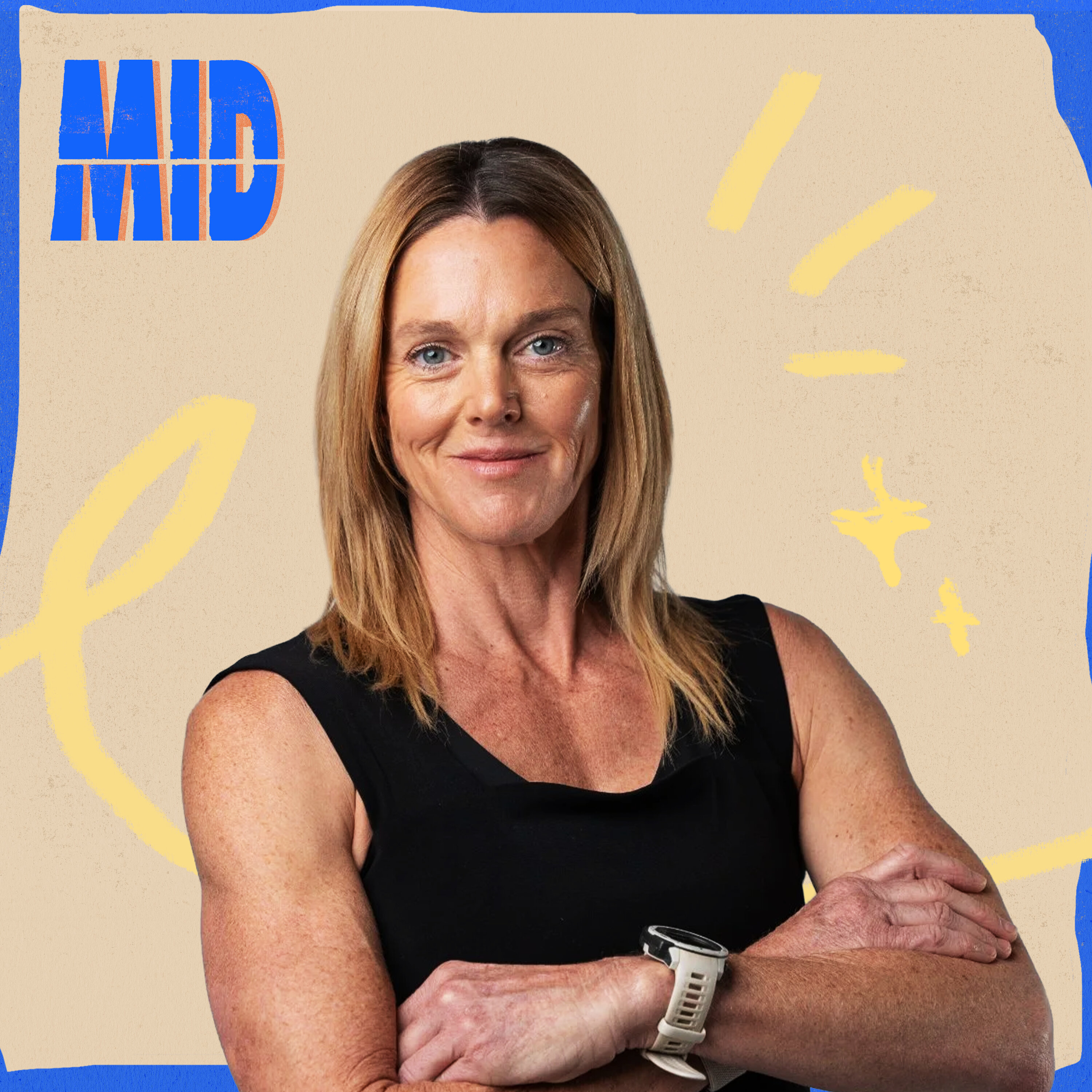
Dr Stacy Sims Knows What Gen X Should Be Eating, Lifting & Feeling
Episode Transcript
You're listening to Amma Mia podcast.
Speaker 2Mamma Mere acknowledges the traditional owners of land and waters that this podcast is recorded on.
I'm trying to find my way back to the gym.
Don't get me wrong, I know where it is.
I'm not lost wandering the streets hoping to stumble into a spin class somehow.
I'm just trying to put exercise back in my regular agenda, the one that includes work and dinner and washing and kid taxing and work and commuting and couple time in front of Netflix and work and dogwalks and sports, sideline cheerleading and work.
Exercise has been there before, Unlike almost everything that's hard but good.
Once I've found my sweet spot, I am always glad I did what seemed impossible to do comes to be impossible to miss.
But right now I'm trying to find my way back to the gym, this time for all the right reasons.
Not to whittle and shrink, to be tiny and height, not to berate and punish and pound, not to look hot and cute and snatched and cut in some expensive, tasteful oak colored active wear, which, let's face it, is particularly lucky, But no, because of what it will give grown up me to make a different kind of promise, to move you because I love you, to make you stronger, and because you matter, to give you some time so you can have more of it, and to make the time we have more meaningful.
I just have to find my way back to the gym.
Hello.
I'm Holly Wainwright and I am Mid Midlife, Midfamily, mid Squat.
I want you to meet someone, but first I want to welcome you back to Mid, your show for gen X women who are anything but This season, we are returning to our roots and giving you six carefully chosen cup filling, never boring conversations with grown up women who have particular wisdom to share.
I can't wait to tell you about the incredible lineup we've got few.
But first of all, I'm going to introduce you to our extraordinary guest on episode You might have already met her, actually, because the woman I'm talking to today is the definition of viral, or at least the first thing she eats every day has gone completely viral, and once the Internet cottoned onto that, they wanted to know what else she knows that we don't.
Doctor Stacy Simms is the favorite exercise expert of grown up women.
In twenty twenty five, you might have seen her or heard her on the Mel Robins podcast, and her appearance on that went viral, not least for the breakfast I talked to you about earlier.
But the main reason everybody loves doctor Stacy Simms is because she is actually an expert, not just someone who understands how algorithms work.
She's an exercise psychologist and a nutritional scientist.
She's a PhD.
And she's an author and a speaker, and she really knows her shit.
And also because this is her matra.
You deserve to feel healthy, vibrant and independent now and well into old age.
Did you hear that, my friends?
You deserve it.
And a whole lot of the exercise noise that can be so loud it actually pins you to the couch and confusion, Stacy Simms says it's bullshit.
Her expertise in female focused exercise and nutrition has made her formidable in her argument that a lot of what we've been told that we have to do to be fit, to live long, to be well was never advice meant for women.
Women are not small men, she says, when it comes to health doctrine and just shrinking and picking up advice and equipment meant for men does.
Speaker 1Not serve us like what you ask.
Speaker 2Well, we're going to get into that, but think ice Bath's fasting and slamming yourself with the kind of cardio that leaves you spent.
Stacy Simms is exactly who I needed to hear from as I tried to find my way back to the gym.
So here we go, and yes she is going to tell us about that viral breakfast.
Be patient, But before we get started, I need to make this clear.
The information discussed in this episode is not intended to replace professional medical advice.
Supplement, availability, safety, and regulation vary between countries, including Australia.
You always need to seek guidance from your GP or a pharmacist and ensure that any therapeutic goods are listed on the Australian Register of Therapeutic Goods before you go near them.
Welcome, Dr Simms?
Can I call you Dr Simms?
Shall I call you Stacy?
Oh?
Speaker 1Call me Stacy?
Speaker 2Please welcome Stacy.
Tell me when did you realize that no, in fact, women are not small men?
Ah?
Speaker 1Probably my second year of university.
Speaker 2Tell me about that.
Speaker 1Yeah, So a seed had been planted by my father right when I was getting ready to graduate from high school.
I grew up in a military family, and you know, the question always is you're going to university, what are you going to do?
What are you going to study?
And I told him that I didn't necessarily want to go to university, that I wanted to be a Navy seal or an army ranger.
And he's like, well, you can't.
And I was like, wellhy can't I?
And he said, because you're a girl.
And I was like what.
And this is the very first time that anything in that nature actually came to appointed conversation, like came out in the open that there are certain things you couldn't do because you were a woman.
So that seed was planted.
And then when I went to university and I was on the crew team and I was rowing, and I transferred into exercise physiology and metabolism and started realizing that all the things that we were learning there was no representation of women.
Textbook pictures were of men.
It was either him or they, it was never her.
If there was a conversation about female athletes as always a pathophysiological aspects of iron deficiency, the female athlete triad, but there was nothing that was representative of me or my teammates or any of the other hard working female athletes that I knew.
So the seed from my dad saying you can't do that because you're a woman into understanding metabolism and exercise physiology with no female representation really started pushing this idea in my head that wait a second, where's the state of coming from?
If people are saying that women shouldn't be in sport, if women shouldn't be successful in these kind of physical parameters to.
Speaker 2Be at university doing what you're doing, and to also be the kind of young woman who says to their dad, I want to be in Navy seal.
You obviously have always been very sporty, very disciplined, very competitive.
Is that fair to say?
Where does that come from?
Did you grow up that way?
And were you competing against boys and men up until that point?
Speaker 1And on par I think, well, I grew up in We are a very close family.
Ahead older sister, my older sister, I love her to death, but we're very opposite and we used to kind of compete with each other when I was growing up, But then I was more of a tomboy.
I was out building forts and jumping out of trees.
And a lot of my friends as a kid were boys, just because of the nature of growing up in a military family.
And then I was running cross country in high school and I was playing co ed soccer, and there wasn't any real determination that this is the boys and this is the girls.
It was like I trained with boys, I trained with girls.
Some of my good friends were guys.
Some of my best friends were girls, and we all did the same thing.
And yeah, competitive, competitive in academics, competitive in sport, And that was kind of like the drive and the question of why and trying to find answers.
So everything has always been this push to understand and asking the question why if I don't understand or try to find the answer.
So that kind of fed through to all of the things that is asking.
When I was going through university.
Speaker 2You talk a lot, and we're going to get to this obviously about the not small men and all kinds of reasons why women haven't been studied and embraced enough by that community.
But do you also think, and I wonder if you were a bit like this when you were young.
I certainly the age that I am.
We spent a lot of time going we are as good as the guys, We're just the same.
We can work as hard players hard.
Speaker 1Yep, party is hard like whatever it was right exactly.
Speaker 2And it feels like now there's a sea change, a little bit led by research like yours that's saying, no, we're not the same.
We need different things, but it's certainly not a less than worse than not as strong as we need to stop looking at it in that binary way.
Is that kind of what you came to when you began to explore this.
Speaker 1Yeah, And part of it also was if we are training according to male data, we're not reaching our potential.
So we don't actually know what is the limits for female physiology because it's never been pushed that way.
So as I was a high performing athlete and then I started working with Olympic caliber athletes and coaches, it's like, we actually don't know what the physicality limits are of female athletes because it's never been studied.
Everything that we apply right now even today through recovery metrics and certain training metrics and what we're looking at from heart rate variability and training stress is still based on male data and male algorithms.
So when I look at female athletes, I'm like, are you sure that we're training women appropriately to actually reach their potential?
And that's the common thread that's been going through everything, is like, are we treating women with the correct dosage of pharmaceuticals to actually improve their outcome from things like cancer or trying to prevent Alzheimer's and all these things that are coming out in popular media.
Because again, when we're looking at the research and now we're looking at AI, it's still through a patriarchal lens, and it's still through that male data.
So we still have a lot to do.
Speaker 2Yes, in the most layman's term, for those of us who aren't PhD you know, PhD level experts, why is that?
Like, so I've heard you speak and and other people speak about the fact that women have just not been studied enough in the right way for various reasons.
Can you explain to us why we're at this point where we're suddenly going, oh, we don't understand half the population on a deep physiological level.
Speaker 1Yeah, So I bring it actually to the pandemic to COVID to really enlighten what's going on, especially in the biomedical world.
We had the global representation of female athletes coming out and talking about the menstrual cycle before the pandemic, and then we started seeing things like ambient dosage still made women really drowsy and narcoleptic when they woke up the next day because the dosage was too high.
But when the pandemic hit and we started seeing sex differences and responses to the actual disease and virus, and we saw sex differences in the recovery and sex differences in the response to the different vaccines, then the whole medical community, because everyone was focused on the same exact thing, the whole medical community woke up and said, oh my gosh, you're right, there are sex differences.
We really have to dig in and figure it out.
So then as the pandemic dissipated, the world started getting back into its commonplace.
People went back to their research.
People went back to their practices and they're like, oh, okay, now we see when women are coming in and women stopped being as gasolt as they were before, and the research really started going, okay, well, now we really want to understand long COVID and we have to look the differences between men and women.
And then from that we started seeing differences in like TBI, which is traumatic brain injury because that's linked to the brain aspect and inflammation of COVID.
So there are a lot of positive repercussions that were coming out of the whole pandemic that made people sit up and go, oh, okay, you're right there are differences from xx XY.
We know that there are physiological differences from birth.
We know that the exposure of sex hormones creates a different environment for these bodies.
So we have to really start acknowledging that and seeing what we're doing in the research to be able to promote better outcomes.
Speaker 2And is it true that until this massive, as you say way cup point, women just hadn't been studied enough.
Is that true?
I think you've told a story about basically being almost kicked off as sort of yeah, a study group because you had a.
Speaker 1Menstrual cyclectly So that was just a teaching lab at university when you're trying to understand the you know, carbohydrate metabolism or the way your body uses carbohydrate when you're exercising.
And I was the only woman who volunteered in our teaching lab, and because my results weren't what was expected in a teaching lab, they were going to throw them out.
And I was like, why are you throwing them out?
And then because you're the anomaly, I was like, but I did everything right.
I did exactly what you told me to do.
I did the familiarization, I did the standardization.
I did everything that I was supposed to do.
And I know how to follow directions because my father was a colonel in the army, So yeah, what gives here?
And then it's the oh, minstrual cycle differences.
And that's another point of contention where I was told that women aren't often included in research because of minstrual cycle.
They are too complex or complicated, too complicated.
Yeah, And I was like, oh, wait a second.
And so then that was another feed forward to understanding that women were not represented in research.
And as you think about the history of research, both in medicine and sports science and just the whole biomedical field, it's who was in the room when research design started, right, and it was men.
And when we come down to funding and trying to facilitate research, it just perpetuated that men specially cis men were the default, and we're just going to study them and everyone else can benefit from it.
We just generalize it out, even rat models.
Right when you're thinking about rodent models, it was always the male rat r and that's changing.
Speaker 2That's how deep that goes.
Speaker 1Yeah, I have.
Speaker 2To get to some of the myth busting advice that you are famous for, right, and one of the things that I think blew a lot of women's minds when they heard you say this.
I mean, I'm sure you've said it lots of times, but particularly on Mel Robins's show, that you need to eat before women need to eat before exercise.
So very typical exercise routine.
I've certainly done this for many years.
Is I get up early and fitted in early because it's the only time in my day before working, kids and everything start.
I would never eat.
You blew everybody's mind by saying fasted exercise, which is the proper term for going to the gym before you've had breakfast, is not great for women.
And you also gave a now viral example of what you could eat before you go.
Tell us a bit about that.
Speaker 1Yeah, So I pull in the research really because of the whole fasted thing right, And when fasting started becoming in vogue, I was like, this doesn't make sense for women because we know that there are sex differences in appetite control, and we see that there are sex differences in the way that a part of your brain responds to low nutrition density, meaning that you don't have food on board before you stress it.
One of the specific things is geralin, which is one of your appetite hormones.
It's the one that makes you hungry, and at rast men and women are pretty similar.
But as soon as women start exercising without nutrition on board, that hormone goes up and it stays up post exercise, and as it stays up, it is being perceived by that area in the brain, the hypothalamus, that there's not enough nutrition.
So then what happens is you have what's called kispeptinurons that get down regulated, so that starts to create a conservation.
So it starts downturning all of your metabolic processes.
So your thyroid starts to go down, your incidental movement goes down, and you're craving for simple carbohydrate comes up as the day goes on because your brain is like, oh wait, everything's slowing down.
I need some food.
I'm in a starvation mode.
And it doesn't take long.
I mean after four days we see the implications.
So if you've done four days of long term fast or fasted training, then we see this implication.
Not only that, we see that women who do fast training end up hitting their lower baseline a lot faster, which means their body is like, oh, I need to conserve.
Whereas if you do fed training, meaning just a small amount of food before your exercise, that extends your keeps your metabolism elevated for a lot longer, and we see that you end up having more incidental movement throughout the day, so you fidget a bit more and you don't crave carbs.
So when you're talking to women and they're like, oh at three o'clock, I always am reaching for the caffeine and the chocolate.
I'm so hungry.
Say okay, well when did you have breakfast?
Speaker 2Oh?
Speaker 1Yeah, well I held my fast eleven I went to the gym this morning.
He's like, well, let's try eating before the gym or eating when you get up, and then let's see what happens at three o'clock and most women are so surprised to finally make that link that if I eat before I put my body under exercise stress, even if it's only ten to twenty minutes, then it feeds forward to better appetite control throughout the day and being able to make wiser choices.
For men, it doesn't work that way.
Speaker 2This is all feels very linked to this idea that women have always been, you know, eat less, eat less, eat less.
You know, and I've heard you say often know you need to be eating more more of the right things.
I mean right things.
That's the wrong language too, but to be eating well for fuel that often women are under eating and overtraining.
Speaker 1Absolutely yeah, And people don't realize it there because a lot of women say, I'm not hungry, and I first get up, And then when we're looking at that learned behavior of not feeling hungry in the morning, then you're not eating.
You go training and you're still not hungry because your appetite is a little bit muted from exercise, especially if it's intensity exercise, and then you're trying not to eat a lot because you've been conditioned not to eat a lot.
Then by the time you get to the end of the day, you're like, oh, I'm really hungry, so you start having snacks before dinner, maybe a glass of wine to help mute the appetite, and then you have dinner, and then a couple hours after dinner, you feel a little bit peckish, so you have something before bed.
So you've bookended your calories at the end of the day, but you still haven't eaten enough for when your body needs it.
So your brain thinks that you're in a starvation mode and it starts at conservation.
It also shifts your circadian rhythm.
And when we're talking about circadian rhythm, all of our hormones are related to different cellular responses to date and light and food and no food.
So if you aren't eating first thing when you get up and you're exercising, and then you're delaying food intake to eleven or twelve, you've effectively shifted your circadian rhythm.
So now your hormone pulses aren't going to be right.
You're going to see that your melatonin peak for sleep is off.
You don't get the right latonin peak at the right time, so your sleep is interrupted.
We already have problems when we're perimenopausal and into menopause because our sleep is interrupted.
Speaker 2We certainly do.
Speaker 1And if you aren't getting great sleep, then you're not going to have anybody composition change.
And we see this like, don't have great sleep, you try to restrict more, you try to train more, you eat less, and it's just as bad twenty four hour kind of repetition of the eighties.
Yes, like trying to fulfill this undercurrent from the eighties that if you don't eat, you're fantastic.
Speaker 2Right, You've said it so many times and that is a little recipe for it on your Instagram.
But you went viral with your protein coffee.
Yeah, you have to tell us very quickly, just because one of the reasons why I think women love this so much is the idea that it could be something small and easy that you sought out the night before.
Tell us what you eat before you train in the morning.
Speaker 1Well, I, you know, am a seventies baby, so I grew up in that whole era of not eating, and I don't ever really feel hungry to all about ten or eleven, but I know that I need food before training for sing in the morning, and I love coffee.
So I was like okay, Well, if I put protein and almond milk and have it as a late first thing in the morning, cold lat first thing in the morning, then I get my coffee caffeine boost as well as some nutrition.
And people would always ask me what do you have before training?
Am I protein coffee?
And then finally I was like, okay, this is how you make it double espresso.
You stir in protein powder into your cold almond milk poured in, and then put it in the fridge over night, and then when you wake up, boom, ready to go.
Speaker 2It's like a little pot of creamy, proteiny goodness.
Speaker 1It is.
Speaker 2Can I ask you if the women listening to this now, and as we've discussed, I mean, there are very different stages.
If there's one thing you want to leave them knowing about their body that would change everything for them, what would you like to tell them.
Speaker 1That the body is not an algorithm and it's an amazing feed of engineering.
And if we take care of it by listening intuitively and then applying different stresses when we need to, that we can completely reframe how we think and how we age.
What I mean by that is like, okay, we've been conditioned to do all these things, right, So if we take a pause and go, you know what, I'm going to do some strength training.
And it doesn't have to be heavy lifting, but I want to do some strength training because I want to reduce my cognitive decline risk.
I don't want to get Alzheimer's when I'm older.
I don't want to have a little bit of dementia when I get older.
And I know that if I do some strength training, not only is it going to improve the brain functionality, but it's also going to give me lean mass.
Okay, so that's one thing that I can do.
And when you start reading about the research with lean mass and the strength training and feeling better and better gut microbiome and better gut brain connection and you know, taking up space, it's a no brainer.
It's like, let's just add that extra twenty minutes, three four times a week and own that for myself, because if I don't show it for myself, then I can't show it for other people.
Speaker 2My conversation with doctor Stacy Simms continues after this little break, I wanted just to sort of bring home the consequences of this massive sort of women are not small men.
Revelation.
You say that it goes to things like the way we're marketed to so you know, make a wait a little bit smaller, make it pink, say it's for girls make up.
But yeah, like tell me a little bit about that, Like the implications of just treating us all as if we are small men in terms of we haven't got the right tools.
Speaker 1Yeah, I mean simple things like crash test dummies in cars.
They're not representative of female body.
So when we're thinking about the way seatbelts fit and how the actual cars is fitted around owned the body that's supposed to be driving it, it is a male body that has just been shrunk to be a five two or five three body.
Instead of actually looking at the anatomical differences of our hips, our shoulders are female length, all the different biomechanical differences and center of gravity differences, and the way that a female body will come forward in a crash.
That's one of the major implications is like how is a female body going to survive some of these crashes when they're all tested on male representation of bodies.
Then we think about like in the sports industry, and when I was developing sports products and saw that really everything out there, based on male data and then marketed to women is a shrink in pink.
Right, Make a protein bar smaller, add some soy, add some color to it, make it look very feminine, and call it a female bar.
Really, it's just a male bar that's shrunk.
None of that has changed.
You look at that.
Nothing that says it's female specific, especially in nutrition, is really female specific.
Most of the research has been done on supplements has been done on men.
There's very very few studies that have been done on women except for creatine and caffeine and protein.
So when we're looking everything that's out there, and that's one of the things with other longevity information that's coming out, it's all male centric.
So we don't actually know how this works for women.
Yet.
Speaker 2I've heard you talk about and we know that it's true that a lot of young women stop fall out of regular exercise around adolescence and puberty and menstrual cycle kicking in.
I have a fifteen year old daughter.
She is wildly sporty.
It's wonderful, love it.
She's competitive, she plays team sport.
But when she was before puberty, so in the late years of what we would call primary school, elementary school.
She loved cricket, for example, and she played at quite a high level, and she wanted to play on the co ed team because she thought the girls team wasn't that great, which is a whole all other kettle of fish, so she joined.
There wasn't a co ed team, so she basically joined the boys team.
But when she was on the boys team, a they weren't very welcoming to her.
No b She learned pretty quickly that at that age where people's bodies were changing quickly, they had her skills and their skills were quite different in terms of power, and she felt she basically dropped out.
She dropped out of that.
She doesn't play cricket anymore.
She plays other things happily.
But it's a common thing, right that girls when they do begin to realize their bodies are shifting, and they do have their eyes open to go, oh, there's a difference here, and the boys are like this about sport, and we're encouraged to be that about sport.
It means that we can often lose sight of this very important passion, right.
Speaker 1Yeah, absolutely, And again it's a lot of a lot of it is how we are looking at puberty for girls.
So my daughter's thirteen and we had to go to a high school open house last night and we went to this one class and the teacher was saying that there were only three girls in this and it was information and computer stuff, and he said the only reason is they battled it out.
And I asked this question with the eye of you know, these are It's part of the same thing that's happening with sport.
I was like, what are you doing to reduce the barrier of entry to this for.
Speaker 2Girls so they don't have to battle it?
Right?
Speaker 1Nothing, They're not doing anything.
The girls that are there were there because they are the only three girls in the class and they wanted to be representative for young girls coming in.
So I asked them.
I was like, what are you guys doing to reduce the barrier of entry to this?
And they said, we're just showing up and I was like, okay, but that doesn't necessarily encourage other girls to come in.
And it's the same thing with purity and sport.
It's like, what are we doing to reduce the barrier?
Nothing?
Because everything is still viewed through the boy is the model and the default out side of that if you don't match what's happening with the boy, then you're not good enough.
Whereas I'm taking it from we have to reteach what's happening here in puberty, right.
We have to look and explain that girls' bodies are changing because of reproduction, Like the body is changing to allow for uterusts to be housed properly, so our hips are widening.
The shoulder girdle widens to match the hips.
We see that girls' limbs grow faster than their core strength does, so they're ungangly.
We're having a change in our muscle fiber and our muscle fiber activity, so we lose the power and the strength.
But it's all temporary.
So if we bring it back to if we're educating the coaches and we're educating the parents, and we're also telling the girls that this is just a temporary decrease in power and performance, then we can change it up and do more functional movement so we can get them strong through their new by mechanics.
If we're looking at how are we squatting, how are we running?
How are we increasing our posterior or strength into a cutting motion for things like football, so that we don't get injured.
So we have to be a bit more specific.
It doesn't mean more complex, It doesn't mean more complicated.
It just means that we have to take away the whole this is how it's been done through the mail lens, through the male sport, and say you know what, Okay, we know that girls respawn differently.
We know that we have to have a positive sporting environment and we're not going to pick people out.
We're not going to make them do corner kicks by themselves.
We're going to have a double corner kick so the girls don't feel like they're being identified and singled out because they don't like that.
The boys respond to that, but the girls don't.
Speaker 2I want to get onto some of the wisdom that you have become very famous for.
It's amazing the impact that the conversations that you've had have had on a lot of women that I know in my world.
There are a lot of women who'll be listening today, Stacy right.
They will be across the board.
Some of them will be they'll be training every day.
Love it very invested in that some people will be.
We go to the gym twice a week.
That's what we can manage.
Some people will be and this is a little bit where I might at the minute, to be honest, on the brink of trying to jump back into some kind of regular exercise that we know is good for us, but you know how it can fall out of your routine.
Yeah.
Yeah, So there'll be a wide range people who love exercise, people who hate exercise.
Taking all that into account, what would you love women at a basic level, all of them to know about the power of exercise.
Speaker 1So I had this conversation with a couple of friends this morning where we're getting really frustrated with all the longevity and health span information that's coming out because they're looking at the one percent.
They're looking at let's use methylene blue, let's use all these supplements, let's biohack all of this.
But if we look and go, you know what, exercise does all of that, and it depends on the dosage and the mode and resistance training types that you might be doing.
But if we were to focus and bring the idea of exercise not being something you have to do, but something that your body responds to really well to improve your health span, then that is way more powerful than going after that one percent of all these little biohacks that the upper socioeconomic class is being pushed towards.
So exercise the reason why people don't like it.
It's uncomfortable.
Ye, exercise in itself is not comfortable, but that's because we have now become a society and it's global where everything is comfortable.
We sit in a climate controlled room, we have access to water and food whenever we want, and if we don't like plain water, then you can go buy something else.
You know, it's relatively cheap, and we're never uncomfortable.
So our bodies are not designed to be that way.
Our bodies are designed to be challenged and with challenge we adapt.
So, yes, exercise is uncomfortable, but after a few sessions you're like, eh, okay, I got this, and it's because your body's adapted.
So you want to change it up.
Because if we embrace the uncomfortable, or as a lot of my kid and her friends say, embrace the suck.
Embrace the suck, then it doesn't become so sucky.
It actually improves everything around you.
We have a kind of a reversal of the aging process.
When you're looking at the actual molecular aspects of aging and what we're trying to reverse.
You're adding exercise in does that?
Speaker 2Do you think that also for a lot of women, and I'm maybe particularly talking about my generational age of women, is we've associated some forms of exercise for a very long time with restriction and punishment, right, Like this is all about trying to whittle myself down to fit in a pair of genes, you know.
Speaker 1To look like Kate Moss from the nineties.
Speaker 2Right, And we've been told that over and over again for such a long time.
Be smaller, be skinnier.
Strength isn't that important?
What's important to hear is taking up as little space as possible.
So it's kind of hard for all that negative baggage not to come with it to exercise in gym work where really what you're saying is we need to shift our perspective to realizing all that it can give us.
Speaker 1Is that fair exactly?
To reframe it?
Yes, Because yeah, we grew up in the eighties and nineties, right with all the eat less calorie restriction.
Don't have this, don't have that fat burning classes.
You have to push through the pain.
You know, what's the expression, no pain, no gain, sweat sweat, and so it's been this very negative connotation to get to a point where you're not really happy because you've had to have all this restriction.
So I really like my friend Gabrielle Lyons She's always it's not about what we're losing, it's about what can we gain.
So if we want to gain health span, we want to gain energy.
We want to gain better sleep, we want to gain better community, we want to gain better relationships.
Then it comes down to building muscle and eating food and allowing our body to be flourishing with the proper tissue and mind body connections that we get when we do different types of exercise.
Speaker 2There's a lot there that I want to grab onto.
But can I just ask you about the words you just use health span?
So when you talk about health span, you mean, you know, as you've already mentioned a couple of times, it's this big focus at the minute on longevity.
But what most ordinary and inverted commas people seem to want from where I sit is they want to live better for longer.
Right, So is that what we're talking about when you use the term health span, like living in good health for as long as possible?
Speaker 1Exactly?
Because when we talk about longevity and you're seeing all the people that are putting stuff out there, they're like, oh, let's live to be one hundred and twenty.
Well, why would you want to live to be one hundred and twenty if you're not self sufficient?
Yes?
Right, And so when we talk about health spin we're talking about living out your natural life and your natural longevity, whatever that is from a genetic standpoint, but optimally like being independent, being able to carry your groceries, being able to drive yourself around, being able to go for a walk and not worry about potential falls, like being robust as you get older.
So you're getting older, but you're not aging.
Speaker 2My conversation with doctor Stacy Simms continues after this little break, So we're in this mindset shift as you're just saying, think of all the wonderful things that exercise can give us rather than the restrictions that we've kind of imposed on ourselves.
So I want to get to some of the things that you have, you know, your research areas that you have really opened up for women.
Now, so should women who are training at whatever levels?
And I mostly want to talk about relatively or ordinary women, but should women be training differently at different times in this cycle.
Speaker 1In their menstrual cycle or the life face.
Speaker 2Cycle in their menstrual cycle.
First, is that true?
Speaker 1Yeah, From a molecular standpoint, we see that your follicular face or day one is your first day of bleeding up to ovulation.
You have the opportunity to really push hard and regenerate muscle tissue and be more stress resilient because that's how the body is trying to be up to ovulation.
But the caveat is there are so many in ovulatory cycles nowaday that we can't really determine what phases you're in.
And we also see there's such variation individual variation in our ratios of estrogen and progesterone that's really hard to put a blank statement out.
Speaker 2So the apps on our phones that might be saying you are in your luteal phase or whatever they're saying that very is not really enough to be getting scientific with, no, not at all, So don't get too hung up about it.
That's that what you're saying exactly.
Speaker 1They're ret you're looking retrospectively, so they're sort of trying to predict from your own data, but they don't actually know so when we're looking at your minstrel cycle, the best thing to do is if you're using an app, then yeah, use that and take it with a grain of salt when they say that you're in your luteal phase, but really track how you're feeling, because over the course of three cycles, you're going to see your own individual pattern and instead of because we're so used to blaming ourselves for things, because that's how society has made women, blame yourself for everything and don't take ownership of your body changing because of hormones, but it's something you did.
So if we're looking at our patterns, it opens it up and say, like day eighteen or nineteen, you always feel super flat.
If you're not tracking, you don't know that.
So then you'll go to a fitness class you normally go to and go what is wrong with me?
What did I do?
When it's not what you did, it's your hormones are changing and on these particular days of your minstrual cycle, you always feel a bit flat.
So if you are able to track that, then you know that you're not going to try to go to a high intensity class on a day you don't feel optimal.
That you go the next day when you feel like you can push the top end of things, because then you're going to get a better training stress, you're going to feel better about yourself and your body is going to respond in kind.
But without tracking and understanding your own patterns, we always get into this blame factor and it's not beneficial.
So put the apps away with all the stuff they tell you because the language isn't appropriate either.
You see a lot of things like, oh, you shouldn't do this, and I get very frustrated with the language output because again it's through the mail lends.
Speaker 2Right, listen to yourself, that's what you're saying.
Tracking you'll yeah, yeah, And let's go into life.
So, women who are around my I'm just about menopausal.
Now I've been in Perry for a long time.
That's we much discussion of.
But women who are I would say thirty five plus are being very much told Now the cardio you've been doing forever, all of those spin classes, all that just run, run, run, it's time to switch it up.
I feel like that message has become quite mainstream, which is great, but can you explain a bit to us why and what that should look like?
Speaker 1Yeah?
So this The whole cardio thing is the hangover of how we grew up and on the messaging that we had of calories and calories out.
If you want to get smaller, you have to burn calories.
But when we're looking at what's actually happening with all of that, cardio is putting women, especially women who are perimenopausal, into what we call a moderate intensity zone.
So it's actually too easy to be hard enough to invoke change, and it's too hard to be easy to get all that low intensity recovery type work.
Because if you are continuously going to a boot camp or a spin class, and we've all been conditioned to not think that it's a good session unless we leave feeling all sweaty and completely demolished from the workout.
That's not what we want.
We want women to understand polarizing.
So if you know that you're going to do an interval session, then you go in there as fresh as you can so that you hit each interval at the right intensity and recover well from each of those intervals, so you actually benefit from those intervals, because if you go in sort of tired, then when you're trying to hit those intervals, you're not going to get the intensity that you need to invoke change.
So trying to reframe it for women to say, you know what, it's not going every day and trying to slam yourself.
It's being very specific at what days or when you want to hit it super hard.
So you go and you make that work for you.
Speaker 2So if I'm a busy woman in this kind of phase of life that we're talking about, and I have got probably maybe three available windows a week to move my body intentionally, so obviously apart from walking and you know, picking up your grocery, shopping, whatever, what would be a good example of what you should be doing with that time.
Speaker 1So if you only have three days, I tell women you want to put the basis of strength training down, like you want to use those three days as proper strength training, and you finish it with a sprint session or apply of session.
Because if you're looking at going in and having one hour in the gym itself and you're like, Okay, what am I going to do with my one hour?
You're going to take ten minutes of mobility, so you're really getting into the range of motion.
It's not about stretching to get muscle lengthening.
It's about getting in and opening up those joints for the right range of motion.
Then you do about twenty twenty five minutes of proper lifting.
It could just be a squat focused one day and then and an upper body push pull motion.
Then the second time you're in the gym.
Then after you finish that, you have twenty ish minutes left, so you can go and do some sprint intervals.
You can get on the assault bike and do thirty seconds as hard as possible and two minutes full recovery.
So then you're hitting all the things that you need to for health, improving health span, which is all your brain health and metabolic health and cardiovascular health, as well as being muscle centric where you're putting load on the muscle on the bone to preserve bone density and lean mass.
So that's an optimal session.
Speaker 2Why is it so important to be building muscle?
This is something that we're hearing so much at the minute about lifting.
Speaker 1Why there's two things.
Really, If we are lifting, then we are putting direct stress on the bone to maintain and build bone density.
Because we see that women around menopause and the five years after stand to lose up to ten per center of their bone mass if they are not doing anything right, and it's really important that we maintain our bone mass.
The other thing about lifting and building muscle is muscle is very metabolically active, so it works as a glucose sink.
So we see that women who are in perimenopause postmenopause are more insulin resistant, and we see one of the big factors that happens with menopause and why there's so much research on the public burden diseases after menopause, cardiovascular disease, metabolic syndrome, diabetes.
It's because of these inherent shifts.
If you are lifting and doing heavier resistance draining and building muscle, you are reducing your risk for developing diabetes because now you have more active muscle tissue that pulls glucose in.
You are reducing your cardiovascular risk factor because we see that the resistance training creates a vascular compliance that means your blood vessels and everything are working better.
You are able to have more heart control, so cardiovascular control.
So it's taking care of those two major risk factors as well as the bone dencity risk factor.
So it's not about I hate lifting, I'm gonna get bulky.
It's about what am I doing to reduce all my risk factors and to make myself really super strong so that I can live independently.
Speaker 2It must also I don't want to be shallow about this because as we're saying, we want to very much be linking this to our health.
But it must feel good to be physically physically strong, absolutely as you are.
I think Stacy, like, it must feel good to have your arms, Like I'm just gonna say it.
You must feel like you could take care of yourself, you could lift things you like.
It must feel great.
Speaker 1Well I kind of laugh about that, like everyone talks about my arms.
But that comes from like a long history of string training because I've been doing it since I was sixteen.
I was on the versy crew teams, a rower and swimming and all that kind of stuff.
I tried to lose it when I was bike racy and didn't really work very well.
But there is a genetic component and a long training history.
But when I can now rock into the gym, and it used to be i'd rock and no other women would be on the lifting platforms Now I might go, oh, I have to wait for squats what?
But it's so great fault.
It's your fault.
I know that's okay, But I love seeing how empowered women feel and how strong and confidence they feel.
Because if you have muscle, especially working on your posteral muscles, you're upright right, so you stand better, your shoulders are back, and you can breathe better, and you're taking up space whether or not you know it.
And so that confidence comes from better posture, and confidence comes from the ability to be strong.
And not only that, we're improving neuroplasticity, which improves all the components in the brain, which feeds forward to better confidence and better mental acuity.
Speaker 2Is it ever too late?
I wanted to ask you.
I've put you say that you wish that young women understood the importance of weight training and let go of these ideas about bulk and you know, whittle yourself down with cardio earlier.
But if you are and obviously I'm definitely not asking this for me, but if you're like fifty ish and you're listening all these messages for the first time, and I really have never lifted weights apart from the little pink ones in the pump class that you know I used to do.
Yeah, and the little pink ones, the little ones that are on the back of my exercise bike.
Is it ever too late?
And it also sounds quite intimidating when people say lift heavy.
You've got to do this carefully, right.
You can't just order yourself some kettlebells on the internet and start throwing them around your garage, can you?
No?
Speaker 1Not really one.
It's never never too late, never too late.
I've just been digging into a lot of the older postmenopausal research about high in density resistance training.
I'm bone health and lean mass, and they're taking seventy year old women who don't have a history of lifting and building them and phasing them into heavy resistance training with no ill effect.
So, like I said earlier, your body is wanting a challenge and is very adaptable regardless of what age you are.
It's just we have to be a bit more cognate and careful as we get older.
So I was helping a woman who's been out of it for a very long time, hasn't been lifting.
I think she might have used some of those same pink dumbbells along her life, but to give her the confidence to do lunges and pull ups and stuff, it's using resistance bands.
So you can tie a resistance band around a poll and put it around your waist and do lunges.
It gives you the confidence to do the lunge because it's taking a little bit of load off the knee, but you also have some resistance to push against, so your body is like, oh, okay, so there's a resistance.
So we can phase women into understanding what it means to lift and get strong, and you can get strong as you're phasing in.
We like to say it's your right and an earned right to lift heavy, and it's a journey to get there, and it might take a year, and that's fine because along the way you're developing robustness and your tendons, your ligaments, your muscles, your bones.
And then you start adding heavier load as you get stronger, and then all of a sudden you're like, oh my gosh, I can deadlift a one hundred kilos.
Speaker 2I love that.
Now that you spend a lot of your time having to talk to people like me, because you've become very famous for your research, when do you fit in your exercise?
You clearly have loved exercise and sport your whole life.
How do you make sure it's something you do every day?
Speaker 1I schedule wellness meeting for myself.
Speaker 2Do you right?
And do you usually do it first thing in the morning.
Speaker 1Yeah, I do because the days get super busy and I often have meetings that go up till ten o'clock at night.
So if I don't get it done first thing in the morning, then I don't have the energy I need to get through the day.
And so it's just become one of those things like I get up, I have what I need from my protein, coffee or whatever.
I go do anything from a thirty minute intensity session in my home gym because I only have time for that, or I'll go to a swim squad if it's summertime to get fit enough to swim in the ocean.
I do something, and so it's for my body, but mainly for my mental status.
Speaker 2A wellness meeting with yourself.
I love it.
Thank you so much, Stacey.
I really appreciate the time you've given us this morning.
It's been amazing.
Speaker 1You're a welcome Thanks for having me.
Speaker 2Friends.
Was that inspiring?
I found her very inspiring, And since we've had that conversation, I have started lifting weights to be proud of me.
My favorite parts well scheduling a wellness meeting with myself.
Love that idea not hacking.
I love that she thinks all the biohackers and the forever guys and nonsense.
And I love that she says it's never too late.
This was the first episode in this season seven of MID.
Over the next week, you're going to hear from extraordinary women on some topics we've touched on before in different ways, like grief and change, and some that we haven't, like travel and success.
And it's going to be excellent, So please like, follow, share, tell your friends, join in.
It's never going to be boring on MID.
The senior producer of Mid is Charlie Blackman, the group executive producer is Nama Brown, and we've had audio design and production from Tina Matterlove and I'll see you next week.