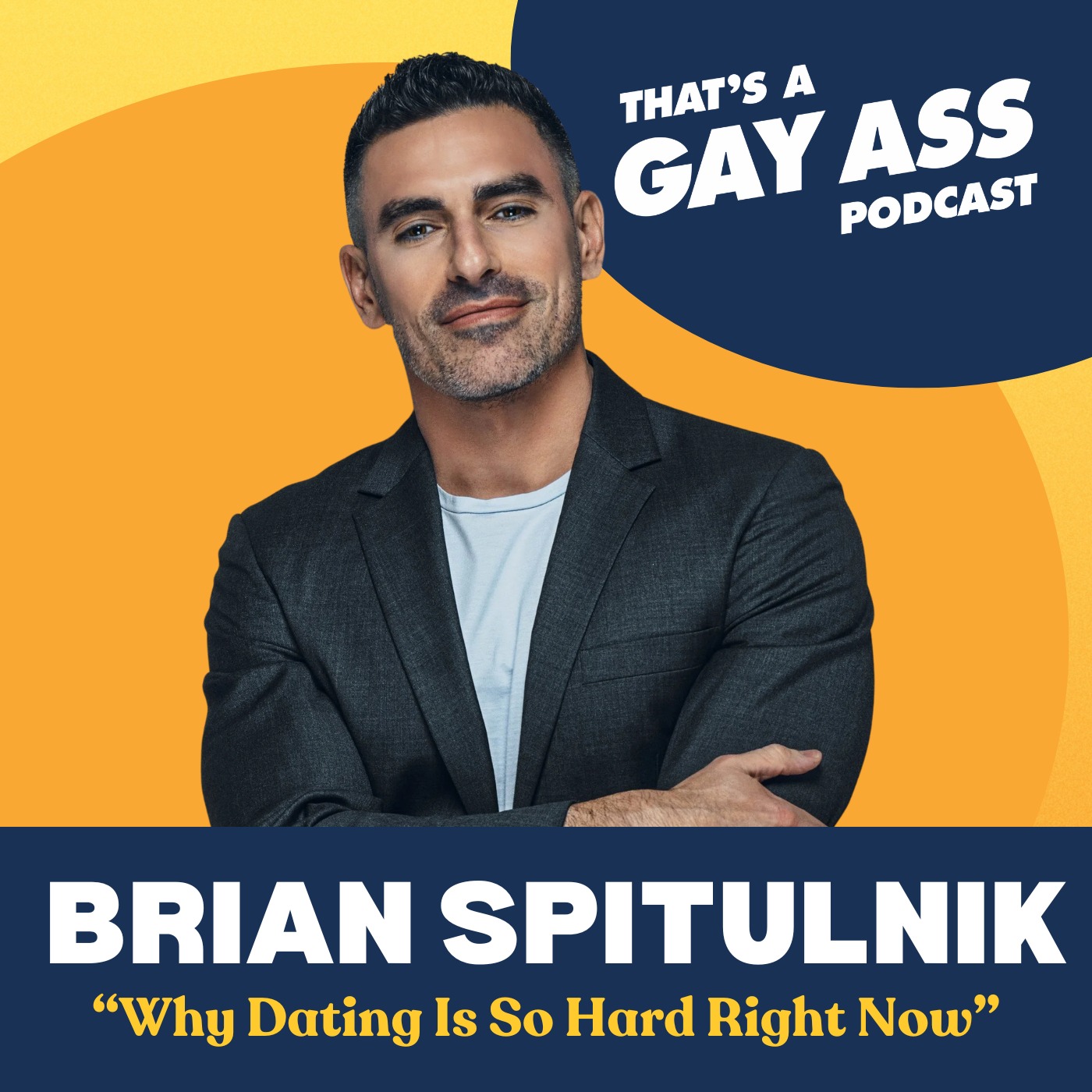
"Why Dating Is So Hard Right Now" w/ Therapist Brian Spitulnik
Episode Transcript
[SPEAKER_02]: Really, really gay podcast that we called that's a gay podcast.
[SPEAKER_02]: At the gay, at the name for a gay podcast.
[SPEAKER_02]: Welcome back to that's a gay ass podcast.
[SPEAKER_02]: The podcast that asks, whose fault is it that you're gay?
[SPEAKER_02]: It is me, Eric Williams, and this week I'm chatting with Brian Spatonic, a therapist who specializes in working with gay men, but he was also a Broadway dancer for 15 years.
[SPEAKER_02]: So you know, we had to talk about the theater of an oil, [SPEAKER_02]: and he does give me a lot of therapy, which ultimately does what, lead me to tears.
[SPEAKER_02]: We do have an extended conversation over on Substack where I ask some sex questions and body image stuff around the holidays, so please go watch that over at Substack.
[SPEAKER_02]: But for now, please enjoy this very therapy-filled, very gay ass combo with Brian Spatonic.
[SPEAKER_02]: Brian Spatonic, a therapist for gay men is on a gay ass podcast, Brian, are you ready to be absolutely dragged through the mud?
[SPEAKER_00]: Oh, always.
[SPEAKER_00]: Always there, kiss.
[SPEAKER_02]: Because as you know, this is a Gacha Journalism podcast and my first Gacha question is, are the rumors true?
[SPEAKER_02]: You have a bachelor's and fine arts from one of the most sought after institutions in the United States of America.
[SPEAKER_00]: Yes, it's true.
[SPEAKER_00]: I confess it's true.
[SPEAKER_02]: Tell the girls where you have a BFA from and in what major may whore.
[SPEAKER_00]: I graduated from the University of [SPEAKER_02]: And Brian, I don't know if you know this, but producer Nathaniel and I myself, Eric Williams, both got rejected from said program.
[SPEAKER_02]: Brian, do you think you're better than us?
[SPEAKER_00]: No, I really don't.
[SPEAKER_00]: A lot of people, I was just actually we had a conversation of very long.
[SPEAKER_00]: I had a gag with gaze at this house over the weekend.
[SPEAKER_00]: We had a long conversation about Josh Grobin.
[SPEAKER_00]: As you do, Josh Grobin was also rejected from the musical theater program at the University of Michigan.
[SPEAKER_00]: Just a few years before I was there.
[SPEAKER_02]: Okay, if I start crying, it's because not only does you miss bringing up instant tears?
[SPEAKER_02]: Well, not actually, but what does bring up instant tears is my first ever concert I went to was Josh Grobin.
[SPEAKER_02]: I was like, because I never went to concerts.
[SPEAKER_02]: I was like, you know, like this, like, [SPEAKER_02]: gay kid that didn't like Dave Matthews being like the rest of my brothers and then Josh Gropon came to St.
Louis, Missouri and my mother and I went to the hockey arena in which he played and I fucking listened to his sing his Italian arreos and I sat there comfortable.
[SPEAKER_02]: I didn't like to stand and Josh Gropon was like my girl but that makes me feel a lot better Brian thank you.
[SPEAKER_00]: I'm so glad.
[SPEAKER_00]: Yeah so I don't I don't think it's really a [SPEAKER_02]: And I agree.
[SPEAKER_02]: I mean, the proud part of the problem is I had a voice teacher who was like, Oh, yeah, I've had people get into you, Mitch, you're gonna get into you, Mitch, and then your life is set.
[SPEAKER_02]: And I was like, perfect.
[SPEAKER_02]: I can't wait.
[SPEAKER_02]: And then the audition was this scary thing I've ever done on my life.
[SPEAKER_00]: Talking, Terry, did you go, Michigan to do it?
[SPEAKER_02]: I did.
[SPEAKER_02]: I went.
[SPEAKER_02]: And you know what's funny is.
[SPEAKER_02]: Every college audition I had, the same ginger, not producer Nathaniel.
[SPEAKER_02]: The same ginger audition right before me.
[SPEAKER_02]: His name is Max Turnin, and he now just started the National Tour of Parade.
[SPEAKER_02]: He was then a class understudy on Broadway.
[SPEAKER_02]: He got it everywhere, and I was like, okay, yeah.
[SPEAKER_02]: He was, he's, he's been for this.
[SPEAKER_02]: And I did some musical theater for a little bit, but now I'm doing this.
[SPEAKER_02]: And I feel like this is my right path in life, but I love that you like pretty well.
[SPEAKER_02]: Yeah, I think so and it seems that you have also have a Broadway herstery and now you're doing amazing things and I want to talk about, of course, your life as a therapist for gay men because I myself am absolutely obsessed with therapy.
[SPEAKER_02]: It has been my saving grace since I really was in college and I'm still in it every darn week for you.
[SPEAKER_00]: I heard you say recently that you, that your best relationship is with a therapist.
[SPEAKER_02]: I mean, I would say so, I've had, I've been very lucky, Brian.
[SPEAKER_02]: I've had my first therapist out of college with Fran Goldfarb, I was with her for eight years, seven years, until she retired.
[SPEAKER_02]: And yeah, I just ended up ending a relationship with the therapist, just out of like pure like, this is a beautiful moment for us to like, it was four years, but listen, Brian, you're already turning the tables on me [SPEAKER_02]: No, see I'm obsessed with it because I fucking love talking to therapists, but before we talk about your therapy journey you were in a Broadway show for many years and I need to ask about the [SPEAKER_00]: 15 years.
[SPEAKER_00]: Yes, I did it for 15 years.
[SPEAKER_00]: No, I think that was the pandemic, which was two and a half years of not doing it, but yeah 15 years from time I was 24 and so I was 40.
[SPEAKER_02]: Okay, so wait, you booked a Broadway show at 24 years old and let me tell you at the time it felt like I had waited [SPEAKER_00]: forever.
[SPEAKER_00]: I thought I was failing.
[SPEAKER_00]: I thought it was never.
[SPEAKER_00]: I thought it was past my prime.
[SPEAKER_00]: Yeah, you know.
[SPEAKER_02]: But you because you had graduated college all two years prior.
[SPEAKER_00]: You know, I had friends who had graduated in Denver, I wish shows that fall, you know.
[SPEAKER_02]: So who did you graduate with that you were like so jealous over?
[SPEAKER_00]: Um, my very closest friend in college was Jenny Barber still one of my closest friends.
[SPEAKER_00]: You may not know her, but she's she's she's not probably right now in the people juice actually I came out of retirement to do beautiful juice on Broadway, which I think is so [SPEAKER_02]: Well, I'm sure you've probably had so many classmates who did the Broadway thing who have just like you pivoted to other careers, because Broadway is famously not only incredibly difficult, but Hard to sort of do forever in fact.
[SPEAKER_02]: It's one might say impossible hard.
[SPEAKER_00]: Well, I couldn't have done Chicago forever, I think.
[SPEAKER_00]: You know, there are a lot of people there still who were there before me.
[SPEAKER_00]: Well, there's one person there who [SPEAKER_00]: big shout out to Sharon Moore.
[SPEAKER_00]: She was the, do you know who she is?
[SPEAKER_00]: This one is she is the swing.
[SPEAKER_00]: So I was the male, I was one of the male swings.
[SPEAKER_00]: She was one of the female swings.
[SPEAKER_00]: She's older than I am, has been there longer and is still there and she's, you know, incredible.
[SPEAKER_00]: The point is I could really have died at Chicago.
[SPEAKER_00]: They probably would have fired me eventually, but I wanted to leave before they wanted me to leave.
[SPEAKER_00]: You know what I mean?
[SPEAKER_02]: Why would they have fired you?
[SPEAKER_00]: they do, they hire people when they just kind of feel like it's time.
[SPEAKER_00]: And I mean, there are a lot of reasons to and somebody's contract, but people who have been there for a long time, it's usually about age, you know, it's usually about like, okay, we've come to our national conclusion.
[SPEAKER_00]: And, you know, it's easier to be fired because you get that severance.
[SPEAKER_00]: And if you quit, you don't, you know.
[SPEAKER_02]: Oh, well, okay.
[SPEAKER_02]: We love severance.
[SPEAKER_02]: Um, we, but it's also what a brutal business.
[SPEAKER_02]: I mean, you imagine in any other job being told, hey, you're too old.
[SPEAKER_00]: Yeah.
[SPEAKER_00]: Hey, you're in the black contract.
[SPEAKER_00]: I mean, the kind of standard Broadway contract says, you know, they can fire you when you no longer look the way you did when they hired you.
[SPEAKER_00]: And as I mentioned, I started that gig when I was 24.
[SPEAKER_00]: I [SPEAKER_00]: So you can imagine by the time I was 40, I did not look the same.
[SPEAKER_00]: So I always have that awareness, just kind of hovering over me of any minute now.
[SPEAKER_00]: They're going to realize you don't look like you're 24 anymore.
[SPEAKER_02]: You know, girl, I'll talk about the like count down clock, talk about the like, yeah, approaching gun to your head.
[SPEAKER_02]: I think that it's a crazy crossover too with the queerness of it all because so much of your work with gay men and just people in general is the idea of like being told what our value is and being told like where we get our sense of self from and you're having a literal job telling you.
[SPEAKER_02]: You're generally your value is looking.
[SPEAKER_00]: a very specific way and we should talk about people really you really said it really well just because that is why I became a therapist because I've seen the men in my show who when they were fired completely lose themselves and there were a few men in particular who killed themselves after they were fired and it was obviously like you can't even say how horrifying and awful it was but it was I mean in my interpretation of that [SPEAKER_00]: my understanding of what that was was always who am I without this thing that has defined me and that that was you know that was always hanging over me as well.
[SPEAKER_02]: So I can only imagine I mean it's it's so hard in general to be an artist.
[SPEAKER_02]: It is so hard to be an artist on Broadway.
[SPEAKER_02]: It is so hard to be a queer person.
[SPEAKER_02]: I think.
[SPEAKER_02]: Period.
[SPEAKER_02]: And then, I mean, there must be some like second-hand trauma to of seeing those people get fired or leave the show, and then what have they end their lives or lose themselves.
[SPEAKER_02]: I mean, it is making a lot of sense while you decided to pivot, because that was one of my questions.
[SPEAKER_02]: Uh, but you know, I feel like I do want to get into those, but as a gay as podcast host, I think it would be against my religion not to ask you the famous gay as podcast question, which is Brian Spatonic.
[SPEAKER_02]: Who's fault?
[SPEAKER_02]: Is it that your gay?
[SPEAKER_02]: Who do we blame even, babe?
[SPEAKER_00]: There is so many answers to this question.
[SPEAKER_00]: I have been, I've been just racking my brains.
[SPEAKER_00]: I mean, the real, the real answer, it's my dad's fault.
[SPEAKER_00]: It's my dad's fault.
[SPEAKER_00]: My dad is not a gay man.
[SPEAKER_00]: He's a, he's a, he's a straight man.
[SPEAKER_00]: And my parents are still married.
[SPEAKER_00]: And my dad is a lover of musical theater and art and culture and music and dance.
[SPEAKER_00]: Oh, yeah, he's, he's one of the good ones.
[SPEAKER_00]: And he was raised that way, [SPEAKER_00]: You know, little boys were not supposed to like art and culture, but his mom would drive him to the other town, you know, I don't know, three, three towns over to take ballet class when he was a little kid.
[SPEAKER_00]: He stopped that eventually because it was too difficult, but, you know, he majored in Obo at Oberlin Conservatory.
[SPEAKER_00]: He then became a social worker and then he became a lawyer.
[SPEAKER_00]: But the point is the reason it's his fault is because he was also a part of the community theater in Potomac where I grew up in Maryland.
[SPEAKER_00]: And he would take us to, well, Potomac, I'm sorry, I watched Bravo.
[SPEAKER_02]: How can I not have it, I don't know.
[SPEAKER_00]: I've never watched it, but I'm told it's not the Potomac that I grew up in.
[SPEAKER_00]: That's, that's what I've been told.
[SPEAKER_02]: You're not a wealthy black woman.
[SPEAKER_02]: No, no, no, I'm sure there are differences.
[SPEAKER_02]: Well, yeah, no, Potomac just kind of pings for me, but community theater, you're fun.
[SPEAKER_00]: Yeah, did they show the community theater?
[SPEAKER_02]: Yeah, there's actually a huge plot line about who's going to be cast as Ado Annie.
[SPEAKER_00]: Stand in the garbage.
[SPEAKER_00]: Anyway, so my dad, because my mom wasn't was working always.
[SPEAKER_00]: And I [SPEAKER_00]: They both worked so unites when my mom wasn't home and my dad had rehearsals He would take me and my two siblings to rehearsal with him So there he was, you know rehearsing the ensemble of pajama game and my siblings and I were like learning the choreography along with them, you know And I will the girl who sang steam heat She could belt she could kick her face.
[SPEAKER_00]: You know, I thought she was 104.
[SPEAKER_00]: She was probably 25 [SPEAKER_00]: I was obsessed with her and I wanted to be her.
[SPEAKER_00]: And that woman was Betty Buckley.
[SPEAKER_00]: What if it would be more accurate like that woman was Karen Ziemba, you know what I mean?
[SPEAKER_02]: And that woman was Karen Ziemba and that woman.
[SPEAKER_02]: I mean we could just start naming everybody.
[SPEAKER_02]: Angie Shore.
[SPEAKER_00]: Oh, well forgot about it.
[SPEAKER_00]: Actually yes.
[SPEAKER_00]: It was Angie Shore.
[SPEAKER_00]: Yes.
[SPEAKER_00]: Exactly right.
[SPEAKER_02]: I have to say that you are hitting on something really important, which is that the power of theater over a young gay boy, because I would say that I can blame the same thing, which was my older brother playing in the pit of once upon a mattress.
[SPEAKER_02]: Okay, and at the high school when I was in sixth grade and I went and saw it and I was like not only is this a Broadway production These people are also 48.
[SPEAKER_02]: They're 16 and I was like, I need to be up there and Ultimately need to be a grown came in eventually, but that sort of came later, but I love that you have you have the theater [SPEAKER_00]: in your literal de-all reasons that we love theater are all the reasons that it's hard to be gay you know it's it's larger than life and it's not quite real and it's [SPEAKER_00]: not societally acceptable really you know that is where we belong that's that's the group that we live in and so of course of course I was drawn to theater of course that was what was your um before you get into you miss before you moved to New York in book Chicago your in high school brides patonic plays what roles and what role did you absolutely devour [SPEAKER_00]: I wore the Ben Verine jazz pants.
[SPEAKER_00]: It was, it was my peak, honestly.
[SPEAKER_00]: Chicago was not my peak.
[SPEAKER_00]: That was my peak.
[SPEAKER_00]: And I kind of felt that at the time.
[SPEAKER_00]: Because I was never going to be a leading man.
[SPEAKER_00]: I was always a dancer.
[SPEAKER_00]: First, that was my thing.
[SPEAKER_02]: I mean, like, this is a sort of sitting across me now.
[SPEAKER_02]: I can see leading man, but you know about them.
[SPEAKER_02]: You're, you're, you're.
[SPEAKER_00]: No, I never.
[SPEAKER_00]: You live for it.
[SPEAKER_00]: No, my voice was never going to do that.
[SPEAKER_00]: Um, it was, it's loud.
[SPEAKER_00]: Um, I, you know, I can be heard at the back of the house.
[SPEAKER_00]: Sure.
[SPEAKER_00]: Um, but it's not pretty.
[SPEAKER_00]: So it's just never where I was going.
[SPEAKER_02]: Wait, can I say something that is really pretty about you, Brian, that it's important is that you have a really great nose.
[SPEAKER_02]: And I've been noticing it in your videos.
[SPEAKER_02]: And I just needed to take a moment to let you know that the, the shnalls is shnalls them.
[SPEAKER_00]: Thank you.
[SPEAKER_00]: Thank you.
[SPEAKER_00]: I'm so glad I didn't change [SPEAKER_02]: No, really, which one, which one did you want more nose or name?
[SPEAKER_02]: And what's wrong with your, what's wrong?
[SPEAKER_02]: Oh, you're not.
[SPEAKER_02]: I mean, listen, I girl, I have this show that I will plug now.
[SPEAKER_02]: I'm doing it in New York at Joe's pub, March 20th.
[SPEAKER_02]: And a few in doing it, Chicago, Seattle, San Francisco.
[SPEAKER_02]: And I have a whole part of the show about my nose.
[SPEAKER_02]: Because I had, I broke it twice.
[SPEAKER_01]: Oh.
[SPEAKER_02]: I did get the job done in high school.
[SPEAKER_02]: and I'm carried a lot of, a lot of shame about it.
[SPEAKER_02]: But like, I also I was made fun of for having a big one.
[SPEAKER_02]: No, it was not supposed to be a Jew.
[SPEAKER_02]: There's a very, you know, start off on the nose stereotype.
[SPEAKER_02]: And so I, when I see my sawing or shanaz on in profile, I was like, damn, great nose.
[SPEAKER_02]: And how nice to be able to appreciate a good nose in a man.
[SPEAKER_02]: You know, thank you.
[SPEAKER_00]: I really appreciate that.
[SPEAKER_00]: anticipating a lot of anti-Semitism as a course boy because like how many Jewish course boys do you know there's not a lot of us you know a lot of Jewish producers you know a lot of Jewish songwriters but not a lot of they're not a cast in the own and the ensemble they're not they're not well they just aren't a lot of dancers like you're not like what Jewish mother is like my son you know it's not it's not it's not what my son will be able to kick his own like [SPEAKER_00]: My parents luckily are like that, but um, but yeah, that's why I wanted to change my name to something nice and go ahead Just you know, I know what is other I played with like taking my dad's middle name Which is Allen so would be Brian Allen, but like that's and I said that oh my friend Jenny Barbara again I said you know in our senior year.
[SPEAKER_00]: I was like I think about a name change my name to Brian Allen And she goes [SPEAKER_00]: Who's that?
[SPEAKER_00]: And I was like, me and she's like, that's not, that's like, okay, it's not me.
[SPEAKER_02]: It's Brian's batonic bit.
[SPEAKER_00]: You say that's so beautifully saying thank you so much.
[SPEAKER_02]: Thank you.
[SPEAKER_02]: It will rolls off the tongue.
[SPEAKER_02]: I mean, Brian's batonic.
[SPEAKER_02]: Ooh, ooh, ooh, ooh, ooh, ooh.
[SPEAKER_02]: You were meant, though, you were meant for a life of staying true to yourself, but also helping so many others because really, I, [SPEAKER_02]: ask you to be on the pod because not only do I love therapy, but I also love how specific, how specifically you help our community.
[SPEAKER_02]: And I think that there are so many parts about being gay, a gay man, a queer person that we sort of know in our psychies as like, [SPEAKER_02]: obstacles, but we don't actually dive into them and you say it very succinctly and well.
[SPEAKER_02]: So I have a lot of questions about those topics about sort of the obstacles we face as gay men, but before I do that, what was the experience for you becoming a therapist?
[SPEAKER_02]: How long did it take for me finding out that Chicago was in fact not going to be reopening during the pandemic because no Broadway shows were?
[SPEAKER_02]: How long did it take you to go from like, oh fuck, I'm out of a job to [SPEAKER_00]: it actually started before the pandemic.
[SPEAKER_00]: I haven't, the truth is I had, I had been trying to get out of Chicago since like two years after I started.
[SPEAKER_00]: I was auditioning for the first two years, you know, and just assuming I was start booking Broadway show after Broadway show, and that didn't happen.
[SPEAKER_00]: And the things that I was booking were not [SPEAKER_00]: um not a dream come true.
[SPEAKER_00]: I booked this a movie called The Big Game Musical and I did that movie and on set I started studying to take my graduate exam, the entrance exams because I was like I can't this can't be where I'm going, this can't be it.
[SPEAKER_00]: So um [SPEAKER_00]: So the long story that is I was really trying to get out for a long time, and then finally when Jeff Leffa holds died when he killed himself in 2018, I took a leave of absence and injury.
[SPEAKER_00]: So I took a long leave of absence a whole year.
[SPEAKER_00]: And I was like, okay, I'm really going to do it now.
[SPEAKER_00]: I'm really going to find something else that I can do with my life because that was terrifying.
[SPEAKER_00]: And I can't, you know, I can't just sit there and wait for my life to be over.
[SPEAKER_00]: So I went to LA with my then boyfriend and we like took some meetings, you know, like we were trying to write and produce and [SPEAKER_00]: That was demoralizing, came back and I started therapy for the first time.
[SPEAKER_00]: I had never been in therapy really.
[SPEAKER_00]: So I started therapy in my therapist wrote biographies and he was, you know, a psychologist in the 60s, but he, like, on the side published like biographies of political figures that were real books and really well received.
[SPEAKER_00]: So that's when it started.
[SPEAKER_00]: So that was, I started applying for graduate programs for therapy in, or for social work in the fall 2019.
[SPEAKER_00]: And then I got in in the spring of 2020.
[SPEAKER_00]: And it just all happened.
[SPEAKER_00]: I had a lot of time in my hands.
[SPEAKER_00]: Wow.
[SPEAKER_02]: So that was Ryan.
[SPEAKER_02]: Yeah.
[SPEAKER_02]: You did two things there.
[SPEAKER_02]: You like listen to your gut.
[SPEAKER_02]: And then you also let the universe guide the way.
[SPEAKER_00]: And that's sort of, well, my gut sounded a lot like terror.
[SPEAKER_00]: You know, I, I, I have not always been awesome at knowing the difference between the two things.
[SPEAKER_00]: I've not always known what is fear and what is, you know, gut self-talking.
[SPEAKER_02]: Just speaking my language, that's exactly my same cross, my Jewish cross to bear is learning how to hear what is my actual gut saying versus what is my survival sort of like screaming sound [SPEAKER_02]: But I think what also is so relatable is like you were on the set of my what the my big game musical is I was called the big game musical So sorry the Number one big game musical and you were like [SPEAKER_02]: There's gotta be more to life, Stacey Orico set up us and I had that feeling during the National Tour of the Grinch musical when I was wearing a fat pouch as a costume and truly thought to myself this can't be like this is the dream.
[SPEAKER_02]: The in quotation marks dream right so many people audition for this and I'm being paid this and Did you know [SPEAKER_02]: I'm not going to get into the whole thing, but it truly was 2014.
[SPEAKER_02]: I did Elf the Musical as Buddy the Elf on tour, and that was the dream.
[SPEAKER_02]: I had the most fun, I had had the most fun I'd ever had in my life until that point, and then the next year they decided not to cast me because even though I did every performance I had, what I thought was maybe like a concussion before a show.
[SPEAKER_02]: What really was, it was a panic attack, but I had hit my head.
[SPEAKER_02]: And I was starting to be like, what if I pass out on stage and the producers of the show had been in the audience that night?
[SPEAKER_02]: And they had heard that I was struggling right before the show.
[SPEAKER_02]: And I did the show and I fucking killed it, but the next year they told me they didn't want that to happen again and they were not going to have me go out on the road again.
[SPEAKER_02]: And I was devastated.
[SPEAKER_02]: And I was a still auditioning and I booked the Grinch tour as like the understudy of one of the leaves in the ensemble.
[SPEAKER_02]: And I was just like, [SPEAKER_02]: What the fuck what is going on and I ended up doing alpha again three years later as like a fuck you to them It's approved to myself that I could do it again and I had a much better time like a motionally doing it the second year I had already decided I wasn't doing musical theater anymore, so it's sort of like a this is my like yeah This is my doing it for myself enough for them and then within a two years after that [SPEAKER_02]: I started a plan this podcast, and then my life sort of dramatically changed, so I know the plight of being somewhere that really you just know in your bones, it does not align with where you want to be.
[SPEAKER_00]: What happened to you to the anxiety to the panic attacks?
[SPEAKER_02]: Um, you know, it's a good question.
[SPEAKER_02]: I, two things happen is that I got on Lexa Pro and I also dealt with the very real panic attack feeling in therapy and the woman I just stopped working with really helped me understand whose voices I was hearing and the physical sensations and [SPEAKER_02]: The first, you know, speaking of that solo show, the reason why it's a big deal, emotionally, that I'm doing it on tour, is because the first live show I did, I had panic attacks.
[SPEAKER_02]: I had like, my body was like, you're not safe, do not do this, do not do this.
[SPEAKER_02]: And after the first time I did it, I said to my husband in the car right after because the show went really well.
[SPEAKER_02]: And I said, I said, Matt, the molecules of my body are changing.
[SPEAKER_02]: Wow.
[SPEAKER_02]: Yeah, and I was like my bot like I didn't die and it actually felt like like this is what I meant to be doing like this is it and And that is what was what I needed and so I still feel the fear very deeply.
[SPEAKER_02]: I still feel the fear very deeply.
[SPEAKER_00]: Yeah, because you know that that You know, I work a lot in parts, you know, I have as internal family systems and like that part of you that [SPEAKER_00]: It doesn't feel safe.
[SPEAKER_00]: It's never going away.
[SPEAKER_00]: But you can teach that.
[SPEAKER_00]: You can teach that old dog mute tricks.
[SPEAKER_00]: You know, you can teach the other molecules to kind of have safety in places that never felt safe before.
[SPEAKER_02]: That's what I've been trying to do is figuring out the ways that when I feel deeply unsafe, what are ways to remind that part of my brain like, hey, the feeling is going to continue to be there.
[SPEAKER_02]: But the reality is that it's okay.
[SPEAKER_02]: And that's why I'm continuing to put the stuff out there that really makes me scared shitless.
[SPEAKER_02]: It's because I know that there's another side of it.
[SPEAKER_02]: I know [SPEAKER_02]: touching my body, like, oh, yeah, I'm still here.
[SPEAKER_02]: I'm still here.
[SPEAKER_02]: You know, like, I, but it's, it's a constant, it's a constant struggle for me.
[SPEAKER_02]: It's very much my own survival thing from growing up in a Missouri and growing up with like parents who love me so deeply, but wanted me to be safe by not putting myself out there in many ways.
[SPEAKER_02]: Uh, and I, uh, [SPEAKER_02]: It's interesting.
[SPEAKER_00]: I mean, there's a reason that I'm able to speak so specifically to these fears is because they're so common to, now we do not have a monopoly on this kind of anxiety and fear and desire for safety, but gay men have it very specifically.
[SPEAKER_00]: Even men who grew up in very liberal [SPEAKER_00]: The year 2000, you know, in like, you know, our Gen Z and all these things and things are different now, they're not that different.
[SPEAKER_00]: They're still living in a homophobic and hom heterosexuals world.
[SPEAKER_00]: And so they are not safe in certain places.
[SPEAKER_00]: And that lives in your body how could it not.
[SPEAKER_00]: So the thing that you're talking about about learning to be able to tell those parts of you that didn't get to grow up.
[SPEAKER_00]: that you grew up actually you the self of you grew up and you are safe now and you can take care of them that's that's the whole bargain that's the whole thing [SPEAKER_02]: This is why I love the rapist brand.
[SPEAKER_02]: You're making me cry.
[SPEAKER_02]: It's just like I like really, um, I really, uh, still agree for the child and me that like just like like did not feel safe.
[SPEAKER_02]: You know, like did not feel, um, [SPEAKER_02]: like okay to just express myself in this really that's like the hard thing that I that I have sometimes had I guess anger about maybe is like um is like you know God why why did it have to be that way like why why do I have to feel such alarm bells in my head now when what I'm really doing is like putting out [SPEAKER_02]: A comedy show or a podcast or just like what like why does it have to feel but it's you know It's we can't control we can't control what happened.
[SPEAKER_00]: We can't control yeah, you know the world around us, but what would it be like For that little boy to see you now like can he see what you're doing you know like what is he thinking about what you're doing at Joe's pub in these podcasts [SPEAKER_02]: Yeah, how did he come out?
[SPEAKER_02]: I haven't even really.
[SPEAKER_02]: Yeah, I mean, it's very like drag race when they show the photo of the young version of himself and I should say well, what do you want to tell little Brian?
[SPEAKER_02]: Let me put it on you though, Brian.
[SPEAKER_02]: What would what do you think the young version of you would think about what you're doing now?
[SPEAKER_00]: The young version of me would have been so Happy that I danced on Broadway just period even if I'd done it for a minute and a half.
[SPEAKER_00]: He would have been so stoked [SPEAKER_00]: Um, I think he'd be like, they're a best.
[SPEAKER_00]: Okay.
[SPEAKER_00]: Tell me more.
[SPEAKER_00]: Yeah.
[SPEAKER_00]: Go on.
[SPEAKER_00]: What's good about that?
[SPEAKER_00]: Um, but I think he would have understood.
[SPEAKER_00]: Why, you know, I always, I always.
[SPEAKER_00]: Even though I was so narrowly focused on making my way to Broadway, my whole childhood into early adulthood, I also had a lot of parts of me that were like kind of scrambling to make backup plans.
[SPEAKER_00]: You know, I never quite trusted that I could do it, there were parts of me that didn't want to do it.
[SPEAKER_00]: So I think at any age that it was, [SPEAKER_00]: That kid would have been not too surprised and happy that I was doing something that was meaningful to me, I think.
[SPEAKER_02]: I think in the entertainment industry, it's just full of landmines emotionally.
[SPEAKER_02]: And I think that allowing yourself to pivot is one of the most important things to do.
[SPEAKER_02]: And I think that you booking Broadway, just like so many people book it and then realize that, wait, this is it.
[SPEAKER_02]: And not like that, it's like bad, but it's just like, oh, it maybe didn't feel as much as like I have arrived as I thought it would.
[SPEAKER_02]: And so allowing yourself.
[SPEAKER_02]: I didn't book Broadway, but like, booking the Elf Tour, I was like, oh, it's not exactly how I envisioned, like, my life is certainly not easy.
[SPEAKER_00]: Right.
[SPEAKER_00]: After doing it.
[SPEAKER_00]: Right.
[SPEAKER_00]: And there may have been, you know, the version of you who existed at 14 and 15 years old may have been totally happy doing elf all of those years with with no complaints.
[SPEAKER_00]: You know, that's that's that is what happens when we train to do something from the time we're forward to the time we're you know in our 20s what we want changes and what we think is fun changes and especially when you take in something that was your fun for me there was that was my fun dancing and being in a show and then you make it your profession and there are things that are not fun about work you know and so it so you had to you had to grow up [SPEAKER_02]: Well, yeah, and also work as work is work.
[SPEAKER_02]: And so it's like, it's like, everyone hates their job at 1.0.
[SPEAKER_02]: It's like, whatever it is.
[SPEAKER_02]: But I do want to take this opportunity to get into some of those topics that you touch on, sure in your videos online that are so well done.
[SPEAKER_02]: But of course, in your work with clients, [SPEAKER_02]: One question about working with clients that I have as someone who loves therapy, how much are clients asking you about your life as a gay man?
[SPEAKER_02]: Because you're relating so much of our experiences, I don't ask my therapist very much about their lives.
[SPEAKER_02]: I have a gay therapist that is our couple's therapist, I will sometimes, we will sometimes see him both individually and I'm kind of obsessed with him, but out of respect and the [SPEAKER_02]: Stick, I don't know too much about him besides he has a partner.
[SPEAKER_02]: He's sometimes in Palm Springs, and that's all I got.
[SPEAKER_02]: Yeah.
[SPEAKER_02]: How much do you reveal about yourself to your patients and how much are you being like, I can't tell you that?
[SPEAKER_00]: Oh, well, it is both, you know, it's I will tell, I will tell clients.
[SPEAKER_00]: something personal if it's helpful, if I think it might be helpful to them.
[SPEAKER_00]: And then after I say it, I will usually ask, is that helpful?
[SPEAKER_00]: And sometimes they'll be like, not really, you know, not really great.
[SPEAKER_00]: That's as far as we need to go with that.
[SPEAKER_00]: But it's not usually that helpful.
[SPEAKER_00]: You know, the reason that there's that boundary there of, um, [SPEAKER_00]: There's the boundary of clinical distance so that you as the client can put whatever it is that you need to work through onto the therapist.
[SPEAKER_00]: You know, that's why traditionally, like you would know nothing about me.
[SPEAKER_00]: You wouldn't know that I had a partner.
[SPEAKER_00]: You wouldn't know that I went to Palm Springs, like all those things.
[SPEAKER_00]: because it's more important that like if you have shit to work out with your dad, that you can just put that on me and we can work it through.
[SPEAKER_00]: That's a very traditional psychoanalytic model and I don't work in that model.
[SPEAKER_00]: So I will, it depends on the client.
[SPEAKER_00]: Some clients really need to be joined in that moment.
[SPEAKER_00]: You know, they really need to know that I understand what they're talking about because I've lived it.
[SPEAKER_00]: For most of them, it's enough to know that like they don't have to explain [SPEAKER_00]: what the underwear party is.
[SPEAKER_00]: They don't have to explain sniffies to me.
[SPEAKER_00]: You know, like that means a huge amount.
[SPEAKER_00]: Most of the clients that I work with who have worked with straight therapist period, they're just, it's not that the therapist weren't good, they were great.
[SPEAKER_00]: And now they just want somebody who understands this part of who they are.
[SPEAKER_00]: And I think that's great.
[SPEAKER_00]: Where [SPEAKER_00]: where it gets interesting is, you know, there are clients who, like, overpried, we can in New York, they'll start telling me about what they're doing for the weekend.
[SPEAKER_00]: And I'll sometimes be like, oh, I'm going to be there too.
[SPEAKER_00]: So here's what happens if we run into each other in that in that context.
[SPEAKER_00]: You can always come up and say, hi, I'm always happy to say, hello, you can introduce me to who you are with, you don't have to, you can tell people who I am, you don't have to.
[SPEAKER_00]: I will not introduce you to who I'm with but like that is up to you.
[SPEAKER_00]: I will take your cue and that's an interesting thing to navigate the kind of ethical rule around that is that if I if you're my client Eric and I see you at planning battles on the Saturday night I'm supposed to leave like I'm supposed to not engage and just leave the space and when because I'm a gay man working with [SPEAKER_00]: It's going to happen and I'm not sure.
[SPEAKER_02]: You would leave every bar because of our students you know, at my end, you'll go to fucking some restaurant and be like, fuck, I just ordered the on track.
[SPEAKER_02]: Right.
[SPEAKER_00]: What's really nice.
[SPEAKER_00]: What's happening now because of doing this stuff online is that guys are coming up to me at the gym and at bars and at restaurants and everything.
[SPEAKER_00]: And I get to talk to them, you know, and they're not my clients, you know?
[SPEAKER_00]: So that is really nice because I feel like I get to be a person [SPEAKER_02]: Um, and I can't introduce them to who I'm with if that feels right is anybody inappropriately Floating with you because you are not only a gay man, but you're a hot gay man.
[SPEAKER_00]: Hmm.
[SPEAKER_00]: Thank you Eric Nobody does I think because I don't know why they don't but my my take on has just been that [SPEAKER_00]: Like, I'm not doing therapy with my short off, you know what I mean?
[SPEAKER_00]: Like, I'm not posting thirst traps.
[SPEAKER_00]: Like, it's very clear why I'm doing what I'm doing.
[SPEAKER_00]: And something about that boundary seems to have been communicated clearly.
[SPEAKER_02]: I'm happy for you.
[SPEAKER_02]: I mean, I mean, happy for all of us because it, again, it just...
[SPEAKER_02]: It's the, we, we contain so many multitudes.
[SPEAKER_00]: You know, I feel like we do.
[SPEAKER_00]: And I love how gay men are horny, you know?
[SPEAKER_00]: Like it's also, yes, it's, it's wonderful that we get, that we get to express that and be that.
[SPEAKER_00]: And, but I'm also glad, you know, I very intentionally sexualized myself as a course boy in the Broadway musical Chicago for a very long time.
[SPEAKER_00]: You know, that was so much part of my currency.
[SPEAKER_00]: I'm so, [SPEAKER_00]: so relieved not to have to do that anymore.
[SPEAKER_00]: I'm so relieved.
[SPEAKER_00]: And actually, you know, if that's another thing like I'm really proud of that I could go back and tell little Brian, like you will not always have to use your sexuality to prove that you are worth paying attention to.
[SPEAKER_02]: You know, it's funny is that we're on sort of like opposite trajectories in the sense that I never sexualized myself and now I'm starting to with some of my work.
[SPEAKER_02]: But here's the thing, as I feel shame about it.
[SPEAKER_02]: But I also feel like pride and confidence with it.
[SPEAKER_02]: But I also feel like, are you just relying?
[SPEAKER_02]: Are you just putting hairy tits because you have no talent?
[SPEAKER_02]: You're.
[SPEAKER_02]: What is it that you do successfully?
[SPEAKER_02]: Like, there's a little bit of that.
[SPEAKER_00]: But again, like talk to that part of you and see what it means, because see what it needs to be caught up about the idea of how do you know, or do you like to say?
[SPEAKER_02]: 30, 30, 30, 30, 30, 30, 30, 30, 30.
[SPEAKER_00]: So the idea that you as a 36-year-old man to consciously bring your sexuality into your work and into your public persona how cool [SPEAKER_00]: And instead of very unconscious part of you being like, well, you're like going to be young for so long.
[SPEAKER_02]: You better be a little bit of a little bit of a little bit of a little bit of a little bit of a little bit of a little bit of a little bit of a little bit of a little bit of a little bit of a little bit of a little bit of a little bit of a little bit of a little bit of a little bit of a little bit of a little bit of a little bit of a little bit of a little bit of a little bit of a little bit of a little bit of a little bit of a little bit of a little bit of a little bit of a little bit of a little bit of a little bit of a little bit of a little bit of a little bit of a little bit of a little bit of a little bit of a little bit of a little bit of a little bit of a little bit of a little bit of a little bit of a little bit of a little bit of a little bit of a little bit of [SPEAKER_02]: A lot of what you talk about with gay dating, I find interesting too, like I'm a married gay, but I have so many single friends and also people who listen to the pot who are in the dating sphere.
[SPEAKER_02]: Can I ask you what your status is, relationship is?
[SPEAKER_00]: I mean, gay, I mean, gay should be gay.
[SPEAKER_00]: He also top-brides, that's all new.
[SPEAKER_02]: Thank you so much.
[SPEAKER_02]: You're engaged.
[SPEAKER_02]: I'm going to respect your privacy, but I want so many more detail, like I tell you, I'm getting married in May.
[SPEAKER_00]: But we're very intentionally keeping it offline, you know, in every way.
[SPEAKER_00]: I also stocked in love with us, you know, how delicious is that.
[SPEAKER_02]: Oh my god.
[SPEAKER_02]: Oh my god, Brian, a wedding in May so much look forward to in 2026.
[SPEAKER_02]: I think also there's some beauty of getting married when you are, like, a more developed brain person.
[SPEAKER_00]: Oh, yeah, such a different thing.
[SPEAKER_00]: I've been there a lot of relationships and I've been out there, you know.
[SPEAKER_00]: You know, not all of my data comes from my clients and from, you know, research as a graduate student, you know, I have my own data and it's, um, it's a really, well, it can be a daunting landscape girl.
[SPEAKER_02]: Especially right now, I think there's something about, you had a really great video about how the having a list of absolutely not just cutting off our chances of intimacy and I find that for Straits gaze and all across the board that it feels to be an issue that might be the worst it's ever been because of scrolling and apps.
[SPEAKER_00]: and every spirit of your life now, you can filter out things that you do not want to exist.
[SPEAKER_00]: So, you're not because of the first of all the distance that [SPEAKER_00]: being online gives you, you never have to be in a space with somebody who you might not consider eliminating that possibility is really doing everyone a disservice.
[SPEAKER_00]: It's that coupled with the idea of what you do need in somebody.
[SPEAKER_00]: You know, I see that almost as much as the things I don't want, I see the things that I do need and those are usually not true either.
[SPEAKER_00]: And I mean, yes, it can be like money and, you know, stable job and yes, I mean, this tall, but it's more about like, well, I'm really all over the place.
[SPEAKER_00]: I need somebody who's really steady and who's going to ground me that is co-dependence and it's it's a model that a lot of us.
[SPEAKER_00]: understand more than we understand interdependence or equality or mutuality.
[SPEAKER_00]: So I see that a lot and so working to understand yourself enough to know actually I can be that grounded force for myself.
[SPEAKER_00]: I don't need a partner to do it.
[SPEAKER_00]: It would be really nice if my partner is also grounded for himself.
[SPEAKER_02]: So, if you don't mind, we're going to, after we end this main app, we're going to go over to Substack to talk about the sex-based questions, the sort of hard-hitting gay-ass journalist questions, but before we do that, I still want to talk a little bit more about what you are finding in the sessions you're having with [SPEAKER_02]: these gay men.
[SPEAKER_02]: Another topic that comes up is age gap relationships, younger dating older, older guys dating younger guys.
[SPEAKER_02]: What do you hear are the biggest obstacles in those dynamics?
[SPEAKER_00]: From the point of view of the younger man in the relationship, it's almost always about power dynamics.
[SPEAKER_00]: most of because they're not aware of their own power, of their youth, and their beauty, and their energy, they're not aware of how much weight that could carry.
[SPEAKER_00]: And because the older partner more likely has more established life and more established routine and kind of idea of himself, a younger person can really get lost in that identity.
[SPEAKER_00]: That's what I see the most from that end.
[SPEAKER_00]: From the other end, [SPEAKER_00]: The older the older the older men more generally skew towards wanting to take care of somebody and start to see their worth as a They don't see their worth outside of being able to take care of somebody financially [SPEAKER_00]: Or emotionally, it doesn't have to be both, sometimes just one of the other.
[SPEAKER_00]: So, there are a lot of places where it can, you know, there are a lot, just like any kind of relationship, there are a lot of places where you could go wrong.
[SPEAKER_00]: And there are a lot of intergenerational relationships that work beautifully, because [SPEAKER_00]: both men have a sense of wanting to be in certain roles with each other, especially at first, some a man like wants to be mentored, a man wants to mentor.
[SPEAKER_00]: And there can be something really beautiful about that dynamic and it can be quite healthy because there are other places where the younger man will pick up and meet him emotionally and energetically.
[SPEAKER_00]: But I think like any relationship that will also evolve.
[SPEAKER_00]: You can't stay the mentor after 25 years.
[SPEAKER_00]: You know, that has to shift.
[SPEAKER_02]: I think you can do you think of a of a long relationship I can do as how the plot can twist.
[SPEAKER_00]: It's got a twist because we change, you know, we're going to change together or the change is going to take us apart.
[SPEAKER_00]: you don't know, but there is work to be done to keep it in relation to each other.
[SPEAKER_00]: You can change and stay in the relational dynamic, and that is the work of any relationship but particularly with, you know, if the age gap is 15 years, you've got to be looking at how you're going to be in developmentally different spots along the way.
[SPEAKER_02]: And so how do you think you can say that you could probably say that about [SPEAKER_02]: Every relationship is going to have those things that you have to be cognizant of, whether it comes to age, whether it comes to finances, whether it comes to Matt and I are very different, the way we see the world, not only in my adju, and he's a Catholic, I'm like, [SPEAKER_02]: expressive chatty oversharing early.
[SPEAKER_02]: He's more sort of grounded and interior.
[SPEAKER_02]: You know, keep this.
[SPEAKER_02]: We have so many.
[SPEAKER_02]: I'm trying to take a more space.
[SPEAKER_02]: I'm like, you know, doing things that.
[SPEAKER_02]: as a Southern Catholic, he was told like, you can't care for the girl.
[SPEAKER_02]: So it's like, my point is like, every relationship, age gap or otherwise, you know, you have your topic, you have your buckets of like, got to check in, make sure, you know, as we're growing, we're staying present and [SPEAKER_02]: I will say, though, that there is more for us to talk about when it comes to the relationships and the sex of it all, but I'm going to keep that over for sub-stacks.
[SPEAKER_02]: Let me ask you, for now, the final gay ass podcast question, Brian Spatonic, is a good one.
[SPEAKER_02]: And it is.
[SPEAKER_02]: If the world was ending, you could only save one.
[SPEAKER_02]: Character Act Trads.
[SPEAKER_02]: Who would you save?
[SPEAKER_00]: did she have to be currently alive?
[SPEAKER_00]: Absolutely not.
[SPEAKER_00]: Okay, good.
[SPEAKER_00]: Okay, good.
[SPEAKER_00]: Because my immediate response to this is the late great metal and con.
[SPEAKER_00]: So yes, let's just take a moment actually.
[SPEAKER_02]: Thank you for saying our name.
[SPEAKER_02]: Yeah, thank you for bringing her into this episode.
[SPEAKER_02]: Madeline Kong.
[SPEAKER_02]: I mean, you really do you're a good you're a good gauge you with good taste.
[SPEAKER_00]: Oh, yeah.
[SPEAKER_00]: Oh, yeah.
[SPEAKER_00]: I first she first blessed me with her presence when I was obsessed with what's up doc.
[SPEAKER_00]: because I was obsessed with Barbara Streisand.
[SPEAKER_00]: So I was also obsessed with what's up doc.
[SPEAKER_00]: This is like, oh, I don't know, probably like I was 10 years old.
[SPEAKER_00]: And I, you know, you see Madeline Con's performance and you're like, who is this?
[SPEAKER_00]: And also I get her also is she going to make it through this movie, you know, to me like that is that is what I want in an actress I want her to be just on the verge of falling apart at all times.
[SPEAKER_00]: They're so strong and they're also on the verge.
[SPEAKER_00]: Are they going to make it through this song?
[SPEAKER_00]: Are they really going to point?
[SPEAKER_00]: Great point.
[SPEAKER_00]: Wow.
[SPEAKER_00]: And Natalie, we talked a little bit about her fragility much.
[SPEAKER_00]: But to me, it always looks like she needs after that take.
[SPEAKER_00]: She really needs you to catch her.
[SPEAKER_00]: That's how I was felt.
[SPEAKER_02]: Well, flames on the side of my face, I think you are worried for her.
[SPEAKER_02]: I think I think she is about to lose it.
[SPEAKER_00]: And I say fully there, so fully.
[SPEAKER_02]: Yeah, and I think that's Brian really well done because I've done this podcast for almost five years.
[SPEAKER_02]: I talk about character actresses every episode.
[SPEAKER_02]: And I have never thought about the idea that they are about to fucking lose their shit.
[SPEAKER_02]: They're on the brink.
[SPEAKER_02]: I think I think Jennifer Coolidge is a modern version of that because It's like she's like like she's always like are you okay?
[SPEAKER_02]: Um, but listen, in the interests of time, Brian.
[SPEAKER_02]: I know therapists are always very much in From hour to hour in need.
[SPEAKER_02]: So I want to end this.
[SPEAKER_02]: We can go to sub stack Brian.
[SPEAKER_02]: Tell the girlies where to follow you.
[SPEAKER_00]: If there's anything that you would like for them to know or You can follow me on Instagram and TikTok [SPEAKER_00]: My handle's at Spitalnik, which is my last name.
[SPEAKER_00]: Is there anything else I want you to know?
[SPEAKER_00]: Oh yeah, I have a gay mental health app.
[SPEAKER_00]: Did I tell you this?
[SPEAKER_02]: No, but I've been reading and researching.
[SPEAKER_02]: I was hoping you were gonna plug it.
[SPEAKER_00]: Yeah, yeah, I'm really excited about it.
[SPEAKER_00]: We're getting a glow up right now, so I'm switching platform.
[SPEAKER_00]: So it's about to be much prettier than it is right now.
[SPEAKER_00]: Right now it's wonderful and it's really created a lovely community and that's the idea.
[SPEAKER_00]: It's a community of gay men who get together, [SPEAKER_00]: And I'm doing right now, I'm doing once a week, a live.
[SPEAKER_00]: We can't call it therapy because it's a coaching thing.
[SPEAKER_00]: It's coaching platform and I can't do therapy out of state.
[SPEAKER_00]: But it is basically the feel of group therapy.
[SPEAKER_00]: And these men are coming together every week and joining each other and knowing each other and connecting to each other.
[SPEAKER_00]: And it [SPEAKER_00]: makes my heart sing.
[SPEAKER_00]: So the app is called Gafely, G-A-Y-F-U-L-L-Y.
[SPEAKER_00]: When is this podcast coming out?
[SPEAKER_02]: Wednesday, December 10th.
[SPEAKER_00]: Okay.
[SPEAKER_00]: So, shit.
[SPEAKER_00]: Well, okay.
[SPEAKER_00]: So this is right now, you might not actually be able to find on the app store, but let them search because it'll be there again soon.
[SPEAKER_00]: I really, I have a lot of hope for gayfully because of all the things that you and I have been talking about.
[SPEAKER_00]: There's such need for connection.
[SPEAKER_00]: and real community, but also real healing, you know, on the individual level.
[SPEAKER_00]: And my hope is by giving everyone the tools, they're basically expensive.
[SPEAKER_00]: You know, what if you just like had the tools and had someone there along the way with you saying, like, yes, this is right keep going.
[SPEAKER_00]: Here are all these other men who are on the same journey.
[SPEAKER_00]: Let's talk about it.
[SPEAKER_00]: That's what I'm hoping to build.
[SPEAKER_00]: And that's, I hope what other people are wanting to so far.
[SPEAKER_00]: That's what I'm hearing.
[SPEAKER_02]: It sounds incredible and as you know, based on our conversation, I think that anybody would be lucky to be a part of that community and I will absolutely be linking it and spreading the gospel and maybe even joining myself.
[SPEAKER_00]: So it's been wonderful to have you.
[SPEAKER_02]: I mean, I, it's, I'm so buying like you're selling and not that you're selling, but you know what I mean?
[SPEAKER_02]: Uh, Brian Spatallnik, thank you so much for being truly a next level guest and I hope we can continue.
[SPEAKER_02]: In fact, we are about to right now, so everyone go to Substack and, um, uh, Brian, you're, you're a, you're a jump.
[SPEAKER_00]: Thank you there.
[SPEAKER_02]: Thanks for joining me on that's a gay ass podcast and thank you to Brian for giving me truly gay ass therapy.
[SPEAKER_02]: If you want the extended version of this interview, we chat for another 15 minutes over at Substack.
[SPEAKER_02]: Questions about sex and body image and dating and all of that, but also this week's bonus episode that was released on Mondays with Sam Altizer, a very [SPEAKER_02]: Harry Belly, you know him as I'm baby lifts on TikTok and it's already becoming one of the most popular episodes I've had on Substack based on how many of you sluts are subscribing for it So please go to Substack to enjoy and as always stay gay [SPEAKER_02]: You've been listening to that's a gay ass podcast hosted by me, Eric Williams.
[SPEAKER_02]: If you want to see it here more, make sure you subscribe on Apple Podcasts, Spotify, YouTube, and follow the Instagram at gay ass podcast.
[SPEAKER_02]: For more gay ass, or the real girlies are over on Sub-Stack where you get bonus episodes every single week and live chats with me and other gay ass guests, that's a gay ass podcast as executive produced by Eric Williams and produced by Nathaniel McClurr.
[SPEAKER_02]: We'll see you next week.