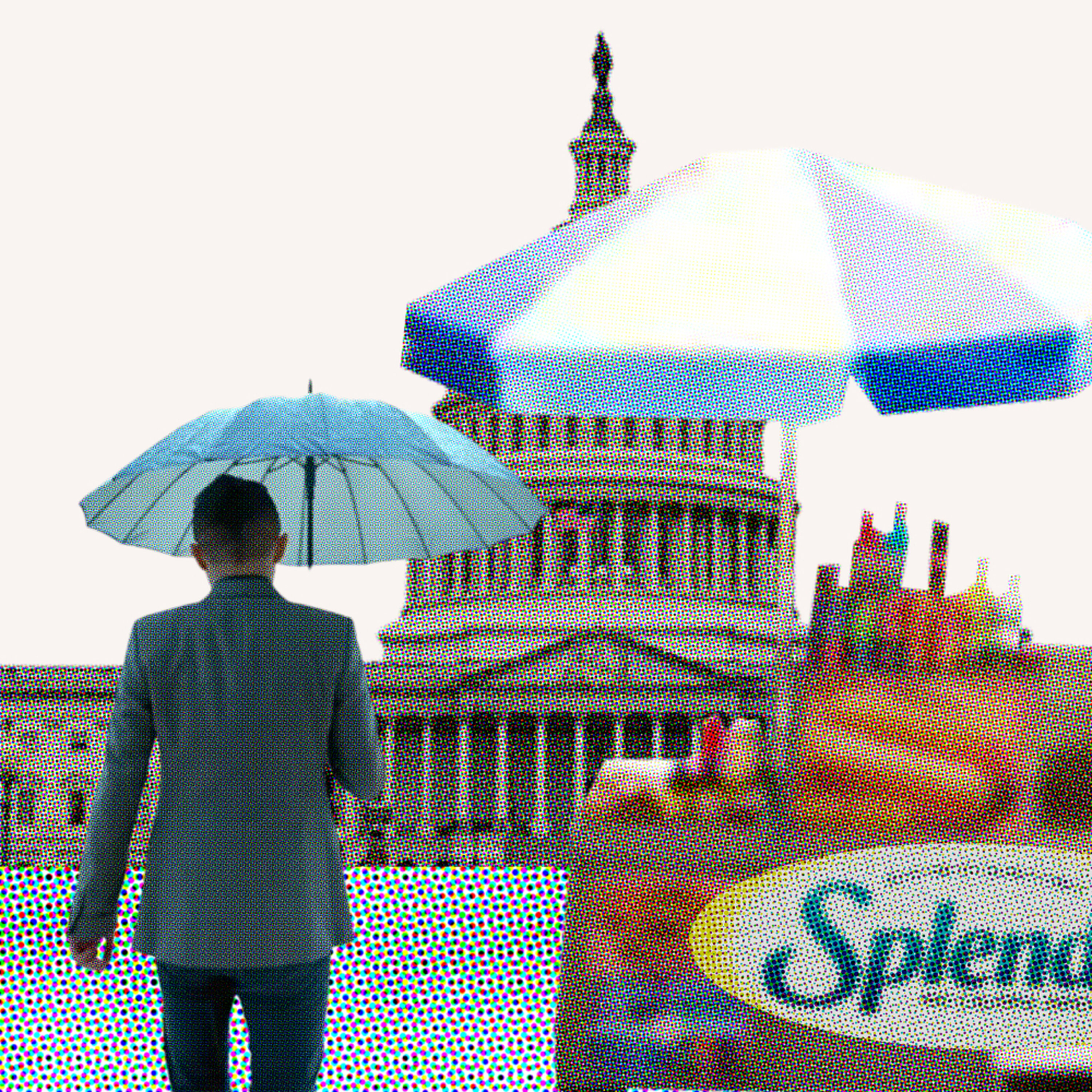
Everybody's Business: Will the Shutdown Lead to DOGE 2.0?
Episode Transcript
Bloomberg Audio Studios, Podcasts, radio News.
Speaker 2This is Everybody's business from Bloomberg Business Week.
Speaker 3I'm Max Chafkin and I'm Stacy Vannoxsmith.
Speaker 2Stacey.
Have we got a story for you.
Speaker 4It is about the wildest, weirdest, most interesting man in crypto.
Speaker 2His name is Justin Sun will tell you all.
Speaker 3About it, Okay, I'm looking forward to that.
Before we get to that, We've got, of course, the big news of the week, Max, government shutdown.
Speaker 2Oh Stacy, we're doing this again.
Speaker 3I know, I know, government shutdowns they happen periodically, but this time I think is different.
We've got Justin Wolfer's an economists here to help us break that down.
Speaker 4And Stacy the underrated story of the week.
Yeah, two words for you, little teas splendid.
Speaker 3Daddy's splendid.
Daddy's all right, hang around for that, Okay, Max.
This week the news has been completely are taken by the government shutdown.
It's all the headlines, it's everywhere, It's all anybody can talk about.
Speaker 4Well, is Stacy, there is one very very positive economic indicator that we need to discuss.
Speaker 3Yes, tell me I want some positive economic indicators.
Speaker 4Life of a Showgirl the new Taylor Swift album hitting on Friday tomorrow.
As we record this today, as you listen, you know, Taylor Swift obviously huge mega phenomenon.
She she criss crosses the country raising hotel rooms.
Speaker 3Hit pause on the podcast and just go listen to that.
Speaker 4But I mean, seriously, this is it does feel like a big cultural moment.
You know, Taylor Swift obviously the biggest pop star on the planet right now.
Speaker 2She's had this amazing run.
Speaker 3She's been mentioned in the Beige Book as I don't know what courses that has moved local economies when her concerts come through town.
Speaker 4That's what I was alluding to, like the arostour when it would hit a town, like hotel room prices would go way up, you know, restaurants would sell more.
Speaker 2I think there were literal earthquakes that.
Speaker 4Happened because people were moving around so much in these stadiums.
Speaker 3So you're saying, this is this moment, is the shutdown versus Taylor Swift?
Can she do enough to salvage the US economy?
I'm the government shutdown.
Speaker 4Donald Trump and Chuck Schumer, they all have their calculations about where Americans are going to fall and how much pain are people going to be willing to accept?
But they haven't counted on the fact that everyone's going to be distracted for like the next month listening to this.
Speaker 3Album and dissecting all the lyrics.
Speaker 4Indeed, that aside Stacy, I mean, the shutdown is happening, and like this sense of chaos, political chaos that then kind of tries to spill into the business world that's continuing this week, and I feel like that's maybe where we need to start.
Speaker 3Yes, indeed, and in fact, I was at the University of Michigan earlier this week.
I got to drop in on economist Justin Wolfer's ECON one oh one class, which was delightful.
It's a class of five hundred students and at the end and I tracked some of them down and asked them how they were feeling about the economy and like what their worries were about the economy at this moment.
Here's what they said.
What scares you about the economy right now?
Speaker 2The cost of living?
Like I have like a girlfriend, and when we talk about.
Speaker 4Like our future, it's like are we gonna be able to get a house or like what are we gonna do.
Speaker 2I think it's a lot harder for people to get jobs.
Speaker 5I think that's just a bigger worry and a lot of students' minds.
Speaker 6I mean, I would agree with And I've applied to a bunch of jobs like Panera, bread and.
Speaker 4Things like that, and I haven't heard bag at all.
Speaker 6I was originally given a pelgrant and then it got taken away wit how saying I don't know, just like the current administration announced that they would be like repealing to a certain like student.
Speaker 3Like your pel grant got taken away?
Speaker 6Yeah, just literally gone.
There wasn't an edification or email or anything.
Speaker 3It's just what was gone that scares you about the economy right now, I would have.
Speaker 7To say the tariffs, And that's really terrifying because President Trump does state that the other countries will be paying.
Speaker 2These taxes, but as we've also learned in econ one on.
Speaker 1One, American consumers will probably be paying a lot of the tax for it.
Speaker 2The cost of food.
Speaker 6Remember, like back in the day, like you could get a candy bar from ninety nine cents.
Speaker 2Right now get king sized candy bars going.
Speaker 6Up to like three dollars, three dollars fifty cents, Like at the stadium.
Speaker 2A bottle of water could be like five six dollars.
Speaker 3So what, oh is this when you guys go to games?
Do you all go to games?
Speaker 6Yeah?
Speaker 3Yeah, really University of Michigan, Big ten school, they all go to the games.
Speaker 2You know what I love about that?
Speaker 4Like and I say love, but I mean what I appreciate about hearing those voices.
We live in an era defined by kind of like reality television and social media, where like presentation is everything, and our politics is playing out essentially on screens, and you have these two sides like trying to spin stuff.
But all these policies, all the stuff that's happening in the economy, it has consequences.
And that, like that woman talking about the pelgrant, Yeah, is a consequence.
Speaker 2I mean sounds really bad.
It sounds really tough.
Speaker 4And I do wonder as we think about how the consequences of this government shutdown that we're entering right now are going to play out.
Those are the kinds of stories that are going to define like how we experience it, not like what Trump says on TV, not what Schumer whoever says on TV.
It's going to be stories like that and and I don't know, I just feel like we have to keep talking to those people.
So good job, Stacey.
Speaker 3The teacher of these really lovely students is economist Justin Wolfers, and he is here today to talk government shutdown.
Thanks again for letting me sit it on your class and welcome.
Hey Stacey, Justinould, what did you think of what your students had to say?
Speaker 7Well, they're brilliant.
They I think, well, try and articulate.
And I think it's so lovely to hear young voices engaging in our economic debates.
We're fighting about the future, and that's who they are.
Speaker 3Is all around.
Speaker 5That's what I say, Oh, you're for grade inflation now.
Speaker 3But Justin, we brought you on to talk about the government shutdown, that terrible moment when politics and economics meet and it is a mess.
And right now we are in the middle of a shutdown.
Before we kind of jump into the more granular issues, what do you see as going on here?
Speaker 5Mostly politics.
Speaker 7I understand that people's first instinct at a moment like this is to call an economist because it feels like a big deal economically.
I think the reality is, if we think about the macroeconomy, the ups and downs of GDP and unemployment and recessions and booms and.
Speaker 5Stuff like that.
It's just not that big of a deal.
Speaker 7So for folks who are not working in or very closely with the government, what I think the appropriate status is sort of disappointed parent.
Speaker 3But seven hundred and fifty thousand people are not working today because of this, that feels like a big economic deal.
Speaker 7Absolutely, Although Stacy, there's one hundred and forty million people who are and one hundred and forty million is substantially big.
In seven hundred and fifty thousand, we're probably talking about a matter of weeks rather than the full year, and so you start to do this sort of math and it starts to become fractions of a percentage point.
Look, two things are true, and I want to be really clear about it, and I thank you for drawing it.
It can be that something's not a major macroeconomic issue yet still is a dumb and horrendous and pointless waste.
And were I president, it wouldn't change the reality that a billion dollars is both a tiny fraction of GDP and a ton of money and wasting it for no reason whatsoever.
Feels utterly pointless and utterly disparity.
Speaker 4So justin you're saying it, it doesn't matter economically, or at least on a macroeconomic point of view.
And I feel like Stacey and I talked about this.
We've both been business journals for a long time.
These shutdowns come with some frequency, right, the last one was in twenty eighteen.
We're constantly hitting the debt ceiling.
And if you've been through this a few times, a dozen times, however many it's been, you basically just start to feel like, eh, like this is like they're going to get it figured out.
This is a sort of a manufactured political crisis.
The only thing that matters really is who gets blamed.
Speaker 2Right.
Speaker 4I do wonder if this one is a little bit different, only because this is coming in a larger context, which is that the Trump administration has been since the beginning, since January, just trying in various ways to kind of kneecap parts of the federal government.
Right, and to me, this really feels like an almost repeat of Doge, which might seem weird to say, but like we had during the first couple months of the administration, Elon Musk going around sort of purporting to close various federal agencies laying people off.
I think it's yesterday as we record this on Thursday, October two, that the workers who took deferred resignations are are in fact leaving the government.
It's like another one hundred thousand workers.
And when you listen to what the Trump administration is saying, and we listen to what russ Vote the head of the OMB is saying, they see this as an opportunity not just to furlough workers, but to attack parts of the bureaucracy permanently.
Speaker 7Yes, so much.
There max so full of ideas.
Let me start with the first one.
You're like, eugh, another, the government shutdown?
Who cares?
The problem with that thinking is the thing that eventually ends the shutdown is people are like, holy cow, this is terrible, and it causes political pain for one side or other of politics.
That causes enough that pushes them back to the table, and they sort it allowed.
If we all sit around and take people like me seriously and say, hey, it's not that big of a deal, then actually it will never resolve.
And so I think your point that we're all sort of a little bit indifferent, right, Well, battered, bruised, and used to large scale shocks to how the government works.
Right now, this would have been outrageous six years ago, and you and I I think our blood would have boiled.
And this might be the thirteenth worst thing to have happened so far in October.
That removes the urgency.
And if you remove the urgency, that then creates the possibility that this one actually runs on a whole lot longer.
So the last one went thirty four days.
When I say government shutdowns are not a huge event, I should say one, We're already shut down most of the government two days every week, so if we made it a third wouldn't be a big deal.
Speaker 3So the government gets shut down right now, it's not that huge of a deal macroeconomically, and potentially, you know, thousands of people will lose their jobs.
Speaker 7Wait, Stacy, could we just hold up because they want to get the premise right.
So what has historically happened is non essential employees are told not to do any work.
The government remains shut down for two weeks then and then they shutdown ends and they come back to work.
And usually in every past case, Congress has passed a law saying even though you didn't do any work for those two weeks, we're going to pay you anyway.
So no one historically was losing their jobs through this.
And then there's the essential workers who keep working, but they keep working without getting paid, and then they'll get repaid later, So there's no job cuts that are essential to this.
What this gets to, though, is Max's earlier point, which is this is a political escalation at the current moment.
This one's different because normally presidents are embarrassed by their inability to keep the government open.
Speaker 3Right this is like a shameful moment, like, oh, you couldn't get it together and make a deal again, And.
Speaker 5What we have is escalation.
Speaker 7Certainly in claims the president says he's going to go after democratic priorities.
He's going to definitely not collect the trash from outside Max's house, and so on.
This president's saying, well, you guys are doing me, I'm just going to fight back.
So it sounds like when my kids were five.
He has no new powers to fire people right now that he didn't have yesterday.
So if there was whole departments he wanted to shut down, if he could do it, he could do it.
Two days ago, and he could still do it in two days time.
So the presidents claim that this brings on an escalation.
There's no structural change that creates that escalation.
So the escalation, though, is that he would be taking advantage of the political moment that somehow the press and the people would let it slide that he's going to do something, and other times we would find repugnant.
Speaker 4You know, I spent earlier this year a couple of months reporting on Russ Vote, who I said, head of the OMB, super interesting character.
He wrote part of the Project twenty twenty five.
I think he was involved in the last government shutdown in fact, and he was kind of like hanging behind the scenes with Doge.
Speaker 2Right.
Speaker 4I described him as like, you know, I can't remember the words I actually use, but like the real mastermind or the ideological mastermind or something like that.
And what's interesting is Vote had been saying for like a decade basically that if we could, we should just like cut all these woke agencies, defang the deep state, massively cut back in the government, and that that was like a political end in itself, and that's what we saw essentially with Doge A couple months ago right where where they did this and then discovered, oh crap, it's unpopular.
Elon Musk suddenly had people protesting outside of his dealerships.
People were suddenly putting bumper stickers on their cars, you know, trading their teslas in.
People hated this because, you know, for all the times we sort of complain and grouse about the ways that the government doesn't work, like it actually does work pretty well.
Speaker 2That was one of the things I think we learned with Doge.
Speaker 4And now they're kind of trying to run it back, but this time blame the Democrats.
And like you said, justin nothing's really changed from a legal perspective, although I'm sure there might be arguments to be made about, oh, maybe it's an emergency or something like that, But really this is about can we pin this on Chuck Schumer?
And I don't know what the answer to that.
I don't think any of us actually know what the answer to that.
I'm not even sure russ Vote Donald Trump or Chuck Schumer knows the answer.
Speaker 7I'm not a very good political scientist, so I'm far less interested in who we pined on, although that's ultimately going to be what results.
Is right one side or the other will find the situation's not working well for them and it's better for them to end it.
There's a deeper economics here, which is why was Dozier failure and why would the same logic fail at the current moment.
So many of us have an image in our minds of the federal government is big and bloated and pointless.
And last time I went to the DMV, I thought the person behind the count it might actually have been a sloth.
Speaker 5There's a kid's movie where it's Zutopia.
It is Utopia.
Speaker 2Yeah, I got three little ones about twenty times.
Speaker 7It's a wonderful movie.
But yeah, you walk in and like, literally, the DMV is run by a sloth.
And I've been in that DMV and the sloth isn't even cute.
They're resentful and middle aged and slow moving.
And we take.
Speaker 3That experience with that, I'm just kidding.
Speaker 7We take that experience and we projected on the rest of government.
There's a few things to recognize here.
First of all, most of our experiences with government, with these annoying officers are actually state and local.
Speaker 4I was just gonna say, you're talking about a state agency that's a problem from Michigan.
Speaker 7Absolutely, but we all have that idea, and that's why there's this strong current, particularly through public and politics.
Oh, let's run the government like a business, or let's choke it, or let's get rid of all these useless employees, which is what you're hearing a lot of right now.
That's the wrong model for the federal government.
There's an old saying about the federal government.
It's an insurance company with an army.
What do I mean by that?
The federal government most of its spending is on what we call insurance programs.
It's unemployment insurance, it's Medicare, it's Medicaid, and those.
Speaker 3Are like not an issue here at all.
I mean, those are mandatory things.
That is not This is what always blows my mind about the shutdowns.
It's not about the big stuff, you know.
I looked into this.
I got really interested in how big a share of the federal budget went to federal workers, and so I actually looked this up, and as it turns out, if you count the military of salary benefits, everything adds up to about seven percent of the US budget, and if you don't count the military, it's about five percent.
So this is a very small part of the budget.
And then this healthcare subsidy, the thing that's become a big point of contention between the right and the left, these sort of extra subsidies that got rolled out during the pandemic to help people afford health insurance.
I mean, that is like zero point two percent of the budget.
That's really little, and it's just it really striking to me that so much is happening over something that is such a small part of the seven trillion dollar budget that we spend every year.
Speaker 7The federal government's it's a small share of the economy.
Much of its function is printing Social Security chicks does checks is still going to go out.
There are important things the federal government does.
Some of them will be shut down for a small number of weeks.
Maybe I just want to come back to this is not a macroeconomic moment.
Every dollar we waste is a dollar we didn't have to waste, and it's all for political posturing.
So it's as if we've just given several billion dollars to both Democrats and Republicans to spend on political advertising so they can yell at each other.
Speaker 3And the billion dollars is that the cost or what is.
Speaker 7The cost here, It's going to be several billion, which again is a real amount of money.
I hate wasting a billion dollars.
We could spend that billion building schools, or feeding hungry or giving tax cuts to people whose yachts are not big enough, guilding the White House, gilding.
We could probably guild another whole room with that.
One part of the story we haven't told is the public servants.
Right, These are real people who I teach the other job I have you started with my economic students.
I also teaching the Ford School of Public Policy.
These are young things in their early twenties who answered Kennedy's call to ask not what your country can do for you, but what you can do for your country, who believe deeply and profoundly in public service and have gone off to school to become smarter at it, and can't wait to go back out there and serve the greater good.
And they're being treated appallingly.
They're being treated as if they're the public enemy.
For the generation of students I'm teaching right now, there may not be jobs for them.
For the folks who are currently in the federal government, which includes many of my former students.
They're being asked to go without pay for as long as the politicians decide.
And that's the thing I will just tell you.
This is not being an economist, This is being a person.
I find it utterly dismaying the extent to which we are using people as pawns in greater political games.
And I've seen more of that since January of twenty twenty five than I've ever seen in my life.
And every time I see it, it churns my stomach a lot.
Speaker 2Wow, justin, thank you for being here.
Thank you, justin, thank you very much.
Speaker 3Okay, Max, at the top of the show, you promised that we were going to hear about the most interesting man in crypto.
It is time to deliver.
Speaker 4Yeah, but we need to back up, and I just need to explain a little bit about Trump and crypto because I think that's what the big issue here is.
Speaker 3Okay.
I do feel like the first six months of the Trump presidency there's been a lot of crypto news.
Some of it I followed, some of it not so much.
So what is going on right now with Trump and crypto?
Speaker 4Yeah, this is an industry that Trump seemed to despise, during his first term.
It's also one that I'm sure most listeners know.
Lots of controversy, lots of allegations, some big ups, some big downs, and many of the leading lights you know going back a few years ago were either criminally charged or convicted or the subject of SEC cases.
And basically Stacy, with a couple of exceptions, all those cases pretty much are gone now they've been.
Speaker 3The President has his own coin, the Converted.
Speaker 4Indeed, yeah, he's he's in the crypto business now.
And there's an amazing BusinessWeek story out right now that kind of explains this.
Speaker 2It's focused on Justin Sun, who.
Speaker 4Is, like I said, this wild figure in the industry.
He's the founder of the blockchain network Tron will explain what that is in a second.
He owns that big famous banana or the banana that was duct taped to the wall, oh.
Speaker 3The art piece.
Is he the guy who ate the banana?
Speaker 2He ate the banana.
Speaker 4And the best thing about this story is that it was written by our colleague Zeke Fox, who wrote a book about crypto It's called Number Go Up.
It's really like the best book that I've read on the subject.
Zeke is basically an expert in all kinds of financial chicanery.
He covered all those ups and downs that I mentioned, and I wanted to talk to him and try to understand the story and why all these guys who I thought of as controversial figures, who would never find themselves in a room with anybody close to the presidency, are now in position of power.
Speaker 2What do they want?
What does it mean for our country?
Speaker 3So this story is called a crypto Billionaire's Path from Pariah to Trump Moneyman, and ze grote it with Muyaushin Max take.
Speaker 2It away, Zeke, thanks for joining us.
Speaker 1Thanks Max.
Speaker 4So you and I I think have covered aspects of this world for a long time.
I thought of you always as like an expert on the on financial scams, of which there are many in the world of crypto, and I had kind of gotten interested because of tech and politics and the way that crypto guys we're trying to be influential, and Justin Son kind of fits into both of these worlds.
Speaker 2He was sued by the SEC.
Speaker 4In twenty twenty three, accused of I'm selling unregistered securities, of manipulating the market for tokens and tron He denied wrongdoing, but then also, and this is where things get kind of interesting, the suit was paused after Sun happened to pay seventy five million dollars.
It's a lot of money to a company controlled by the Trump family.
And at some point he also invested fifteen million dollars.
For those keeping track at home, that's ninety million total in Trump's mean coin.
We're not sure of the timing there.
Maybe he was before or after the sec thing, but either way, after this big initial investment, Justin Son and the Trump family go into business together.
Speaker 2Did I get all that right, Zeke.
Speaker 1Yeah, as long as we're just very strict on the we're talking about time here.
Son first invested ninety million dollars in Trump coins, and then the lawsuit was paused.
We don't know why exactly.
Speaker 4I'm just kind of curious that somebody who had kind of followed these figures in crypto for a long time, Justin Son being kind of an important figure in this world.
Were you surprised when he just like showed up in Trump world, you know, when he appeared at this event in Arlington and like gave a speech next to Trump.
Speaker 1Yes and no.
Within crypto, Son is infamous as lawyers for Coinbase, the biggest US crypto company, once set in court.
He's kind of mysterious, like people aren't quite sure how rich he is or how he made his money, but he's really out there.
He loves publicity stunts.
He commissioned a theme song for his blockchain tron by the Oscar winning composer Hans Zimmer.
He paid millions of dollars to have lunch with Warren Buffett try to pitch him on crypto.
It did not work.
Speaker 2Yeah, Buffett not a fan of crypto in general.
Speaker 1Hates crypto.
And he ran for prime minister of the libertarian micro state liber Land.
Speaker 2Right, which, as I understand, that's somewhere in the Balkans.
Is he is he the prime minister.
Speaker 1He's the prime Minister, right.
Speaker 4Okay, And he likes to be referred to as your excellency.
He has a title to that effect from Janata.
Speaker 1Yes, the title does come from Grenada, and this was because he was appointed their ambassador to the World Trade Organization.
Speaker 2I'm going to take a wild guess of how you get that appointment.
Speaker 1So at the time, it has since come out that there was kind of a scandal there and diplomatic posts were for sale for one hundred and fifty thousand dollars.
We asked Son how he got his post, and his lawyer said there was no impropriety.
Speaker 2Okay.
Speaker 4So Sun is this larger than life figure, and like you said, you know, he's sort of everywhere and nowhere in crypto.
I think over the last like ten years or so, this company Tron, was at the center of this sec thing that was dropped.
Speaker 2It's his main thing, Like what is Tron?
Speaker 1Yeah, so Sun's been around since the twenty seventeen ICO boom initial coin offering.
Yes, and this was like the first crypto bubble when it seemed like anybody who just said the word blockchain could raise tons of money for whatever.
The pitch was like pretty vague.
It was going to be like a new decentralized Internet, it was going to be for content, it was going to be an app store.
But at that time it didn't really matter.
And Son had kind of a following from his podcast in China called the Road to Financial Freedom Revolution, and so he raised I think seventy million dollars or so for Tron in this ICO despite the kind of vague pitch and what tron is is very similar to other blockchains.
So if you only think of crypto as like a replacement for dollars, that's kind of like a outdated vision of the industry, And a blockchain is kind of like a ledger.
Speaker 2The thing.
Speaker 4The thing usually here is that it's a distributed ledger.
It's like a way of keeping track of payments.
But there are lots of people who think it could be useful for other things like tracking inventory or something like that.
Speaker 2I think that's the explanation and.
Speaker 4The one that is used when people are trying to explain why crypto isn't just a bunch of guys essentially trying to pump up worthless currencies.
Speaker 1Yeah, and tron has become There's one particular thing that it's mainly used for, which is a stable coin called Tether, just sort of like a digital dollar, And often when people transact in Tether, they're using tron to do so.
Speaker 4So and Tether is used by people who are investing in cryptocurrencies.
Speaker 2It's also.
Speaker 4Very very useful for people who are trying to move money around without it being noticed, so that could be like money launders, criminals, terrorists, and so on.
Speaker 1Yeah, in the last few years, word has definitely spread around the criminal world that there is this cool new way of moving money from person to person that does not involve revealing your identity.
Speaker 4Right, and a bunch of disclaimers here, number one, pretty much everyone in the crypto industry.
When when people point this out, we'll say something like, you know, US dollars are used by money launders and drug dealers.
No one is trying to get rid of the US dollar.
Does it make the Federal Reserve complicit in drug dealing?
We are trying to stop illegal activity.
This is just like kind of a bad thing that's happening.
And then the last thing they bring up is that, you know, many of these currencies are decentralized, like we don't even control like what is happening on this network.
Speaker 1Really, they try to say, like a blockchain like Bitcoin or Tron, it's like the protocols that power email or websites.
Right, we don't see anyone going after them this technology.
Yeah, Tron and Tether formed the T three Financial Crime Unit, and they've said that even know it's just technology, we don't want people doing bad things here.
We're going to try our best to root out crime.
Speaker 4So just to take a few steps back from the sort of questions around Justin Son, he was part of this larger, essentially like romance between Trump and the crypto industry.
It started, you know, sort of mid campaign last year.
I BLUs is like July at the Bitcoin conference, and I think the conventional wisdom for why Donald Trump, a populist who had in the past said that he, you know, thinks crypto is terrible, he prefers the dollar, you know, in all sorts of ways, doesn't seem like the kind of guy who would want to embrace crypto.
The conventional wisdom I think for why he embraced it is basically money.
That this is a big class of donors and they were all writing him checks and as a result, you had this kind of confluence where Trump took a lot of crypto money, he got into the crypto business, and he's also been changing policy and making and causing the SEC to drop cases such as the one that Justin Sun's involved in.
If you had to make a case for like why Trump would embrace crypto at that moment, like what is the case for doing it outside of donations, just like trying to please donors, like is there any way that what these guys are offering, either for the American economy or for the global economy somehow like fits Trump's agenda.
Speaker 1I mean, the Trump argument is that the traditional players in a financial system have been discriminating against conservatives.
They've been cutting off bank accounts of people like the Trumps because of like the perceived risk of dealing with them.
Speaker 2Right, this is the decentralization thing.
Speaker 4Maybe you can't stop money laundering as well as you could if it were centralized, but you also can't discriminate against ideological viewpoints.
Speaker 2Yeah.
Speaker 1I think that Trump he has a lot of respect for other rich people, and that in the past he may have thought that crypto was not real money and that these people were not really rich, But then once he saw that they had lots of real money in addition to cryptocurrency, he was like, all right, they seem like my kind of guys.
Maybe we should hang out, Like if they're buying memberships at mar A Lago, but they're donating to his campaign.
Speaker 4I also feel like there's something about Justin Sun that's kind of trumpy, Like he's totally this like self created who's like using like all of these tools to sort of create an image, like you brought up the Hans Zimmer theme song for his company, which is funny, like, like what company needs a Han Zimmer theme song?
I almost want to hear it kind of coming up in the background as we're discussing it.
Speaker 2Have you heard the theme song?
Speaker 1I definitely have, but don't I cannot describe it properly.
Speaker 4And then you know he bought this, this piece of art, the banana that had been duct taped to the wall, you brought the buffet lunch.
Speaker 2He basically like, if there's any way.
Speaker 4To signal status or to use money to signal status, just the Sun is gone for it.
Speaker 2Yeah.
Speaker 1I mean, actually it's kind of funny because like Trump, he's willing to sell any sort of like status symbol that you want as long as it's like a Trump status symbol.
Like he's like, pay me money and you can live in a Trump apartment, or you can wear a Trump watch or whatever.
And Sun is like the perfect customer because he loves to spend lots of money on things that might make him look rich or important.
Speaker 2He got a Trump watch.
In fact, he.
Speaker 1Got a Trump watch.
He actually played a really key role in Trump, the Trump's getting into the crypto business.
So Trump gave the speech he said, you know, I love crypto.
I'm gonna deregulate the industry.
It's going to be great.
Everyone liked that.
And then a few weeks later Trump said, and I'm going to get into the crypto business myself.
I've got this company called World Liberty and the crypto industry.
A lot of people were like, oh man, this is like you're in it for the wrong reason, right.
We thought you just like want to to decentralize things.
We didn't think you were trying to make money off of us.
And so the sales of Trump's first cryptocurrency were really slow.
It was looking like the project might not get off the ground.
They'd set out to sell like hundreds of millions of dollars with these tokens and they only sold a couple of million.
And Son stepped in and bought initially thirty million dollars in one go, and this like got a lot of momentum for the Trump project.
Sun got named and advisor to World Liberty, and it kind of put them right in the in the Trump's orbit.
Speaker 4And Son, in addition to this money that went into World Liberty.
He also bought one of the Trump Meme coins.
That's another payment that effectively goes to companies controlled by the Trump family.
I feel like I have to ask the question that like everybody is thinking, but maybe everyone is afraid to ask, which is first of all, Justin Sun's born in China, he is not allowed to make political contributions to political candidates.
You're also not, I don't think, allowed to just say, hey, I'm going to write a seventy five million dollar check to help with an SEC problem.
Speaker 2How is this not improper?
Speaker 4I mean he's making a payment to Trump's or many payments to Trump's family, and also getting a bunch of policy considerations.
Speaker 5Yeah.
Speaker 1I think Trump has made it very clear that he sees nothing wrong with accepting payments with his family, accepting payments from people who have business before his administration.
And for this to be illegal, you'd have to prove that favors had been done in exchange for these payments.
I mean, absence that proof, they can just say, hey, you know, Son really wanted to buy these coins.
He thought they were investments.
And then Trump has you know, said I want to deregulate crypto because I see it as the future of money.
And this case against Sun was just one of many lawsuits the SEC had filed.
I'm instructing them to toss all of them.
So it's not hard to find examples where there's a conflict of interest.
But so far, I haven't seen anyone who's nailed down something where they've proven that like a particular action was taken because of a particular payment, which is like the current standard for what constitutes corruption.
Speaker 4Well, and like you said, Trump just blends his personal identity and his political identity.
It's all kind of tied up together.
And I feel like this story and this guy is just like one example maybe the best example of what of how Trump is changing, you know, the presidency.
Speaker 1There's something that Trump said, and this was about the four hundred million dollar jet that his administration was accepting from the government of Cutter that I think illustrates his attitude.
And he said I could say no, no, no no, or I could say thank you very much.
Speaker 4And okay, zeke to finish up here.
We said at the beginning that tron is decentralized.
But in August, the Bloomberg Billionaires Index published an accounting of Justinsun's assets.
That accounting, and I'm pulling this from your story, was based on material that had been provided to Bloomberg by Justin.
Sun had all a bunch of his assets, including his art collection which I believe was worth fifty five million, his plane and airbus two hundred million, and then this crypto wallet, and using this crypto wallet, Bloomberg calculated that Sun had sixty billion Tron tokits, which is a majority of the supply.
Speaker 2And he's suing Bloomberg over this.
Speaker 1Yes, So after Bloomberg Billionaires published this valuation, Sun sued in federal court in Delaware, and he claimed that this report included details that he'd been promised wouldn't be in there, something Bloomberg has denied.
And he said that listing his crypto holdings put him at risk of hacking or kidnapping.
And he also said that the list of holdings that he provided to Bloomberg mistakenly included wallets that did not belong to him, and that he does not in fact own a majority of Tron's tokens.
But when Bloomberg went to ask him, which of these holdings are not actually yours?
To get a little more detail on what he was saying.
They did not respond.
We've published our story.
The lawsuit is still pending.
Speaker 2Zeke Fox, thanks for being here.
Speaker 1Thanks Max.
Speaker 4All Right, Stacy, the underrated part of the show.
You're gonna love this story.
I feel right, this is gonna be an economic indicator that.
Speaker 2Is meaningful to you.
Speaker 4Okay, shoot, Okay, I'm joking because I know you hate it.
But this is a story in Bustle.
The headline is even the sugar daddies are feeling the squeeze, and it is about how the economic forces that we have been talking about on the show, the Vibe Session, are impacting this sector of the economy, the sugar daddy sector of the economy, essentially where wealthy men are essentially women to be their girlfriends.
These men are feeling less wealthy, these sugar daddies, and they are cutting back and there the article suggests that people in this world have a new term to describe them, splendid daddies, because they're so cheap, Because I splend it as kind of a crappier.
Speaker 2Version of sugar.
Speaker 4And so basically this is the Vibe Session but playing out in the world of sex work.
Speaker 3Right, Okay, well, I obviously care about these issues a lot.
I wrote a book about women in the workplace, Machiavelli for Women, And what this makes me think of immediately is, you know, for most of history, like women's economic opportunities was this attaching themselves in whatever way they could to a man because that was the only way to earn money or one of the only ways to earn money.
I find it a little distressing that that still exists, but we still have, you know, like a gender pay gap is still a really serious thing.
So I just see when I hear these stories, I just feel like the economic limitations of women in the economy have not gone like I It makes me sad.
I just feel like Bustle should do better because it's supposed to be a feminist publication and women are having a hard enough time in this economy right now.
Women the participation in the workforce has gone backwards recently for the first time in a long time, because childcare expenses have gotten so high, and women's earning potential is lower than often their male partners or whatever husbands, And so if there's if it's a couple, often it's more economically feasible for the man to work and the women to stay home.
These are all the things going through my head right now when I hear about sugar daddies.
I just feel like it's a very old profession finding a rich boyfriend.
But I just feel like, of all the messions, it is the hardest.
Speaker 4You're saying, like, of all the economic stories, the fact that these guys are like cutting back on their spending, we shouldn't be talking about it, like we should be talking about something else other than the tough times and sugaring.
Speaker 2Well.
Speaker 3I just think it's alarming that this is still a career path for women.
I'm surprised and saddened that Bustle would cover this.
Speaker 4So yeah, Stacy, And when we talked about this offline, it was even more Stacy is sort of is being gentle right now that she had some.
Speaker 3I've had some time to digest it.
Speaker 4So but one thing I wanted to say about this story is that the story is sort of premised on the idea that this is like the vibe session.
So you have these guys who are like I think the lead anecdote is like a tennis coach.
He's not able, he doesn't have as many clients right, people are cutting back on their tennis lessons.
Therefore he's cutting back on his expenses and essentially sending his girlfriends less money and and so like.
Speaker 2That is one possible explanation.
Speaker 4The other possible explanation that the story suggests, and that some of the women who are in this world put forward, is that these guys are just cheap, and that it's not that the economy is bad, it's that, like dating websites, it's that there's like a market problem.
Speaker 3I would find it funnier if I felt like the steaks were lower.
I just feel like the stakes are high, you know, like a lot of women are single parents, a lot of households count on women, women live a long time.
I just want to see women able to thrive in this economy.
But I don't know that I do better, do better, report on something else.
The show is produced by Stacy Wong.
Magnus Henrickson is our supervising producer, and Amy Kean is our executive producer.
Kelly garat Handle's Engineering, and Dave Purcell factchecks.
Sage Bauman heads Bloomberg Podcasts Special thanks to Jeff Muskus, Julia Rubin, and Maria ling.
If you have a minute, please rate and review the show.
It means a lot to us.
And if you have a story that should be our business, please send us an email.
Everybody's at Bloomberg dot net.
That is, everybody's with an us at Bloomberg dot net.
We love to hear from you.
Thank you for listening, and see your next time.
Speaker 2Ye send us stories you hate too, We'll we'll walk about those.
Speaker 3We're fine.
Speaker 2We're good with that.
Speaker 3We want to hear stories you hate.
I control max with them.
Next time, we want us to talk about sugar daddies.