View Transcript
Episode Description
Knowing the returns on your fixed deposit before investing can help you plan your finances with greater confidence. An FD interest calculator allows you to estimate the maturity amount of your fixed deposit and the interest you are likely to earn based on the details you provide.
What Is an FD Interest Calculator?
An FD interest calculator is an online tool that helps investors calculate the maturity value of a fixed deposit and estimate the interest earned over the investment period. By entering a few key details, such as the investment amount, annual interest rate, and tenure, the calculator instantly provides an estimate of your returns.
Using an FD interest calculator eliminates the need for manual calculations and makes it easier to compare different investment options while planning your savings.
How Does It Work?
FD interest calculators use standard mathematical formulas to estimate the returns on a fixed deposit. The calculation method depends on whether the FD pays simple interest or compound interest.
Simple Interest Formula
For non-cumulative FDs that pay interest periodically:
SI = (P × R × T) ÷ 100
Where:
P = Principal amount invested
R = Annual interest rate (in percentage)
T = Tenure in years
Compound Interest Formula
For cumulative FDs where interest is compounded:
A = P (1 + r/n)^(n × t)
Where:
A = Maturity amount
P = Principal amount
r = Annual interest rate (in decimal form)
n = Number of compounding periods per year (quarterly = 4)
t = Tenure in years
The interest earned is calculated as:
Interest Earned = A − P
Step-by-Step: Using an FD Interest Calculator
Using an FD interest calculator is simple and usually takes less than a minute.
Step 1: Enter the Principal Amount
Enter the amount you wish to invest. The minimum deposit amount generally starts from Rs 5,000, although it may vary across institutions.
Step 2: Enter the Interest Rate
Input the annual interest rate offered by the bank or financial institution.
Step 3: Choose the Investment Tenure
Select the duration for which you want to keep your money invested. This can be entered in months or years, depending on the calculator.
Step 4: Indicate Customer Type
Specify whether you are a senior citizen, as many banks offer higher interest rates to senior citizens.
Step 5: Select the Interest Payout Option
Choose whether you want interest to be paid monthly, quarterly, or reinvested through a cumulative FD.
Step 6: Click on Calculate
The calculator will instantly display the estimated maturity amount and total interest earned.
The results are generated automatically, allowing you to evaluate different investment scenarios with ease.
Why Use an FD Interest Calculator?
- Estimate Returns Accurately
The calculator helps you understand the potential returns on your investment before committing your money. This allows you to make informed financial decisions and avoid surprises at maturity.
- Compare Different Options
You can compare various combinations of deposit amounts, tenures, and interest rates offered by different banks and financial institutions to identify the most suitable option.
- Support Financial Planning
Knowing your expected maturity amount can help you plan for future financial goals such as education, retirement, or major purchases.
- Benefits for Senior Citizens
Many banks offer senior citizens an additional interest rate benefit, typically ranging from 0.25% to 0.75% above regular FD rates. The calculator helps estimate the impact of these higher rates on overall returns.
- Save Time
Using an FD calculator eliminates the need for manual calculations and reduces the chances of errors. You get instant and accurate estimates without having to work through complex formulas.
Understanding FD Types and Payout Options
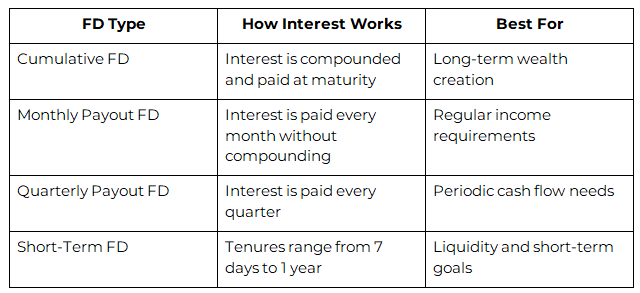
Key Factors Affecting Your FD Returns
Several factors influence the returns you receive on a fixed deposit:
Principal Amount: The larger the deposit, the higher the absolute interest earned.
Interest Rate: Returns vary depending on the bank, financial institution, and tenure. FD rates generally range between 6.5% and 7.5%, though they can vary over time.
Tenure: Longer tenures often result in higher overall returns due to the longer earning period.
Compounding Frequency: More frequent compounding, such as quarterly compounding, can generate higher returns compared to annual compounding.
Customer Type: Senior citizens typically receive preferential interest rates, which can increase overall returns.
Final Thoughts
Fixed deposits remain one of the most popular low-risk investment options in India. An FD interest calculator helps investors estimate returns, compare options, and make better-informed financial decisions before investing.
Spending a few moments using the calculator can give you a clear picture of your future returns and help you choose an FD that aligns with your