View Transcript
Episode Description
Cast your vote for The Next Reel as Best TV & Film Podcast today!
“Your grandfather has left you the sum of seven million dollars. Providing --- you are married by seven o’clock on the evening of your twenty seventh birthday.”
Running for Love and Legacy: Revisiting Seven Chances
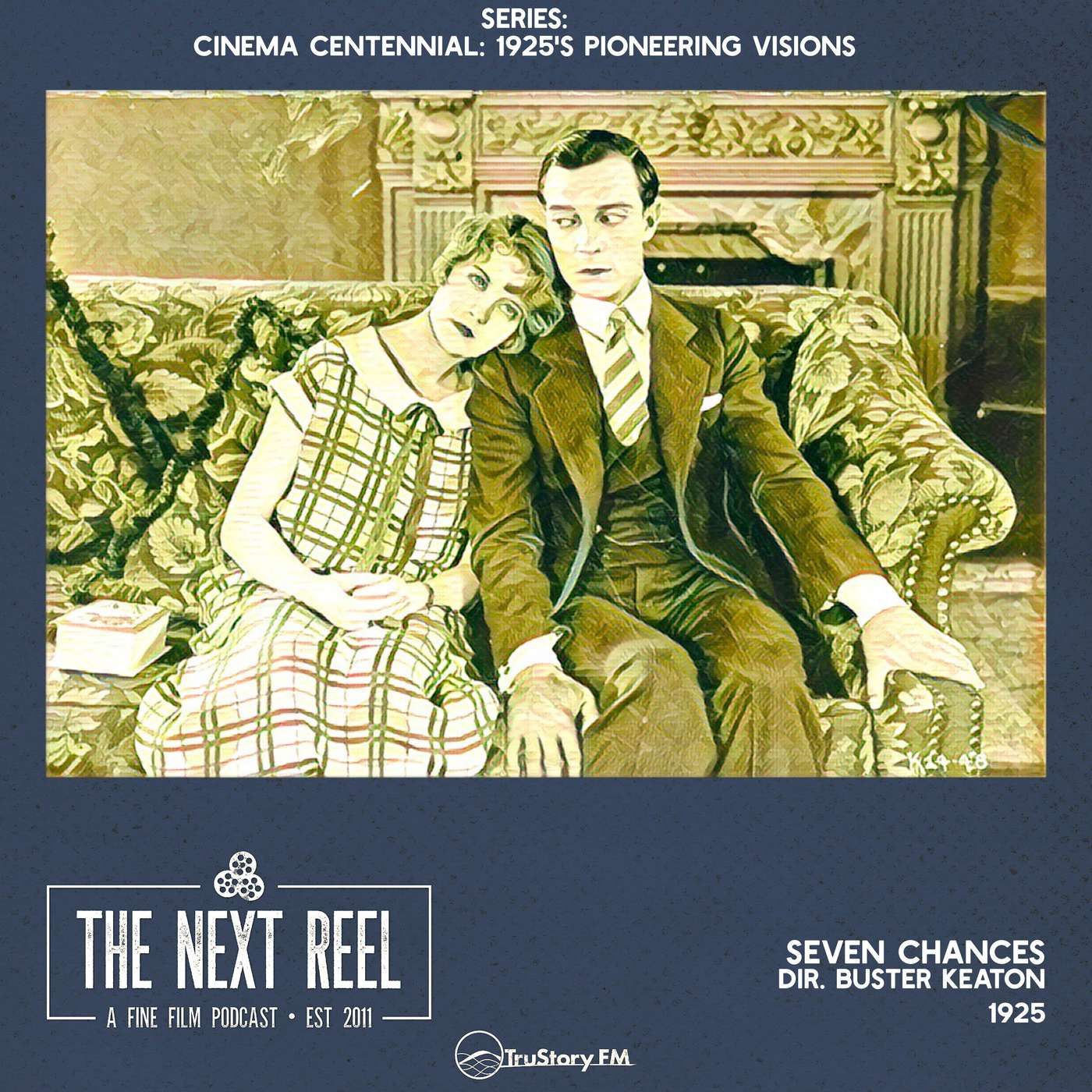
Seven Chances (1925) stands as one of silent cinema’s most inventive romantic comedies—a perfect blend of physical precision, deadpan humor, and daring spectacle. Directed by Buster Keaton, this short feature follows the frantic day of a man who must marry by 7 p.m. to claim a fortune. Originally based on a Broadway play, the project wasn’t one Keaton sought out—it began as a studio assignment before he transformed it into one of his defining works. With its 57-minute runtime, silent slapstick brilliance, and inventive chase cinematography, Seven Chances shows why Keaton remains a cornerstone of early American filmmaking. Join us—Pete Wright and Andy Nelson—as we continue the Cinema Centennial: 1925’s Pioneering Visions series with a conversation about Seven Chances.
The Setup: From Studio Assignment to Keaton Masterpiece
In this episode, Pete and Andy explore how Seven Chances—a 1925 romantic comedy produced by Joseph Schenck and distributed by Metro-Goldwyn—evolved from a “sappy farce” into one of Keaton’s most memorable physical comedies. The hosts discuss Keaton’s initial reluctance, his eventual takeover after the original director quit, and the creative accident that produced the film’s iconic boulder sequence. Through Seven Chances, the duo highlights Keaton’s ability to blend danger, grace, and architectural precision into silent-era storytelling.
Deadpan Genius and Dangerous Comedy: What Pete and Andy Saw in Seven Chances
Both hosts unpack how Buster Keaton’s trademark stillness—his "Great Stone Face"—contrasts with the high-energy chaos of the final chase. Andy praises Keaton’s “human metronome” cameraman Elgin Lessley, whose perfect timing allowed Keaton’s stunts to land safely (most of the time). Pete connects Keaton’s physical comedy lineage to Jackie Chan and Tom Cruise, noting that Seven Chances feels like a forebear of the modern action-comedy.
They also dive into the film’s uncomfortable historical elements—its dated racial caricatures and blackface performance—and how these moments complicate contemporary appreciation. Both agree that beyond its problematic era markers, the film’s inventive cinematography and physical storytelling remain stunningly modern.
Additional Topics Covered:
In their wrap-up, Pete and Andy agree that while Seven Chances is not Keaton’s most personal film, it’s an impressive showcase of his timing, ingenuity, and comedic rhythm. They celebrate its tight runtime, luminous restoration, and enduring joy—qualities that make it a strong entry in their ongoing exploration of 1925’s defining cinematic landmarks.
We have a great time talking about it, so check it out then tune in. The Next Reel—when the movie ends, our conversation begins!
🎬 Watch & Discover
“Your grandfather has left you the sum of seven million dollars. Providing --- you are married by seven o’clock on the evening of your twenty seventh birthday.”
Running for Love and Legacy: Revisiting Seven Chances
Seven Chances (1925) stands as one of silent cinema’s most inventive romantic comedies—a perfect blend of physical precision, deadpan humor, and daring spectacle. Directed by Buster Keaton, this short feature follows the frantic day of a man who must marry by 7 p.m. to claim a fortune. Originally based on a Broadway play, the project wasn’t one Keaton sought out—it began as a studio assignment before he transformed it into one of his defining works. With its 57-minute runtime, silent slapstick brilliance, and inventive chase cinematography, Seven Chances shows why Keaton remains a cornerstone of early American filmmaking. Join us—Pete Wright and Andy Nelson—as we continue the Cinema Centennial: 1925’s Pioneering Visions series with a conversation about Seven Chances.
The Setup: From Studio Assignment to Keaton Masterpiece
In this episode, Pete and Andy explore how Seven Chances—a 1925 romantic comedy produced by Joseph Schenck and distributed by Metro-Goldwyn—evolved from a “sappy farce” into one of Keaton’s most memorable physical comedies. The hosts discuss Keaton’s initial reluctance, his eventual takeover after the original director quit, and the creative accident that produced the film’s iconic boulder sequence. Through Seven Chances, the duo highlights Keaton’s ability to blend danger, grace, and architectural precision into silent-era storytelling.
Deadpan Genius and Dangerous Comedy: What Pete and Andy Saw in Seven Chances
Both hosts unpack how Buster Keaton’s trademark stillness—his "Great Stone Face"—contrasts with the high-energy chaos of the final chase. Andy praises Keaton’s “human metronome” cameraman Elgin Lessley, whose perfect timing allowed Keaton’s stunts to land safely (most of the time). Pete connects Keaton’s physical comedy lineage to Jackie Chan and Tom Cruise, noting that Seven Chances feels like a forebear of the modern action-comedy.
They also dive into the film’s uncomfortable historical elements—its dated racial caricatures and blackface performance—and how these moments complicate contemporary appreciation. Both agree that beyond its problematic era markers, the film’s inventive cinematography and physical storytelling remain stunningly modern.
Additional Topics Covered:
- The inheritance clause as a farcical critique of class and marriage
- Parallels between Seven Chances and modern films like The Bachelor (1999) and Brewster’s Millions
- Keaton’s signature underacting compared with Chaplin’s heightened emotion
- Silent-era stunt safety—or lack thereof—and its evolution into modern production rules
- The striking use of early two-color Technicolor in the opening sequence
- Extraordinary precision in the climactic “bride chase” and boulder avalanche sequence
- How Seven Chances bridges slapstick, satire, and proto-action filmmaking
In their wrap-up, Pete and Andy agree that while Seven Chances is not Keaton’s most personal film, it’s an impressive showcase of his timing, ingenuity, and comedic rhythm. They celebrate its tight runtime, luminous restoration, and enduring joy—qualities that make it a strong entry in their ongoing exploration of 1925’s defining cinematic landmarks.
We have a great time talking about it, so check it out then tune in. The Next Reel—when the movie ends, our conversation begins!
🎬 Watch & Discover
- 🎥 See Our Full Conversation on YouTube
- 🎭 The International Buster Keaton Society
- 🍿 Watch the Film: Apple TV | Amazon | Letterboxd
- 📽️ Theatrical Trailer
- 📚 Adapted from Seven Chances by Roi Cooper Megrue
- Become a member for just $5/month or $55/year
- Join our Discord community of movie lovers
- Cinema Scope: Bridging Genres, Subgenres, and Movements
- The Film Board
- Movies We Like
- The Next Reel Film Podcast
- Sitting in the Dark
- Main Site: Web
- Movie Platforms: Letterboxd | Flickchart
- Social Media: Facebook | Instagram | Threads | Bluesky | YouTube | Pinterest
- Your Hosts: Andy | Pete
- Merch Store: Apparel, stickers, mugs & more
- Watch Page: Buy/rent films we've discussed
- Originals: Source material from our episodes
- Special offers: Letterboxd Pro/Patron discount | Audible