Craniotomy Stroke Recovery: How a Massive Medical Event Reshaped One Man’s Identity and Way of Living
Episode Description
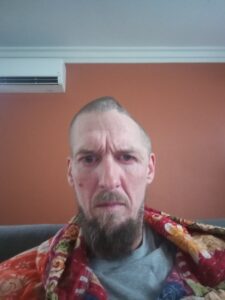
When Brandon Barre woke up after his stroke, half of his skull was missing.
Doctors had performed an emergency craniotomy to save his life after a severe brain bleed. His left side barely worked. His memory felt fragmented. Time itself seemed unreliable; days, weeks, even months blurred together into what he later described as a kind of perpetual Groundhog Day.
And yet, amid one of the most extreme medical experiences a person can survive, Brandon remained unexpectedly calm.
This is a story about craniotomy stroke recovery, but it’s not just about surgery, rehab, or timelines. It’s about identity, mindset, and what happens when your old life disappears overnight, and you’re forced to rebuild from the inside out.
Life Before the Stroke: Movement, Freedom, and IdentityBefore his stroke, Brandon lived a life defined by movement and autonomy. He worked in the oil fields as an MWD specialist, spending weeks at a time on drilling rigs. Later, he left what he called “traditional life” behind and spent years traveling the United States in an RV.
He found work wherever he went, producing music festivals, building large-scale art installations, and immersing himself in creative communities. Stability, for Brandon, never meant stillness. It meant freedom.
Stroke wasn’t on his radar. At 46, he was active, independent, and deeply connected to his sense of self.
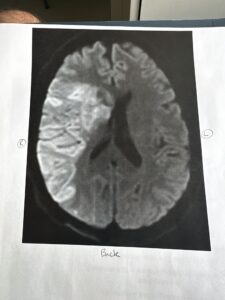
The stroke happened in Northern California after a long day of rock climbing with friends. Brandon didn’t notice the warning signs himself; it was others who saw that his arm wasn’t working properly. Later that night, he became profoundly disoriented.
He was found the next morning, still sitting upright in his truck, barely conscious.
Within hours, Brandon was airlifted to UC Davis Medical Center, where doctors removed a blood clot and performed a large craniotomy due to dangerous swelling. Part of his skull was removed and stored while his brain recovered.
He spent 10 days in intensive care, followed by weeks in inpatient rehabilitation.
Remarkably, he reports no physical pain throughout the entire process, a detail that underscores how differently each brain injury unfolds.
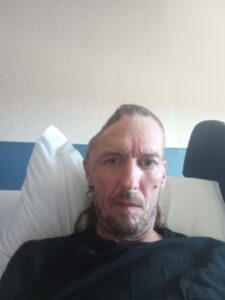
Physically, Brandon’s recovery followed a familiar but still daunting path. Initially, he couldn’t walk. His left arm hung uselessly by his side. Foot drop made even short distances difficult.
But what challenged him most wasn’t just movement; it was orientation.
He struggled to track days, months, and time itself. Short-term memory lapses made planning almost impossible. Writing, once a core part of his identity, became inaccessible. He could form letters, but not their meaning.
This is a common but under-discussed aspect of craniotomy stroke recovery: the loss isn’t only physical. It’s cognitive, emotional, and deeply personal.
“It’s kind of like I’m in this perpetual day ever since the stroke… like Groundhog Day.”
Technology as Independence, Not ConvenienceOne of the quiet heroes of Brandon’s recovery has been voice-to-text technology.
Because writing and spelling no longer function reliably, Brandon relies on dictation to communicate. Tools like Whisper Flow and built-in phone dictation restored his ability to express ideas, stay connected, and remain independent.
This matters.
For stroke survivors, technology isn’t about productivity. It’s about dignity.
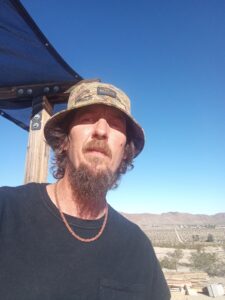
Perhaps the most striking part of Brandon’s story is how little resentment he carries.
He doesn’t deny frustration. He doesn’t pretend recovery is easy. But he refuses to live in constant rumination.
Instead, he adopted a simple principle: one problem at a time.
That mindset reshaped his lifestyle. He stopped drinking, smoking, and using marijuana. He slowed his pace. He became more deliberate with relationships, finances, and health decisions. He grew closer to his adult daughter than ever before.
The stroke didn’t erase his identity, it refined it.
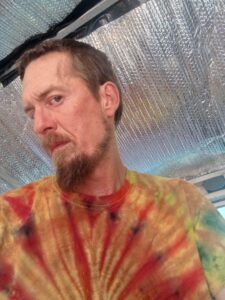
A turning point came when Brandon realized he couldn’t rely solely on the medical system.
Insurance changes, rotating doctors, and long waits forced him to educate himself. He turned to what he jokingly calls “YouTube University,” learning from other survivors and clinicians online.
That self-directed approach extended to major medical decisions, including choosing monitoring over immediate invasive heart procedures and calmly approaching a newly discovered brain aneurysm with information rather than fear.
His conclusion is clear:
Recovery belongs to the survivor.
Doctors guide. Therapists assist. But ownership sits with the person doing the living.
A Message for Others on the JourneyToward the end of the conversation, Brandon offered advice that cuts through fear-based recovery narratives:
Don’t let timelines define you.
Don’t rush because someone says you should.
Don’t stop because someone says you’re “done.”
Every stroke is different. Every brain heals differently.
And recovery, especially after a craniotomy, continues far longer than most people are told.
Moving Forward, One Intentional Step at a TimeCraniotomy stroke recovery isn’t just about regaining movement. It’s about rebuilding trust with your body, reshaping identity, and learning how to live with uncertainty without letting it dominate your life.
Brandon’s story reminds us that even after the most extreme medical events, calm is possible. Growth is possible. And a meaningful life, though different, can still unfold.
Continue Your Recovery Journey
 Learn more: https://recoveryafterstroke.com/book
 Support the podcast: https://patreon.com/recoveryafterstroke
Disclaimer:
This blog is for informational purposes only and does not constitute medical advice. Please consult your doctor before making any changes to your health or recovery plan.
Brandon’s Story: Surviving a Craniotomy, Redefining Identity, and Recovering on His Own TermsHe survived a stroke and craniotomy, then calmly rebuilt his identity, habits, and life one deliberate step at a time.
 Research shortcut I use (Turnto.ai)
I used Turnto.ai to find relevant papers and sources in minutes instead of hours.
If you want to try it, here’s my affiliate LINK
You’ll get 10% off, it’s about $2/week, and it supports the podcast.
Highlights:
00:00 Introduction and Background
01:52 Life Before the Stroke
03:32 The Stroke Experience
11:03 Craniotomy Stroke Recovery Journey
17:09 Adjusting to Life Post-Stroke
28:46 Living Independently After Stroke
35:09 Facing New Challenges: Aneurysms and Uncertainty
42:13 Support Systems: Finding Community After Stroke
47:06 Identity Shift: Life Changes Post-Stroke
58:39 Lessons Learned: Insights from the Journey
Transcript:
Introduction and Background
Brandon (00:00)
next morning
was still in the driver’s seat with my head on the steering wheel.
and I couldn’t make either of my arms work
I had been bleeding into my brain for 12 hours overnight they had to go ahead and do a,
craniotomy. And so they took this whole side. It was a big craniotomy.
They took that whole section of my skull out, put it in the freezer
Bill Gasiamis (00:27)
Before we begin today’s episode, want to take a moment to speak to you directly. If you’ve had a stroke, you already know this part. The hospital phase ends, but the questions don’t. You’re sent home expecting to get on with it. And suddenly you’re left trying to work out recovery, mindset, fatigue, emotions, sleep and motivation all on your own. You shouldn’t have to. That’s why I wrote my book, The Unexpected Way That a Stroke Became the Best Thing That Happened.
Not to tell you what to do, but to walk beside you and show you the tools real stroke survivors use to rebuild their lives when the system stopped helping.
and now with this book, you won’t have to figure it out alone.
You can find that at recoveryafterstroke.com/book. All right, let’s get into today’s episode. Today, you’re going to hear from
Brandon Barre. Brandon was 46 years old, active, independent and living an unconventional life when he had a stroke that led to a craniotomy.
where part of his skull was removed to save his life. What stood out to me immediately about Brandon wasn’t just the severity of what he went through. It was the calm grounded way he approached recovery, identity and rebuilding his life. This is a conversation about stroke recovery. Yes, but it is also about mindset, ownership and what happens when you decide to take recovery into your own hands.
Life Before the Stroke(01:52)
Brendan Barre, welcome to the podcast.
Brandon (01:54)
Thank you, man.
(01:56)
You struggled a little bit getting here. There’s a couple of little things that caused a bit of a challenge for you. What are those things?
Brandon (02:05)
Well, I mean, first of all, I’m, I’m, I’m, even before my stroke, I was never very computer-y. Um, so using my phone for more than just making phone calls is kind of new to me. Um, so yeah, a new microphone, that was fun. And then I had made a bunch of notes, not realizing that I probably wasn’t gonna be able to see those notes. Um, you know, so that was also a little bit of a issue, but uh, but yeah, other than that, man.
Not much, you know, I mean I’m here.
(02:37)
Yeah. I remember receiving your emails about, I’m not sure what day we’re on. I need to reschedule all that kind of stuff. Stuff that I used to do heaps. I remember in the early days of my kind of stroke recovery, I used to make appointments, put them in my calendar, get reminders about my appointments and still be confused about the day, the time and the location of the appointment.
Brandon (03:04)
Yes, absolutely. That’s a big thing for me too. know, and I mean even just, you know, remembering from minute to minute where of what day, what month and everything I’m in right now is a little bit tricky still. It’s getting better, but ⁓ but yeah, I still have a lot of trouble. I can always think of every month except for the month that we’re currently in.
(03:24)
Okay, so you have like a short term memory thing, is it? Or…
The Stroke Experience
Brandon (03:28)
Yes, yes, have short-term memory issues. ⁓ A lot of times ⁓ I struggle to find, like I said, the date and everything else. ⁓ But I don’t know, man. It’s kind of like I’m in this perpetual day ever since the stroke, and I have trouble keeping track of exactly what that is on everybody else’s time frame.
(03:53)
Like a, like a groundhog day.
Brandon (03:55)
Yes. Yeah. You know, I mean, if I really work hard and think about it, I can figure out what day it is, but it takes a while generally to get the month.
The day of the month isn’t quite as difficult anymore, but at the beginning I had trouble with the whole thing.
(04:11)
I hear you man, I totally hear you. I reckon there’s been a ton of people that relate to what you’re saying. ⁓ Tell me, day like before stroke? What’d you get up to? What type of things did you involve yourself with?
Brandon (04:23)
Well, ⁓ you know, I was, I was really involved in, ⁓ production of music festivals and, ⁓ doing that kind of work. ⁓ I’ve always kind of freelanced. Well, you know, I actually, ⁓ left traditional life in 2000 and ⁓ January 1st of 2012 and started traveling and, you know, living out of an RV and whatnot. Before that, I was in the oil field.
I’ve worked as an MWD specialist on a drilling rig, which means that I used to ⁓ take down all the information about where the actual drill bit was underground and send that off to all the geologists and everybody else so they can make sure that the well was going in the right direction. And, ⁓ you know, I just really didn’t feel happy in life, man. So I decided to take off and see the states out of my RV. And that started about 10 years of travel. And then
In 2019 I bought some property and started to kind of slowly come off the road and started to be on my property more often but you know it just yeah I don’t know man my life has been a lot of different transitions one thing to another I move around a lot in life.
(05:25)
you
Yeah, so the RV was kind of just exploring seeing the country Doing that type of thing or was it going somewhere with a purpose say to get work or to? Hang out there for a little while. What was that all about?
Brandon (05:57)
A little bit of all of it. A little bit of all of it. I’ve always been able to find work where I go, you know, doing different things. But I kind of fell into music festival work, like setting up and tearing down for music festivals and building art installations, doing like mandalas out of trash and stuff like that. And just kind of always did kind of the artist thing, I guess you could say.
Even before, while I was still in the oil field doing the traditional life thing, I was always very art motivated.
(06:30)
Yeah, when you talk about traditional life, you’re talking about nine to five kind of routine and working for the man type of thing. Is that what you mean by traditional life?
Brandon (06:43)
Yes, except mine was a little bit different. My work in the oil field involved me being on site on the drilling rig for up to six weeks sometimes. So it wasn’t really nine to five. I would stay gone for a lot more than that. But then when I would go home, I’d be off for three weeks, a month. So yeah, just ⁓ doing that.
(07:07)
Where were these oil rigs? Were they in the middle of a desert? Were they in the ocean?
Brandon (07:13)
No, they were all onshore and I worked a lot in like Pennsylvania, but also a lot in Texas ⁓ Just you know anywhere where they were doing natural gas drilling
(07:27)
And is that a remote kind of existence in that if you’re on the rig for six weeks, are you getting off it? Are you going into town? Are you doing any of that stuff?
Brandon (07:38)
Usually the rigs are within an hour of some type of small town usually a Walmart that type of thing So I would go and get groceries a couple of times a week You know me and the other guys would go out and get you know dinner times and whatnot but ⁓ but yeah, basically just sitting in a little trailer a directional trailer is what they called it because it was me and ⁓ Two two other three other guys two more ⁓
directional drillers and then one other MWD hand which is what I was and so there was a night shift and a day shift of two guys each.
(08:16)
12 hour shifts.
Brandon (08:17)
Yes.
(08:18)
Dude, hard work.
Brandon (08:21)
Yeah, I mean on paper it was hard work. In real life, I mean there were those really problematic jobs where you know everything went wrong but in most cases it was just you know taking a bunch of measurements on the computer whenever they would add another link of pipe to the drilling string and drill down further so every time they would add another length of pipe I would have to take more measurements.
(08:47)
I hear you. So not physical, but still mental. And you’ve to be on the go for a long amount of time.
Brandon (08:56)
Right, but yeah, I mean it did when I would have to go up on the rig floor to like change the tool out or to put something You know together or what not so there was a little bit of that but still not as physical as like a traditional drilling rig roughneck
(09:04)
Uh-huh.
I hear you. Yeah. Everyone’s seen those videos on YouTube with those guys getting covered in that sludge and working at breakneck speeds so that they can make sure that they put the next piece on.
Brandon (09:24)
Yeah, yeah, no, I, you know, and I mean, I wore my share of that mud, but not near as much as a floor hand would.
(09:34)
I hear, I feel like you’re, ⁓ you’re toning it down and you’re making it sound a lot more ⁓ pleasant than what it might be. But I appreciate that, man. like the way you talk about things. I couldn’t imagine myself doing that, that level of physical labor. Maybe I’m just a bit too soft myself.
Brandon (09:54)
Yeah, no, I don’t know, man. I consider myself soft in a lot of ways, too, man. You know, it’s just, we’re all different in our softness.
(10:02)
yeah. ⁓ tell me a little bit about, ⁓ your stroke, man. Like what was that particular week? Like the day? Like how did the lead up happen?
Bill Gasiamis (10:12)
Let’s pause for a moment. If you’re listening to this and thinking, I wish someone had explained this part to me earlier. You’re not alone. One of the hardest parts of stroke recovery isn’t the hospital. It’s what comes after when the appointments slow down, the support fades and you’re left trying to make sense of what your life looks like now. That’s exactly why I wrote the unexpected way that a stroke became the best thing that happened. It’s not a medical book. It’s a recovery companion built from real experiences.
real mistakes and real breakthroughs that stroke survivors discovered along the way. If you want something that helps you think differently about recovery and reminds you that you’re not broken, you can find the book at recoveryafterstroke.com/book. Let’s get back to the conversation with Brandon.
Craniotomy Stroke Recovery Journey
Brandon (10:59)
Okay, so I was helping a friend in Northern California to clean a property that was owned by an artist who had died and we went on to his 10 acre property and we’re just cleaning up for his family. But he had like all kinds of art stuff everywhere and so it was kind of right up my alley and ⁓
We were just trying to get the property clean for these people and we decided to take off and go and do a little bit of rock climbing. so we took off early one morning and drove to a town called Willets, California where there’s good rock climbing and we spent the day doing rock climbing which was a fairly new thing to me but the guys that I was with were very experienced lifelong climbers.
And so I was kind of the new guy and they were showing me the ropes and we climbed all day. I did really well, I thought, and didn’t really notice anything. No problems. ⁓ Got back in the car. We’re headed back to the house about an hour away, a friend’s house where we were all going to stay the night. And on the way there, I
noticed that I was really thirsty and I stopped and I got two 40 ounce bottles of Gatorade and I drank them both immediately and like just downed them and still didn’t notice anything was a problem was in the truck by myself with my two dogs and eventually I guess about an hour later we got to the house
And I went inside to hang out with everybody. And one of my friends said that my arm wasn’t working well. I didn’t notice it at all, but he said that my arm wasn’t working very well. ⁓ so ⁓ I just kind of went on with my life. a couple of, I guess about an hour later, I decided that I was really tired.
and I could not quench my thirst so I just grabbed a whole bunch of water and went out to my truck and I was gonna go and lay down and sleep in the back of my truck for the night and ⁓ when I got out to my truck ⁓ by this time my friend had said that my arm was working fine again and he noticed that I he felt like I had gotten over whatever it was and so I went out to my truck got into the driver’s seat of the truck
And that’s about the last of my recollection that night.
next morning when I wasn’t up making breakfast before everyone else, they realized there was a problem because I was usually the first one up making breakfast and doing all that stuff and I wasn’t there. So my friend came out to my truck to check on me and I was still in the driver’s seat with my head on the steering wheel. I never even fell over.
(14:05)
Hmm.
Brandon (14:17)
And so this is 12 hours later. And so ⁓ he tried to wake me up and I was only halfway coherent and I couldn’t make either of my arms work and only one of my legs could I get any response from. So he realized there was a problem immediately, pushed me over into the passenger side of the truck
got in and drove me an hour to the closest hospital, just a small little regional hospital. And they were pretty quick about realizing that I was having a stroke. And they didn’t even, I don’t even remember them putting me in a room. They brought me straight up to the roof and put me in a helicopter and helicopter and helicoptered me to UC Davis hospital in Sacramento.
(14:59)
Wow Wow
Brandon (15:15)
And I got into the hospital and within, I think about an hour and a half, they had called my mom and my brothers who were all in Louisiana at the time. And they had gotten permission to start treatment and they brought me into the surgery. at first they just
(15:25)
The The following is a video of the first year of
Brandon (15:45)
removed
a three millimeter blood clot from my main artery on the right side. But then the swelling was so bad because I had been bleeding into my brain for 12 hours overnight that they had to go ahead and do ⁓ a, what do you call it? The craniotomy. Yeah, craniotomy. And so they took this whole side. It was a big craniotomy.
(16:05)
Craniotomy
Brandon (16:12)
They took this whole side, everything to the center of my forehead, above my eye, down to just above my ear, front to back. ⁓ They took that whole section of my skull out, put it in the freezer so that my brain had room. then I spent 10 days in intensive care recovering from that. And then they moved me to a rehab hospital where I spent four weeks.
And yeah, so in that rehab hospital, yeah, immediately after the surgery, I couldn’t walk and I had pretty much no function on my left side, know, arm or leg. But by the time I got to the rehab hospital, I had gotten some control back, but I still couldn’t walk. ⁓
(16:44)
Wow, man.
Adjusting to Life Post-Stroke
Brandon (17:10)
And that about a week after I was in the rehab hospital is when I started to walk again without assistance. So that came back fairly quickly, but I still had really bad foot drop and my left arm wasn’t working. It was hanging, you know? And then, so they kept me in there, ⁓ you know, going through, I guess, regular rehab.
(17:24)
Thank
Yep.
Brandon (17:36)
They the series of lights on the ground in front of me and I’d have to like run around and touch the different lights as they would activate and you know, I don’t know I mean, I guess it’s the same type of rehab stuff that most people go through and ⁓
(17:51)
Yeah, it’s probably
similar. Mate, ⁓ this is what I really want to know is what’s it like to experience having half of your skull removed? Can you somehow paint a picture of what it’s like to go through that process and how aware were you of it? Because you just had a stroke, right? So you’re in a bit of a challenged sort of healthy health state.
Brandon (18:14)
Right.
No.
Yes.
⁓ well, I think that that deliriousness was actually kind of helpful. First of all, I have not experienced any pain through the entire process. From the stroke, no pain from the craniotomy, no pain through rehab. I have not experienced any pain through this entire experience.
None whatsoever. Now the doctors say that I might have lost some of that ability to sense it But you know, I mean whatever it took I Really, you know, I didn’t you know, whatever the reason was The effect of it was that I had a pretty fame pain free experience, you know
(19:07)
and you’re like looking in the mirror and seeing yourself and you know, like experiencing your head and how do you kind of deal with all of that?
Brandon (19:21)
Well, ⁓ I couldn’t feel a whole lot. I still have a lot of, or not so very much sensation on my scalp on that side. So, you know, but as far as looking in the mirror, that was kind of interesting. You know, it took a little while to get used to it, you know, and, it, ⁓ was definitely not something that I would recommend.
Anybody else going through if they don’t have to you know, but ⁓ But I don’t know man. I mean, I’ve always tried to stay pretty positive about things and so, you know, I just Kept going, you know, I mean they shaved my head. I had dreadlocks for a very long time I had dreadlocks and And so this is all the hair that I’ve gotten since they put my skull back together, which was January or it’s actually
It’ll be one year tomorrow since they put my skull back together. So, ⁓ my hair is coming back, which I’m really grateful for. About this time next year, I’m gonna start trying to put my dreadlocks back in. you know, but yeah, it’s, I don’t know, man. It’s really been an interesting ride. ⁓ You know, ⁓ learned a lot more about stroke than I ever thought I would need to.
You know, I mean, I’m 48 right now. I was 46 when the stroke happened. So it wasn’t even on my radar, man. I wasn’t paying any attention at all. I didn’t know the anagrams or whatever. I didn’t know the symptoms of stroke. So I just kind of rolled with the punches as they came. I took it one step at a time. And that’s kind of the way it’s been with my recovery too.
is I try to address one problem at a time so I don’t overwhelm myself. So after I started to get my leg back, I started to shift my influence to my shoulder and my arm. And at this point, I’ve got almost full range of motion back to the left side. I still can’t write. ⁓ Well, actually, technically, I can make my whole alphabet and all of my numbers with
(21:16)
Yep.
Brandon (21:37)
both hands at this point. trained myself to use the other hand and then about the time I was able to get that back the other hand started to come back online. So now I can do all that with both hands but words I’m word blind and numbers and letters don’t make a lot of sense to me. So even though I can make the shapes I have a lot of trouble associating the sounds of certain letters and the functions.
of different numbers and letters, you know? That’s where a lot of my trouble is now, and that’s where most of my work is at the moment.
(22:14)
I hear you. So you sound like you’re very cool, and collected. How do you remain positive when you wake up from a stroke? You’re missing half of your skull. Your body doesn’t work on half the side. Is it your default? Do you have to work on that? Have you been working on being positive over?
the decades that you’ve been on the planet, give us a bit of an insight into that part of you.
Brandon (22:47)
Okay, so yeah, I think I’ve always maintained a pretty positive demeanor, you know, I mean I’ve gone through some rough stuff in life, but I’ve just kind of kept going, you know, rolling with the punches. So I really don’t think that I have had much difficulty remaining positive through it. You know, there’s ⁓ definitely, you know, ⁓ days that I don’t feel as good as other days, you know, and you know, I definitely have… ⁓
things that I have to work through. have to, you know, I have to make an effort to remain positive, you know, at times. But my default has always been to be a pretty positive and happy person. So I think that that was really the majority of it is that I’ve always even in the light of extreme adversity, I’ve always been able to remain positive. You know, ⁓ so that that’s always been, you know, key even before the stroke. But
(23:39)
Yeah.
Brandon (23:46)
Yeah, I mean definitely waking up and realizing that half of my body didn’t work anymore was not fun, but it’s what I was given. I couldn’t change it, you know, only time and work was gonna change it. So I just kinda accepted it, you know, I mean, ⁓ one of the biggest things that helped me out was by the time I got out of surgery and started to get coherent,
My mom and my brother had already flown from Louisiana to be with me in California at the hospital. And that was huge just to know that my family was there. And they stayed with me for the whole time that I was ⁓ in the hospital for the 10 days. And then when I went to the rehab hospital, they went home. ⁓ But yeah, so that was ⁓ just really, that was a big part of it too, you know, I mean.
My mom and my brothers are pretty much the most important people in my life. Of course, my daughter as well. yeah, so, you know, to have them all there and just to have that support and have them there to help me because when I first came out, from the time I came out of surgery, I could still speak very clearly. So I did not know what I was saying.
(24:56)
Mm-hmm.
Brandon (25:15)
Nobody could tell like I wasn’t making a lot of sense, but I never lost my voice They think that that’s because of my left-handedness Because I’m left-handed I store things like that differently in my brain So because of that I was able to keep my speech even though I cannot write I can’t do you know I mean I can write my letters, but if I try to
(25:32)
Okay.
Brandon (25:44)
make a word this was yesterday
(25:48)
Aha! Lux-
Brandon (25:50)
But I can,
yeah, it’s just scribble. It’s just scribble. Yeah, but, you know, if I try to like draw a letter or a number, I can do it, but I have trouble assigning it to its value.
(25:53)
Yeah.
Understood. So before that, were quite capable of stringing sentences together, writing things down, doing all that kind of stuff. So that’s a very big contrast.
Brandon (26:14)
I have always been known.
Huge contrast.
(26:22)
Is it frustrating that you can’t write in the way that you did before? it matter?
Brandon (26:27)
Yes, yes, I used to write all the time, know, poetry, things like that. I’ve always been considered, you know, a good writer, a good orator, public speaker, you know, that kind of thing was a big part of my life, for my whole life. And so to go from that to not being able to write a sentence on a piece of paper or even a word is really a big change for me.
You know, and I mean I do use my phone for voice to text. If I wouldn’t have had voice to text, I really don’t know where I would be right now.
(27:06)
Is that how you communicate most things?
Brandon (27:09)
Yes, absolutely. it’s- if I can’t say it, like speak it, I have to use voice to text. I can’t spell- I can’t- I can’t spell my own name half the time.
(27:17)
Dude, I love that.
Yeah, I hear you. I love voice to text. So I was told by a friend of mine about a product called Whisper Flow. I’m gonna have links in the show notes and in the description on the YouTube video, right? And it’s spelled W-I-S-P-R-F-L-O-W, Whisper Flow. And what you do is you program one key on your keyboard. And then what you do is you press that key and it activates
Brandon (27:36)
Yes.
(27:52)
the app and then you speak and it types beautifully. It types at all. And I’m a terrible like typist. I could never be one of those really quick secretary kind of people and take notes because I’m not fast enough, but it can type for me by speaking like beyond 99 words per minute, which I think is crazy fast.
Living Independently After Stroke
And I do it because it just saves a heck of a lot of time, me looking down at the keyboard and all that kind of stuff. My left hand does work, but I can type with it, but often my left hand, you know, we’ll miss the key and I’ve got to go back and do corrections and all that kind of stuff. So voice to text, this comes such a long way and everyone needs to know, especially if they’ve had a stroke and one of their limbs is affected, especially if it’s their…
they’re riding limb or if they have a challenge like you, everyone needs to know about the fact that technology can really solve that problem. I’m pretty sure, I know this sounds like an ad for Whisper Flow, it probably is, but I’m not getting paid for it. I think they cost, it costs about hundred bucks a year to have this ⁓ service. So it’s so affordable and it does everything for you just at the touch of one button on your computer.
And for some people you can also use it on your phone. But I think phones are pretty awesome at doing voice to text already. So you don’t really need ⁓ it for the phone, but you definitely need to check it out for the computer.
Brandon (29:27)
Okay, yeah, well, you know, I pretty much have my phone. I don’t have a computer, so… But, ⁓ it does sound like an amazing product, and I am looking to get myself a computer because I really, ⁓ like, I haven’t touched a keyboard since my stroke. So, it would be nice to get myself a laptop with a keyboard so that I could start working on trying to see how that interface works for me.
(29:33)
Yeah.
Yeah. How was the transition out of hospital and rehab back to your place? and how long after the initial strike did you end up back at home?
Brandon (30:04)
Okay, so, when I, I left the hospital after, or I’m sorry, after 10 days in intensive care, they put me in the rehab hospital and I was there for four weeks. After that, they still didn’t think that I was ready to live by myself yet. So I had to, ⁓ rent a house in Joshua tree from a friend of mine who lived on the property in another house.
And so I had a whole house to myself still which allowed me to keep my independence. But I still had somebody close enough to holler if I needed anything. And so I kind of, you know, baby stepped by renting a house, you know, for a while. And, And I have property in Northern Arizona where I normally would take my off time when I wasn’t traveling. But, ⁓
But, ⁓ because of the stroke, I wasn’t able to go back to that property for quite a while. And only about Christmas of last year did I start to be able to spend some more time on my property, you know. But at this point, I’m still renting the house in Joshua Tree and starting ⁓ to branch out a little bit more, do a little bit more traveling, things like that. Now with that said…
I have been ever since the stroke happened about two months after the stroke I went back to my first music festival. So I didn’t have half of my skull. I had to wear a helmet for six months. And so here I am at a music festival with all of my friends and I’m in a helmet with half of my skull missing. But I still was able to be there and then ⁓
you know, be a part of the festival. So I got back to the activity that I enjoyed pretty fast.
(32:07)
What genre of music?
Brandon (32:09)
Well, it’s actually the Joshua Tree Music Festival in particular, which is the only music festival that I’m really involved with anymore. ⁓ They do world music. We get artists from all over the world in. And that’s kind of one of the reasons I’ve continued to be a part of this music festival and really haven’t been that big of a part of the other ones is because I’m always learning about new music when I go there. And that’s a big important part of it to me.
(32:40)
Understood. So your transition back to living alone took a little bit of time. You’re renting a place. Are you alone there? Are you living with anyone else? How is the home set up?
Brandon (32:55)
I have a home all to myself but there is a shared home on the other or on the property that a friend of mine lives in and he’s actually the one that I’m renting from so yeah
(33:09)
So you have access to support to help to people around you if necessary.
Brandon (33:15)
if I need it. also another big part of one of the symptoms of my stroke is that I don’t recognize my own disabilities. I have a lot of trouble with that. So I generally do not ask for help with things, which in a lot of cases has made me a lot stronger and I think been a big part of a speedy recovery. But at the same time, I can put myself in some kind of sketchy situations at times.
(33:43)
It’s not, are you sure it’s not just your male ego going, I can do this, I don’t need help.
Brandon (33:49)
I mean, I’m sure that that does tie into it, I’m certain. But yeah, that’s one of the things that I’ve struggled with from the beginning. And I didn’t recognize the left side of my body as my own. I thought it was somebody else’s. That wasn’t very long, just for maybe the first couple of weeks. But that was a very interesting sensation, that I felt like there was somebody else there.
(34:06)
Wow.
Yeah, it just feels like it’s my, I kind of describe my left side as if it’s because my star sign is Gemini, right? So now I describe it as being the other twin, like the other part of me, which is me, but not me. And it’s so strange to experience 50 % of my body feeling one way and then 50 % of my body feeling a completely different way, which is
Brandon (34:25)
Yeah.
Facing New Challenges: Aneurysms and Uncertainty
(34:44)
the only way I remember and then tying them together, like bringing them together has been a bit of a wild ride, like just getting them to operate together. When they have different needs, my left side has different needs than my right side. And sometimes one side is getting all the love and the other side is missing out. And I’m always conflicted between where do I allocate resources? Who gets…
how much of my time and effort and who I listen to when one of them’s going, my left side’s going, I’m tired, I’m tired. My right side’s going, the party’s just started. Let’s keep going. Don’t worry about it.
Brandon (35:25)
I have to deal with that. Of course, my left gets a lot tighter than my right side, but I don’t know. think I’ve done a pretty good job of giving it that care. And a big part of where I measured my success was getting my shoulder back online and being able to pronate and go above my head. It took months to get my hand over my head. But
But at this point, you know, I’m pretty much back to physically normal except for the fine motor skills on my right, on my left side. You know.
(35:59)
Sounds like things are going really well in really small increments. And if you’re only, what, two years post stroke, sounds like recovery is gonna continue. You’re gonna get smaller, more and more small wins and they’re gonna kinda accumulate and make it pretty significant in some time ahead.
Brandon (36:17)
Right.
It’s a year and a half. So my stroke was on the 4th of November of 2024.
(36:32)
Yeah. Do you know in this whole time, did you ever have the…
like, this is too hard, I don’t want to do this. Why is this happening to me kind of moment? Did you ever have any of that type of negative self talk or thoughts?
Brandon (36:50)
no, I mean, I suppose there probably were moments, but I don’t pay a lot of attention to those kinds of moments. You know what I mean? I do kind of even without the stroke, maintain a pretty positive mental attitude, you know, and I think that that’s been one of my biggest blessings through this. ⁓ yeah. So yeah, that’s never really been a good emotion.
(37:12)
I
get a sense that you have those moments, but you don’t spend a lot of time there. Is that right? Is that what you just sort of alluded to that you have those moments, you just don’t give them a lot of time. Therefore they don’t really have the opportunity ⁓ to sort of take up residence. And then you just move on to whatever it is that you’re getting results with or makes you feel better or… ⁓
supports your project which is ⁓ recovery or overcoming or…
Brandon (37:48)
Yes.
No, I completely agree. ⁓ You know, I mean, speaking of which, four days ago, I got ⁓ a phone call from the doctors. ⁓ They found an aneurysm in my brain. So I have to go and meet with a neurosurgeon on Tuesday to discuss what we’re going to do about a brain aneurysm. So I thought, you know, I was just about back to normal.
And here I go into another situation. But again, until I know what’s going on, there’s no point in worrying about it, you know? So I’ll know more about it on Tuesday, but until then, I’m not spending a whole lot of time wondering, you know, am I just going to have an aneurysm and collapse tonight? You know?
(38:36)
that tends to be my default as well. I was really good as a kid. ⁓ When I was being cheeky and not doing my homework for school, I would go to bed and I would remember, I haven’t done my homework. And then I’d be like, yeah, but you can’t solve that problem now. Now you got to sleep, right? So you got to worry about that in the morning after you’ve had a good night’s sleep and you wake up and then deal with it. And that was a strategy to help me forget about that.
minor problem, which back then, if you haven’t done your homework as a teenager, that was a big problem. If your teachers found out, if your parents found out, but the idea was that, don’t I just pause all of the overthinking? Why don’t I just pause all of the rumination and all the problems and all that stuff that it could cause for now. And I’ll worry about it when there’s a opportunity to have the resources to do something about it.
And the classic example was in the morning, I would have an hour before school where I could reach out to one of my friends, take their homework, copy their homework, and then hand in my homework.
Brandon (39:46)
Absolutely. Yep, that was very much like me in school.
(39:51)
Yeah, not much point worrying about things you can’t change or control in the moment. Just pause it, deal with it later. I had a similar situation with my bleed in my brain, because I had a number of different bleeds and it was kind of in the back of my mind a little bit. What if it happens again? But it actually never stopped me from going about life from bleed one through to bleed two.
was only six weeks, but like through blade two to blade three, it was about a year and a half. But I got so much done. I was, we were just going about life. was struggling with memory and all different types of deficits because of the blood clot that was in my head. But I never once kind of thought about what if something goes wrong, unless I was traveling.
to another country, because we did go to the United States when I was about almost a year after the first and second bleed, we went to the United States. And then I did worry about it from a practical sense. It’s like, if I have a bleed in Australia, I’m near my hospital and then they can take over from where they left off previously and healthcare is paid for here. So there was no issue.
But if I’m overseas and something goes wrong, I’m far away from home, we got to have the expensive insurance policy. Cause if something goes, I want to be totally covered when I’m in the United States, we don’t know the system. don’t know all these things. So that was a practical worry that I had, but I didn’t worry about my health and wellbeing. Do you know? I worried about the practicality of having another blade in the airplane because then I’m in the middle of the ocean.
over halfway between Australia and the United States. And that’s eight hours one way or another or something. And I thought about that, but I didn’t think about how I would be personally ⁓ negatively impacted by the medical issue. I just thought about the, do we get help as quickly as possible if something were to happen? So I know a lot of people have a stroke and they,
Brandon (41:55)
Right.
Support Systems: Finding Community After Stroke
(42:18)
⁓ They overthink about what if it happens again and they’re constantly kind of got that on their mind, but I was dealing with just the moments that made me feel like perhaps I should do something about this headache that I’m getting. I dealt with things as they appeared, as they turned up, I didn’t try to plan ahead and solve every problem before it happened.
Brandon (42:24)
Yeah.
Yes, I agree. I’m very much the same way. You see, before my stroke, I didn’t have medical insurance. I hadn’t seen a doctor since my early 20s. just, I was, I was, I had always been extremely healthy. You know, I’ve always been very physically active, you know, and, so it just, I never really, I never really ⁓ went out and looked for medical. I just didn’t need it, you know? And so,
When the stroke happened, I was very lucky to get put on California’s healthcare plan. And they’ve taken care of all of my medical bills. ⁓ You know, I’ve never pulled a single dollar out of my pocket for all the rehab, all the doctors since. And I mean, I have doctors still once every week, two weeks at the most, doctor visits, you know? And so I’m extremely fortunate.
that it happened to me where I was, you know, because not all states here are like that, but California is extremely good. So, you know, I’m really grateful that it worked out the way it has because it could have been a whole different situation, man.
(44:00)
I have heard some horror stories about medical insurance for people who are not covered, have a stroke and then they leave hospital with like a $150,000 bill or something. Is that a thing?
Brandon (44:13)
Yes, it really is. I mean, I was extremely fortunate. By the time I got out of that first 10 days with the helicopter ride and everything else, I was close to $2 million in bills.
(44:25)
Dude, that’s mental.
Brandon (44:26)
Yeah. And, ⁓
yeah, I mean, it just doesn’t really, I mean, you know, I mean, I’m not a big fan of, the way that the medical system works money wise. think it’s all just paper or fake money, just fake numbers, you know, but yeah, I don’t know. I just, ⁓ I was extremely fortunate that it all happened the way that it did and that California is so good and they really do take care of their citizens, you know, so.
(44:54)
Yeah, I love that.
Brandon (44:55)
Yeah, very
fortunate.
(44:57)
You know, in your recovery, did you have somebody that you kind of leaned on for support that was a confident, ⁓ that was like a mentor or did you have somebody like that in your life that was really helpful in your recovery?
Brandon (45:15)
Actually in about the year before my stroke I lost the three gentlemen that I had always considered my mentors, older guys that I’ve known for years. They all three passed away the year before my stroke. So I really kind of felt on my own. You know, I have a lot of friends, you know, but ⁓ but after my stroke I really don’t have the brain space for like Facebook or anything like that.
So I really, closed down my very active Facebook account and when I did that, I lost so many people that would have been my support because I just, they weren’t there, you know, in real life. They’re only there on the computer, you know? And so, but luckily, you know, I’m a part of the community in Joshua Tree. So I had a lot of support from people there and… ⁓
Then I have probably four or five other friends that are scattered around the United States that I keep in touch with pretty closely. But I went down from talking to hundreds of people a month and all of that on the internet to really a very small closed social circle, you know? And then in addition to that, surprisingly,
people that I’ve known for years just are not very good at accepting the differences in who I am as a person since the stroke, you know? And so, you know, I hate to say it, but a lot of friendships have kind of gotten a lot more distant since the stroke. you know, it’s just, I mean, it is what it is. You know, people have to do what they feel is right for themselves, you know? But yeah, I really… ⁓
Identity Shift: Life Changes Post-Stroke
(47:06)
Yeah.
Brandon (47:07)
I don’t have a very large support network. You know, I just basically kind of take care of a lot of it myself. You know, I mean, I did two and a half months of outpatient rehab with a occupational therapist. And what’s the other one? Occupational and physical therapy.
(47:33)
Mm-hmm.
Brandon (47:33)
So I
did occupational and physical therapy for about two and a half months after I got out of the hospital. And that was all really good and helpful. And ⁓ I’m really grateful for those therapists that worked with me. And they helped me get ⁓ basically back to a normal cadence because I was having trouble putting one foot in front of the other. And they really helped me work on my cadence and getting my walk back to fairly normal. ⁓ My arm.
has been mostly me. It has never been able to be rushed. It takes its own time. So even with the physical therapy, my hand coming back, it works at its own pace. That was never really influenced that much by physical therapy. And then my actual use of my hand, I was balled up. I was curled up and balled up to the wrist.
after the stroke and eventually I got to where I could hold it out flat and I still tremor a lot there but it’s a lot better than it was and but yeah all of that had to come back at its own pace the physical therapy and stuff was helpful for a lot of other aspects of my recovery but that was all just taking its own time and coming back as I guess as it did my brain learn to re-communicate
(48:58)
Yeah, it sounds, it sounds like you’re kind of really well made up somehow, like you picked up the skills early on in your life to be able to deal with this situation. The way that you do is just amazing. Like it’s
seems like it’s second nature, the way that you go about approaching the problems, the challenges, the difficulties, know, the missing half your skull, all that thing. It just seems really innate that you have that within you. you, people are listening and going, you know, that’s not me or I didn’t experience that or I’m overthinking things. Do you think that’s the way that you’re approaching things is teachable, learnable? Can people change the way
that they’re going about ⁓ relating to their stroke or dealing with their stroke or managing it.
Brandon (49:53)
⁓ you know, I think that that you’re going to find that a lot of people, can be taught and a lot of people, can’t be taught. You know, some people’s nature just is not going to be able to handle that. But other people, you know, I think that you can go through very real processes to gain, ⁓ knowledge base, you know, to be able to start working with it. You see another big aspect of my recovery.
is that I immediately after my stroke and getting out of the hospital moved eight hours away from UC Davis Hospital where my original care providers were. So I had to go through a whole new medical plan, a whole new set of doctors and everything else. And that changed on me like three times over the first six months. So I really couldn’t rely on the doctors for support either.
because they were changing so often I would just meet one and the next thing I would know I would have a new doctor coming in or a new healthcare plan and so it took about six months for me to start seeing the same healthcare providers routinely so I went to YouTube University man I found you I found several other people that had these just these huge amounts of information
you know, on how to handle my own recovery. So I took a lot of my own recovery into my own hands. And actually, ⁓ a week ago, I was talking to my neurologist, who is a really amazing lady, and, you know, and had to tell her pretty much that same story that, you know, I couldn’t leave it up to the doctors to fix me. I had to take care of myself.
because of my situation and switching insurance and everything else that I went through, there was just not that much option. ⁓ so, you know, and she was like, I wish that all of my patients had that kind of an outlook. You cannot rely on the medical system to fix you. You know, we were talking about what can help people. I think that’s a really big thing that could help a lot of people is
to realize that you have to take care of your health care decisions. You know, they found a PFO in my heart, a ⁓ Framon Parabot.
(52:24)
A patent for
Ramen Ovali. Hole in your heart.
Brandon (52:28)
Yes,
yeah, they found that and they wanted to fix it and I was like, you know, I’m 47 years old. This is a one-time thing. So I opted to have a loop recorder installed, a loop recorder to measure my heart rhythm and everything and send messages to the doctors at nights about my heart. So that because I thought that was a little bit less invasive.
For my age, the last thing I want is for later in life, my body to start having problems with an implant that’s in my heart. So I decided not to go with that and to go with the less invasive loop recorder, which is still implanted under the skin in my chest, but it doesn’t affect my heart.
(53:08)
Thank you.
Brandon (53:21)
It just sends the information
about my heart rhythm to the doctors so that they can keep track.
(53:26)
and it can be easily
accessed and removed.
Brandon (53:30)
Exactly, exactly. So, you know, I mean, if I have another stroke or if I find through the little device that I’m having trouble with that PFO, you know, then I’ll get the PFO closure done. But until then, I didn’t want to just jump straight to that, you know, three months out of my out of my stroke. You know, I want to make sure that that’s the problem.
because they did pull a 3mm blood clot out of my brain. So there’s a good chance that that went through the PFO and into my brain. But I was also way outside of my normal activity range trying to rock climb the day before. So there’s just, there are too many variables about the experience for me to just want to go and have something installed in my heart permanently, you know?
(54:28)
I hear you. What about the aneurysm? Where is that? What’s the long-term kind of approach to that?
Brandon (54:35)
Don’t know yet. I do not know anything about it. I’ll find out more information on Tuesday They said it’s not it’s not in the same part of my brain that my stroke was So that’s a good thing and there’s a good chance that it may have been there for a long time before the stroke So we just don’t know I don’t know anything about it So that I’m gonna go and meet with this neurosurgeon and decide what we’re gonna do about it
(54:42)
that’s right.
Brandon (55:03)
I think the most likely option, as long as it’s not big, is that they just wait and they monitor it. But there’s also a process where they coil it. They put a coil of platinum into it and pack it off so that it can’t become a problem later. And then the third scenario is that they take another piece of my skull off and go in and actually put a clip on it.
to stop the blood from going into it. So I may actually have to have my skull open back up again. But, again, there’s no point in thinking about it now. I’ll think about it after Tuesday when I figure out where this thing is, what size it is, and all the details of it, you know?
(55:46)
Yeah.
I love it. I love it. I love that man. That’s a great way to approach it. Also, ⁓ I love your comment about YouTube University. I love the fact that people find my podcast sometimes when they’re in hospital because clearly they realize I need to ⁓ learn more about this, understand it and ⁓ straight away they’ve got answers because of YouTube. it’s such a great service. It’s free. If you don’t want to pay for a paid service and all you got to do is put up with
ads that you can skip through most of the time. So I think that’s brilliant. ⁓ What about your identity, man? People have a lot of kind of ⁓ examples of how they have a shift in their identity, how they perceive themselves, how they fit into the world. Did you feel like you have a shift in your identity or the way that you fit into the world? What’s that like for you?
Brandon (56:46)
Well, I mean, I definitely do feel like there was a big shift. Now at the core, I feel like the same person. know, mentally, I still feel like I know who I am, but it definitely has shifted my priorities in life a lot. ⁓ I did not raise my daughter and I developed a much closer relationship to her since the stroke.
and we’ve been spending more time together and just really working on our relationship together. She’s 28 years old. So, you know, that has really been an amazing aspect of my stroke recovery is that I’m closer with my daughter than I ever was. But yeah, I mean, you know, I do things a lot differently. I was a heavy smoker, a heavy drinker, and a heavy marijuana user.
I don’t smoke marijuana, don’t smoke cigarettes, and I don’t drink alcohol anymore. So huge change in my lifestyle as well. ⁓ But you know, I just I’m not as much of a hurry as I used to. I was always accused of my mind working on too many levels at one time, you know, and had too much on my plate, too much going on in my brain all the time. Now.
My brain doesn’t keep up as well. So I struggle to stay on one subject, much less juggle multiple things in my brain. So it’s really kind of slowed down my whole mental process. But I think that again, that’s in a good way. I think that ⁓ I needed to slow down a little bit in a lot of ways.
Lessons Learned: Insights from the Journey
(58:31)
I hear you. With the alcohol, marijuana and the smoking. So you might’ve been doing that for decades, I imagine, smoking, drinking.
Brandon (58:43)
Yes.
(58:44)
how do you experience your body differently now that it doesn’t have those substances in it anymore? Like, cause that’s a mass, that’s probably one of the biggest shifts your consumption of, we’ll call them, I don’t know, like harmful ⁓ things, you know, like how, so how do you relate to yourself differently now that those things are not necessary?
Brandon (59:12)
You know, I never really had like an addictive aspect. So I really don’t, I don’t feel like, ⁓ I mean, I don’t feel like it’s changed me a whole lot. I just had to take the daily habits out. But after spending a month in the hospital, all of the physical wants, all of the physical aspects of it were already taken care of, you know? So I just had to kind of maintain and not go back to old habits.
So really, I mean, I don’t feel like it was that big of a difference. But now physically, I’ve always been an extremely skinny person. You know, I’m six foot one and I’ve always weighed 135 to 145. Now I weigh 165. So I did put on some weight after stopping all that. But other than that, really don’t notice a lot of
⁓ physical differences. Now, I have not coughed since my stroke. I used to wake myself up at night coughing, but for some reason, like literally when I had the stroke, I have not coughed since. Now I clear my throat a lot more and I have a lot of, we’re trying to figure out why, but I have a lot of problems with my sinuses.
and stuff like that all on the side that I my injury was on this side but on the side the mental side like where it’s all mental stuff that changed the you know all of that I have problems with my sinuses and drainage and things like that so right now I’m seeing an ear nose and throat specialist and we just did a cat scan of my sinuses so I’ll see on the 13th of this next month
I’ll get more information on about what’s going on there. ⁓ really, if that’s all I have to deal with is a one-sided sinus infection, I’m okay with that, you know?
(1:01:23)
Brandon, you’re all over it, man. I love your approach. It’s ⁓ refreshing to hear somebody who’s just so all over getting to the bottom of things rather than kind of just letting them kind of fester, which kind of leads me to my next question is you seem to have gained a lot of learning and growth from all of this. So what… ⁓
What are some of the insights that you gained from this experience that you didn’t expect?
Brandon (1:01:54)
⁓ No, I’m really not sure, man. I’m really not sure. I mean, again, I feel like pretty much going back to the same person. I mean, I have, I think, a little bit more respect for the human lifespan. You know, I was one of those people that always felt like, since I’ve never died, I can’t tell you that I’m going to die. Even though everybody else on the planet has to die, I never necessarily felt like that. I definitely feel mortal now, you know?
I used to tell everybody that I still felt 25, but as soon as I had my stroke, felt 48. I felt every bit of my age. So it kind of cured me of that. You know, I pay a lot more attention to like, you know, things like, setting up my daughter for the future, you know, and like,
Purchasing property for her and things like that to make sure that she’s gonna be taken care of when I’m not here anymore Things that I never paid attention to beforehand, you know, I always just lived in the moment Really didn’t care about the rest But now I’m more prone to put the work into my vehicle before it breaks down Instead of just waiting for it to be on the side of the road to fix it You know, I just I I think that I handle my life
responsibilities more like a grown up than I used to, you know, but ⁓ but really, I don’t know, I’d say overall though, it’s still really difficult question to answer, man. I don’t I don’t feel like I live a lot differently. I feel like I’m still the same person, you know.
(1:03:35)
You nailed it, man. You answered it beautifully, especially the part about mortality. That’s a hap that happened to me. I realized at 37 that, ⁓ I actually might not be around in 12 months, six months, three months. So who knows like tomorrow. And that made me pay attention to my relationships and make sure that they were mostly mended healed. Reach. I reached out to people who I needed to reach out to. cut off people who I didn’t need to continue connecting with.
Brandon (1:03:51)
Right?
(1:04:05)
You know, like I realized that this, I’ve got to attend, attend to certain things that I hadn’t been attending to because if, ⁓ if the shit hit the fan, if things go really ugly, then I wouldn’t be able to attend to those things. And I, now that I had the ability to do it, was my responsibility to do that.
Brandon (1:04:28)
Absolutely, absolutely. I completely agree. I did the same thing. I cleared out a lot of the people that really weren’t being, you know, or that weren’t adding benefit to my life and causing problems in my life. I cleared all of that out. I started to focus more on the core group of people that were a big part of my life and, you know, my recovery and just, you know, who I am as a person. And just, you know, it really made me
take a better look at the life that I had created for myself and and ⁓ and Just take care of the things that I should be taking care of and don’t pay as much attention to the things that weren’t serving me
(1:05:12)
Yeah, it’s a great way to continue moving forward. Your daughter, does she live nearby or does she live in another state?
Brandon (1:05:21)
She lives in another state. She lives in Alabama right now, but we’re starting to consider her coming out here to Arizona. Her and her boyfriend have lived there for several years, but the only reason she was living there is because her grandparents lived there on her maternal side, and she was very close to them for her whole life. But they passed, both of them, over the last several years. And, you know, she enjoys her work. She enjoys her friend group.
But she also feels like she might need to go and explore a little bit more and move out of her comfort zone. So she might be a little bit closer sooner. Her and her boyfriend might actually move out here. we’ll just, know, only time will tell, but it’s just, it’s a fun thought, you know?
(1:06:08)
Yeah, I hear you. So we’ve shared a whole bunch of amazing things on this episode right now. The last question I want to ask you is there are people watching and listening that had either been listening for a little bit of time. They’ve just started their stroke recovery or they’re on a different part of their journey of recovery. Do you have like a little bit of, I don’t know, a wisdom, something that you’d like to kind of leave them with, with regards to
this whole journey, you maybe your greatest lesson. don’t know. Like, is this something that you would like to say to people who are watching and listening who might be going through this journey as well?
Brandon (1:06:50)
⁓ you know, keep pushing, keep pushing because seriously, at a year, I still didn’t feel as good as I do now. You know, it’s six months, all those times, all the measure points that the doctors give you, all of the timeframes that they tell you, don’t take any of it to heart. Every stroke is different. Everyone’s recovery is different. If you feel like it’s rushing you,
Slow down. If you feel like it’s going too slow, speed up. know, but take it in your own hands. Your recovery is yours, not your doctor’s.
And I guess that’d be it.
(1:07:28)
That’s profound,
That’s profound, my friend. I really appreciate you reaching out. ⁓ Thanks for sharing your story. I had such a great time chatting to you, getting to know you a little bit.
Brandon (1:07:38)
Yeah, no, absolutely, and the same, man. Again, I wish we were closer. Next time you’re in the States, if you come back, let me know. I’d love to hang out. I’ll come and drive to you. We’ll hang out. We’ll have a good time,
(1:07:52)
That’d be awesome. Thanks for being on the podcast.
Brandon (1:07:55)
Absolutely man and look for my order for your book in the next few hours here I’ve been waiting on some money situations to clear up that actually just resolved today But I will be picking up the book even though I can’t read yet I’m picking up the book so that when I get there, it’ll be the first thing that I dive into
(1:08:16)
Thank you man, that’s so generous of you man. I really appreciate it. Thanks so much
Bill Gasiamis (1:08:21)
Before you go, I want to leave you with one thought. If something in today’s episode resonated, if you found yourself thinking, that’s me, that’s exactly what I’m dealing with, then I want you to know something important. Recovery isn’t just about what happened to your brain. It’s about how you respond next, emotionally, mentally, physically, and socially.
That’s what my book, The Unexpected Way That a Stroke Became, The Best Thing That Happened is about. It brings together the 10 tools that stroke survivors, including me, unknowingly use to move from surviving to growing. You shouldn’t have to piece this together on your own. And now with this book, you won’t have to. You can find it at recoveryafterstroke.com/book. And if this episode helped you, consider sharing it with someone who might need it or leaving a comment to let others know.
that they’re not alone either. I’ll see you in the next episode.
The post Craniotomy Stroke Recovery: How a Massive Medical Event Reshaped One Man’s Identity and Way of Living appeared first on Recovery After Stroke.