View Transcript
Episode Description
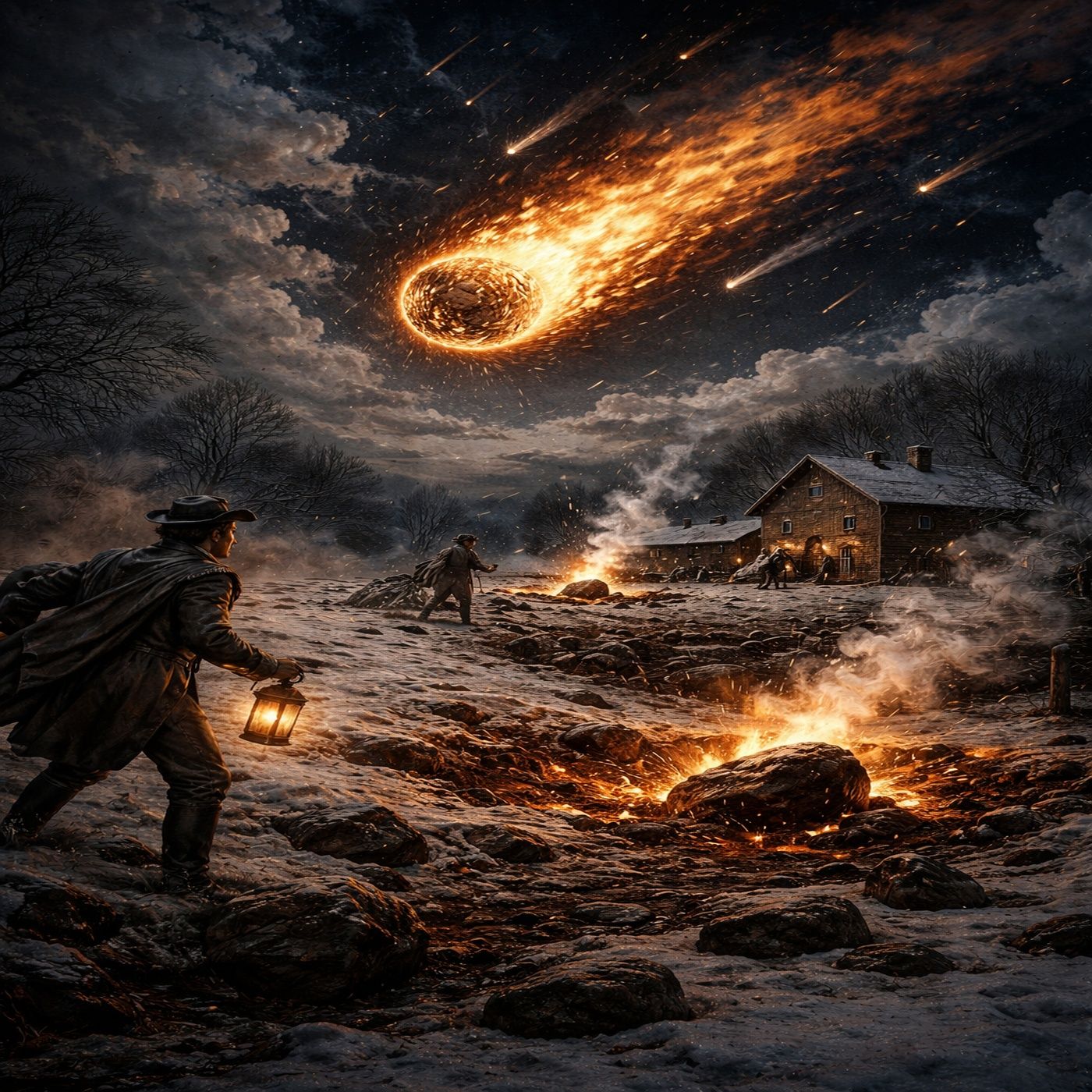
On the morning of December 14, 1807, the residents of southwestern Connecticut witnessed something that would change the course of American science forever. A blazing globe of fire, nearly two-thirds the apparent size of the full moon, streaked across the New England sky from Vermont to Fairfield County. Three thunderous explosions shook the frozen ground. And then, impossibly, stones began to fall from the heavens.In this episode of Disturbing History, we explore the full story of the Weston Meteorite, the first meteorite fall ever scientifically documented in the Americas.
We follow Judge Nathan Wheeler on his early morning walk as the sky erupted in fire above him. We visit the farm of Elijah Seeley, where terrified cattle fled their enclosure and a strange warm stone lay smoking at the bottom of a fresh crater. And we meet Benjamin Silliman, the 28-year-old Yale professor who had never studied chemistry until he was hired to teach it, and who would go on to become the father of American meteoritics.But this is more than a story about a rock from space.
It is a story about a young nation struggling to prove itself on the world stage, about the tension between scientific inquiry and religious interpretation, and about the bitter political divisions that colored how Americans viewed even the evidence of their own eyes. We examine the question of whether President Thomas Jefferson really dismissed the Yale professors' findings with the famous quip that it was easier to believe two Yankee professors could lie than to admit that stones could fall from heaven. The answer, as it turns out, is more complicated than the legend suggests.
We also explore what happened after the fall, a tale that includes treasure-hunting farmers who smashed priceless specimens searching for gold, a wealthy Rhode Island collector who snatched the largest fragment before Silliman could acquire it, and an 18-year wait before that prize finally arrived at Yale. Of the approximately 350 pounds of meteorite material that fell that December morning, less than 50 pounds can be accounted for today.
The rest was destroyed, lost, or simply thrown away by descendants who never understood what their ancestors had witnessed.The Weston Meteorite fundamentally changed how the world viewed American science. Silliman's careful investigation and chemical analysis was read aloud at the Royal Society in London and the Academy of Sciences in Paris. It established Yale as a center of serious scientific learning and launched a legacy that continues to this day at the Yale Peabody Museum of Natural History, where the largest surviving fragment remains on display.
The Weston Meteorite is classified today as an H4 ordinary chondrite, an olivine-bronzite chondrite containing chondrules that formed more than 4.5 billion years ago in the solar nebula before the planets existed. To hold a piece of this meteorite is to hold something older than the Earth itself, a fragment of cosmic history that traveled through the void of space for eons before its path intersected with a small Connecticut farm town on a cold December morning.Stones fell around Weston on December 14, 1807. Two Yale professors proved they came from space. And American science was never quite the same.
We follow Judge Nathan Wheeler on his early morning walk as the sky erupted in fire above him. We visit the farm of Elijah Seeley, where terrified cattle fled their enclosure and a strange warm stone lay smoking at the bottom of a fresh crater. And we meet Benjamin Silliman, the 28-year-old Yale professor who had never studied chemistry until he was hired to teach it, and who would go on to become the father of American meteoritics.But this is more than a story about a rock from space.
It is a story about a young nation struggling to prove itself on the world stage, about the tension between scientific inquiry and religious interpretation, and about the bitter political divisions that colored how Americans viewed even the evidence of their own eyes. We examine the question of whether President Thomas Jefferson really dismissed the Yale professors' findings with the famous quip that it was easier to believe two Yankee professors could lie than to admit that stones could fall from heaven. The answer, as it turns out, is more complicated than the legend suggests.
We also explore what happened after the fall, a tale that includes treasure-hunting farmers who smashed priceless specimens searching for gold, a wealthy Rhode Island collector who snatched the largest fragment before Silliman could acquire it, and an 18-year wait before that prize finally arrived at Yale. Of the approximately 350 pounds of meteorite material that fell that December morning, less than 50 pounds can be accounted for today.
The rest was destroyed, lost, or simply thrown away by descendants who never understood what their ancestors had witnessed.The Weston Meteorite fundamentally changed how the world viewed American science. Silliman's careful investigation and chemical analysis was read aloud at the Royal Society in London and the Academy of Sciences in Paris. It established Yale as a center of serious scientific learning and launched a legacy that continues to this day at the Yale Peabody Museum of Natural History, where the largest surviving fragment remains on display.
The Weston Meteorite is classified today as an H4 ordinary chondrite, an olivine-bronzite chondrite containing chondrules that formed more than 4.5 billion years ago in the solar nebula before the planets existed. To hold a piece of this meteorite is to hold something older than the Earth itself, a fragment of cosmic history that traveled through the void of space for eons before its path intersected with a small Connecticut farm town on a cold December morning.Stones fell around Weston on December 14, 1807. Two Yale professors proved they came from space. And American science was never quite the same.