Episode Description
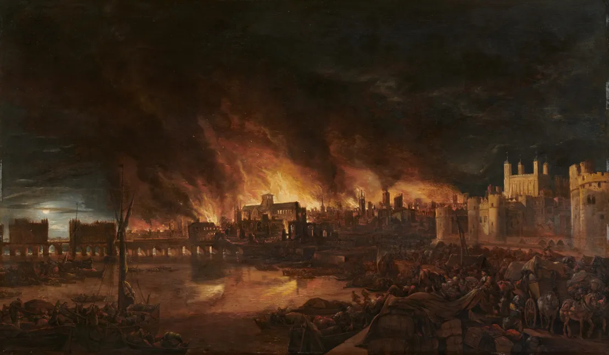
The war with The Netherlands in 1665 ended on a low, with the Thames blockaded. Poor London – trade was devastated by war, trade was devastated by plague. Hopefully 1666 would be better, as the royal court rumbled back into town. Money was short, but still a fleet was sent out into the Channel, as the good people of London started to rebuild their lives and their businesses. Nothing could be as bad as 1665.
Download Podcast - 438 Burned to Sticks (Right Click and select Save Link As)

Transcript
Hello everyone and welcome back to the History of England episode 438
“In 1666 London Burned to Sticks”
It is very important that you say the title of this episode in exactly this manner, by the way, so that you can imagine being with my offspring Milo in their primary classroom. Shall we all do it together? Like a chant, imagine you are sitting on titchy tiny chairs, and are looking adoringly at your teacher, and everything in the world is bright, new and exciting. Can you do that? Ready? OK, after 3 –
1
2
3
“In 1666 London Burned to Sticks”.
Ok, so prizes for guessing what we are going to be discussing today – among other things I should say.
Buty first of all I have an official correction to make, courtesy of Daniel. Do you remember that gruesome bit of medical science last time with Pepys? You might want to turn your ears away again if you are in any way squeamish. OK? Well you might remember the small matter of an incision between scrotum, and anus, without anaesthetic, in pursuit of a stone. Well, I said Gall stone, which Daniel informs me, reliably, pleasantly and sweetly, would mean that the surgeon would need to insert their arm up to the elbow. Or maybe it was shoulder. Either way – much further than you’d ideally like, so it seems Pepys had a bladder stone, not a gall stone. I hope that has put the matter to bed, and that we can talk no more about it.
So there has been a theme over the last couple of episodes. We have been enjoying War, Pestilence, and there was probably famine somewhere. And this week, I’d like to carry on this happy new tradition. War wise, England started off by having a good war against the Dutch in 1665, and James Duke of York had won a cracking victory at Lowestoft, but the Dutch had De Witt, Admiral de Ruyter – and a shedload of cash which they were prepared to spend, spend, spend, with bigger ships and diplomatic magic that kept England isolated, friendless and alone, just like Greta. And so by the time the 1665 campaigning season closed, the Dutch were havin’ a laugh, messing up London trade by blockading the Thames. Then there was a small matter of tens of thousands of people in England dying of plague, and especially in London – so that didn’t help the trade balance either. I mean it never rains, but it…well, in 1665 it never rained, full stop. Hot, dry, diseased.
And so when Charles and his royal court finally decided to return to London in April 1666, having apparently trashed Oxford with parties and poo, they found that all their taxation and customs dues had been levied on non-existent trade which had hit hard times, so there was nowhere near as much money as they hoped, and only part of the fleet could be taken out of mothballs. So, hopes were not high, expectations were lower. Not least because the French had at last dragged themselves out of bed to wearily join their Dutch allies, which had Charles and the English sweating in their collective pyjamas as they dreamed of the French mediterranean fleet sailing into La Manche, or worse, ferrying an invasion force to Ireland. They needn’t have worried actually, Louis XIV didn’t see any of ‘La Gloire’ on offer by helping the Dutch, and might well qualify as the most reluctant ally in the history of allies in a perfidious Gaulois competition. But Charles wasn’t to know that.
The Earl of Sandwich had been dumped as Admiral last year, accused of keeping too much prize money, and so the commanders were fire and ice, Prince Rupert and Monk, otherwise known as Cumberland and Albermarle in that irritating way we Brits have. And it was fear of an Irish landing that made them split up in May 1666, though then there was rumour and vague reports that de Ruyter, latest in the long list of genius Dutch seamen, was out there with a battlefleet somewhere. So, more sweaty pyjamas, orders were sent off to Rupert to rejoin Monk. Not quite sure why everyone’s wearing PJs. I’ll stop that metaphor.
But before he could do so, Admiral Monk of the Ice had melted, since when Monk heard that the best Admiral of the age was nearby, that he had 84 ships, which was about 30 more than Monk’s command, and had built bigger ships, which could match the English shot for shot for firepower, when he heard all that, Admiral Monk said, ooh yes we’ll ‘ave a bit of that’. His captains did murmur that fortune did of course favour the brave, and faint heart never won fair lady and all, but shouldn’t they wait for Rupy? Or maybe they said Cumbers. Anyway, not a bit of it, said Monk not on your nellie, nor by the hair on my chinny chin chin. I didn’t get where I am today by worrying about impossible odds. So with Rupert’s fleet just 2 days sail away – Monk went for it on 1st June 1666 and threw his little fleet at de Ruuyter.
Just as a bit of a plot spoiler, this little skirmish has acquired the name of the Battle of Four Days, so when I call it a skirmish that, my friends, is irony. Or is it? Simply understatement maybe? I’ve never understood my language. Anyway, it’s a four day bloodbath. The battle proved that while the English were superior in discipline and holding formation, the Dutch could manoeuvre and signal better, and now matched the English for firepower. On the first day the English probably had the best of it; though Admiral Harman had a tough time, with HMS Henry singed by three fireships, at which point his crew started to jump. Or they did until they were confronted by their own captain, sword drawn, muttering ‘make my day, able seaman’. At which point the Dutch Captain demanded surrender; was refused; and was then cut in half by a cannon ball. What fun, eh? The good ship Henry ran for shore, had a few patches stuck on it in the port of Harwich, and was back up for it the following day. It had been a long day, as Lieutenant Roche of the Antelope wrote
And then began the most terrible, obstinate and bloodiest battle that ever was fought on the seas…Then we tacked and fought our way through again and again and so we held on til 10 O Clock at night
On day two the English attacked again, line abreast, then swinging round to form a line of battle when they arrived in firing range, which sounds impressive. As a French observer wrote
‘Nothing equalled the good order and discipline of the English,’[1]
Sadly, nothing equalled the carnage wrought on the English, not even their discipline. Monk had started day one with 56 ships operational, day 2 with 50 – he started day 3 with only 28 ships in fighting order. Only a few of those lost had been captured, most had been blasted out of the battle; like Lieutenant Roch’s poor Antelope as it happens
‘our ship [was] cruelly shattered, our commander’s arm shot off, 55 of our men killed and never so many more wounded, our masts, sails and rigging all in tatters, our deck dyed with blood like a slaughter house!’
So – Monk’s Captain’s conference that night agreed that it might that this time fortune favoured those that legged it – or whatever the aquatic equivalent is. On day Three, 15 of the heaviest ships formed a rearguard as the rest of the fleet attempted a dignified retreat, the Dutch followed nibbling away until glory be! To the west appeared Prince Rupert in his pyjamas and 24 ships, which, when united would put the English back in the fight – 52 to the Dutch remaining 69. At which point we need to talk about The Galloper.
The Galloper is a large sandbank about 15 miles off the east coast of blighty, possibly called that because it moves so quickly, or at low tide the breakers look like the white horses in the Old Spice adverts, but whatever, it can be very shallow and appear out of nowhere – there’s a whopping great offshore wind farm there now. But on 3rd June 1666, there was no wind farm, but there was the good ship the Royal Prince, with Admiral George Ayescue running around like a headless chicken on the poop deck. Because the Royal Prince, whopping great 90 gun second rater, had run aground on the Galloper, and George Ayescue, Admiral of the White was forced to surrender, and thus became the highest ranking Naval officer ever to have surrendered. Put that in your pub quiz pipe and smoke it. The Royal Prince was burned, Admiral of the White George went to a Dutch prison. Oops.
But, nonetheless the English now had their Ensigns up silly to waste them, and so go into day four, which started well when English squadrons broke the Dutch line, but that was the high point; thereafter it all went progressively pear shaped. Rupert’s Flagship the Royal James was dismasted and had to be towed to safety, the English were anyway running out of ammo, and also running out of morale and confidence, and by the end of the day they were in full flight. De Ruyter had once more led the Dutch to victory.
One evening, a few days later when all the news was in, William Penn came round to the navy Office where he found his good friend Samuel Pepys and they went for a walk together and talked about this disaster, and there was a good deal of ranting and also a three point plan, and a deal of trashing of Admiral John Lawson for some reason, and by the end of it, Sam felt a bit better
I took more pleasure this night in hearing him discourse, than I ever did in my life in anything that he said
But the pain of defeat lingered, in a year’s time, Pepys had still not forgotten the Galloper, remembering when
the Duke of Albemarle run away from the Dutch
and he concluded
Thus, in all things, in wisdom, courage, force, knowledge of our own streams, and success, the Dutch have the best of us.
‘Twas ever thus. Evelyn saw the fleet come in too
‘appearing rather so many wracks and hulls, so cruelly had the Dutch mangled us’.[2]
Now Johan de Witt was not one for kicking a man when he had been down, for more than 10 or 12 minutes, but this was the 10 or 12 minutes now, so he demanded of De Ruyter that the Fleet should sail up the Thames, into the heart of the English power, wealth and pride and bomb it to smithereens. De Ruyter fancied this idea, or better still, he thought to sail down the River Medway and destroy the devil’s nest itself, the Naval Dockyard at Chatham, and the French said they’d turn up and help their beloved allies so de Ruyter had 3,000 marines with him and was ready to go. But turns out the French were doing their hair that day, never turned up, and so the Dutch settled for a blockade to strangle an English trade already mutilated by plague and they both imagined this was free “kicking when a man was down”, time.
Well they were wrong, gentle listeners, little did they know their opponent! We don’t stay down when we are kicked, no siree cry Harry and all that. On 22nd July Monk and Rupert led out the fleet again, a line 10 miles long and on 25th July, St James Day, on the principle of getting right back on that horse that threw you, they met again at the Galloper. I detect the faint whiff of politicians messing with military professionals at this point; de Witt, still riding with the fleet, was apparently worried at how many flag officers they were losing, so ordered a snaky line with the flagships further away from the English to protect those poor old flag officers from breaking their nails. Well even to a landlubber like me that sounds like a losing strategy.
And So it proved, and this time the shoeing was delivered from an English boot. This was not helped by a younger Admiral chip off the old block Captain Trump pursuing personal glory with his own squadron, only to later return and see that the main body had been mangled without him. Though once more de Ruyter demonstrated his genius with a hard fought fighting retreat which saved most of his ships – though he left 7,000 Dutch dead, lost 2 ships and lost command of the seas to the English. In the middle of this when under dire pressure from the delightfully but incongruously named English fireship, the Land of Promise – I mean; is that English irony again? – in the middle of this De Ruyter was heard to declare
Oh, God, how unfortunate I am! Amongst so many thousands of cannonballs, is there not one that would take me?
Melodrama or what? Fortunately, there was not. When De Ruyter and Tromp met up again, there were words, gentle listener; there were words. Trump was accused of being responsible for the whole sorry mess. The whole sorry mess was made infinitely sorrier in August by what became known as Holmes’ Bonfire. Captain Holmes, him of raiding the African coast fame, found a Dutch traitor who led them to a fleet of 150 merchantmen on the Dutch coast, all of which he burned; and then he hopped ashore and fired a local Dutch town, just for the war-is-hell of it; the meaningless vandalism of the Terschelling raid would rankle with the Dutch, their papers were full of fury, fire and brimstone and that they would have their revenge. But in the meantime, the conflagration over Tromp became a public, political slanging match, made sharper because Tromp was very much seen as the representative of the Organist faction, and De Witt would therefore delight in permanently stomping to stop more Tromping.
There was one more engagement in September, but that was it really for the 1666 campaigning season. For the Dutch, their big East India fleet had come safely home, so they had no more need to cruise around to protect it, and could settle down to spending some of the cash they would make from it – probably splashing the cash on a newer, bigger, better navy.
In England meanwhile, the Navy board was in despair. I mean victory was all very well, and yes, parliament had voted what they thought to be vast sums, but it was still nowhere near enough; also it was theoretical – the might have voted another £1½m, but it was proving impossible to fully collect. And income from trade & customs dues had been weak before; and now were to plummet again. And plummet big time.
Because it is time, ladies, gentlemen and all you good people who identify in other ways, it is time for one of those events in English history about which it is impossible to complain is not taught enough in schools. Poor School teachers really, if you had to teach all the topics every faction shrilly demanded, no one would do anything else at school but history. Anyway I’m pretty sure every school child in England at least has heard that in 1666 London burned to Sticks. But to start the story, let me take you by the hand, and lead you first of all to a good old CofE church service in 1682, a rather grand funeral service this, in St Annes, Aldersgate, London; a church founded in the 12th century, but completely rebuilt just two years before in 1680 by one Christopher Wren – Sir Chris to you and I – a little gem of a church actually. Anyway – it’s a funeral service, and it’s time for the sermon.
The person delivering said sermon was the rector, Samuel Freeman, and it was long and it was tedious. Of the many crimes of which the puritans are accused long and tedious sermons are right up there, but let me tell you I know from personal experience that the good old C of E are perfectly capable of a bit of tedium as well. Freeman is speaking about the dead man, and criticised all the nasty, small minded people who criticise the great and the good for, and I quote
their little mistakes blown up into Crimes of the greatest magnitude
Now the dead man was Thomas Bludworth, and it is about that “little mistake” we are going to talk in the rest of this episode. To start with a little bit about Thomas he is indeed of the great, though I’ll leave good up to you to decide. He was a Londoner and merchant born and bred, who’d made good money through the East India company and Levant company. He was a staunch royalist and Anglican, and so was thoroughly pleased when the Stuarts returned; in later life he would also enjoy their new creation of the Royal Africa company, become a board member, and owned two ships sent to Guinea there specially ‘to take in Negroes’, so he was a slaver among other things. He was survived by a son and a daughter, Anne – Anne who would marry the hanging judge, Judge Jeffries, by odd chance – it’s a small world after all.
So that’s Thomas, but for his little mistake we should go back to the night of Sunday 2nd September 1666, to a bakery in Pudding Lane in the City of London, where the owner Thomas Farriner had been woken by smoke coming under his door. Now Londoners were used to fire, it was no biggie, although they all had to escape from a window; except the maidservant, who was too scared to climb out poor thing, and so died in the flames.
Well the thing to do was to pour on water, pour on water, and shout fire! fire! And they did that but it kept going, so the next thing to do would be to pull down the houses around to make a fire break. This was very normal; so normal in fact, that some title deeds defined the houses in sales “as it was before the first fire’, knowing that there was a good chance it wouldn’t last and have to be rebuilt. But the tenants around didn’t know if their owners would approve of the pulling down, or were even required to approve, so they called the Lord Mayor to decide – who was our Thomas Bludworth. He’d had a difficult time of it already – he’d been denied a proper mayor’s pageant the previous year, because of the darned plague, so he was probably already cursing his luck poor man. Pepys knew him, because he’d already crossed swords with Bludworth, over the matter of naval press gangs in London; Pepys had not been impressed
I find him a mean man of understanding and despatch of any public business
He wrote. Which is very rude of him. Rude, Pepys, nasty Pepys.
Though, to be fair to Pepys he had a point. Our Bludders turned up as was his duty, and being a man of property and not really having a barney about the rules, refused to order the pulling down of any buildings, good lord, this is private property couldn’t do that without permission, and anyway, look at that feeble fire, and uttered qwords which would haunt him and his memory for ever
‘A woman could piss it out’
Well, quite apart from the casual misogyny inherent in this phrase – I mean amongst all their other failings in the 17th century male mind, are you to include women’s wee’ing ability too? Anyway this was to prove more than the Rector’s ‘little mistake’, as it happens. But at the time Bludders was unconcerned – he went back to bed. After all – it was late, and the little people could deal with this fire.
We should talk about London a bit more maybe, though I think you have probably been told what it was like in the 17th century – I think we have talked about it, but we should make a couple of points. First of all London was a city made of wood for the most part; and one of the reasons why there hasn’t yet been a great rebuilding in London so far is that there are no sources of good stone nearby. Now brick of course had become much more affordable from the 16th century, so there were some brick fireplaces and ovens that sort of thing, but still not many of the poorer sort could afford them. The other thing, is that fire places are all very well, but it means that 7/8ths of the heat goes up the chimney[3], and firewood and coal is expensive so the poor were not fans of chimneys. So there were open fires everywhere.
And then, as I am sure we have mentioned last time, there is massive overcrowding in the city, with houses sub divided and subdivided to cram in all the immigrants from the surrounding countryside; houses were very close together often, down tiny narrow lanes, and with overhanging jetties to make a bit more space, so you could barely put a cigarette paper between some of them, assuming roll ups were the thing back then. Well, I exaggerate for effect, but you know what I mean. During last year’s plague, the Magistrates of Middlesex had written in complaining about the overcrowding, by
Receiving, harbouring and placing of inmates and undersitters in houses and cellars, and by the erecting of new buildings, and by dividing and parcelling out the said buildings and other houses into several petty tenements and habitations, and pestering and filling the same with inmates and poor indigent and idle and loose persons[4]
Those loose persons lying around can be a problem, I know, I’m a parent. The Justices did try to evict a whole load after the plague and started in June; there were riots and protests, many could not afford any larger accommodation, and anyway for employers it made hiring cheap labour easier having all these people loose lying around all over the place. So the Madges gave up.
So it all meant that fire was a daily fact of life; and this is not just in London. So last time I signed off with the tantalising, teasing statement that Loughborough was on fire in 1666, and I did not speak the tongue of metaphor. Thomas Webster had a kiln attached to his house, probably for making bricks or burning lime for mortar, there was a spark, there were thatched rooves, one thing lead to another and by the end of it 200 houses had been burned to the ground. [5]
So people had things in place to deal with fire; there were about a thousand men of the City Watch, and their job included watching out for fires and getting everyone to form chains with buckets. Every parish church had a kit of ladders, leather buckets, axes, and firehooks. There were even Elm pipes from a water Tank on Cornhill – in theory you could puncture a pipe and get water, though the rapid spread of buildings being what it was, good luck finding one in the right place. There were fire engines on carts; though again, bit rubbish – probably not much better than a woman wee’ing, anyway. Pull the houses down, that was the thing.
Anyway, back to the story. At 3 am, Jane Birch the maidservant in the Pepys household woke them up and told them about the fire. Jane had been in the household for 8 years since she was 14; and was part of the family really. Samuel and Elizabeth would fund Jane’s marriage in 1669, and when she was widowed she’d come back twice, and be remembered in Samuel’s will. The reason I tell you this is a slice of social history; servants are still very much an integral part of a household, that gap hasn’t grown up yet, between servant and master – albeit everyone knows who the boss is. The other reason I tell you this is that I am a podcaster, and I like telling people things. Drives people up the wall.
Anywhat; Samuel and Elizabeth looked out the window, probably muttered something like ‘a woman could deal with that in the normal way’ and they went back to bed.
But at 7, Pepys realised his mistake; Jane told him 300 houses had been burned now, more even than Loughborough she said. No she didn’t say that, but the fire was now raging, uncontrolled and uncontrollable. The fire had reached Thames Street, and the warehouses all along the river, and the fire was now wagging its tail and yelping with joy as it got it’s snout stuck into pitch, tar, hay, spices rope and timber. Boom. So we are told that it was Pepys who now took the initiative. Am I the only one who finds it a bit suspicious that it turns out the most famous diarist in London just happens to be a hero? Well anyway, he went down to the Tower from his house in Seething Lane, sees burning of everything, everywhere all at once, and hordes of people trying to save what they could
Everybody endeavouring to remove their goods, and flinging into the river or bringing them into lighters that layoff; poor people staying in their houses as long as till the very fire touched them, and then running into boats, or clambering from one pair of stairs by the water-side to another… and nobody, to my sight, endeavouring to quench it, but to remove their goods, and leave all to the fire, and having seen it get as far as the Steele-yard, and the wind mighty high and driving it into the City[6]
So Pepys got himself a boat and took himself to Whitehall; mentioned as he passes the house where pretty Mrs Horsley lives – I mean blokes, really, can they never turn it off? Also on the way he sees houses at the end of the Bridge burning. I learn from Sam Hume’s podcast episode on the fire in Pax Britannica, which is far better than this sorry thing by the way, I learn that there happened to be some work on the bridge and so there was in effect a fire break; hence Southwark and south of the river were spared.
Anyway Pepys got to see the king would you believe! Presumably someone had mentioned it to the king – ‘oh by the way, King, London’s burning down’. But Pepys also had him called out of his closet, and told him all about it, and Charles and James sprang into action, telling Pepys to go and tell Bludworth to get his act together and pull down as many houses as needed, and offering more soldiers if he needed them. Pepys does as he was told, struggling through the maddening crowds
every creature coming away loaden with goods to save, and here and there sick people carried away in beds. Extraordinary goods carried in carts and on backs.
He finds the Mayor. Who is not in a good way, who cries to Pepys
Lord! what can I do? I am spent: people will not obey me. I have been pulling down houses; but the fire overtakes us faster than we can do it
Fair does, the fire is, well, on fire.
Thomas Vincent remembered the sound
Rattle, rattle, rattle was the noise which the fire struck upon the ear round about, as if there had been a thousand iron chariots beating upon the stones…[fires] were uniting together into one great flame throughout the whole street…then you might see the houses tumble, tumble tumble from one end of the street to the other with a great crash[7]
The following day John Evelyn saw the sight from the south of the river
All the sky was of a fiery aspect, like the top of a burning oven…God grant my eyes may never behold the like, who now saw ten thousand houses all in one flame! The noise and cracking and thunder of the impetuous flames…like a hideous storm’
I also learn from Pax Britannica that as the fire took hold lots of people took their papers and things to a really, really safe place – St Faiths, which was an odd parish church, in stone crypts under the choir of St Paul’s cathedral. The Stationers company kept all their papers down there, so that was as safe as …well, far safer than houses in the current circumstances. But not safe enough as it turns out. Because as St Pauls went up, huge blocks of Portland stone fell from the vaults, and crashed through the floor, into the crypts. To find all the paper. And Whoosh! Up it all went; apparently charred sheets of papers of I don’t know, deeds or bills or contracts turned up as far as Eton. Where presumably the local schoolboys would be able to use the old ‘the dog burned my homework’ excuse.
By this stage, everyone was looking around for someone to blame for this. God was obviously the chief candidate, punishment for sins, of which there were many, obviously especially up at Whitehall where they were practically re-writing the rule book on sin. But there were other candidates; Catholics were one, and to be fair it probably was them. One man was arrested because he had
‘the appearance of a Frenchman’,
and again to be fair riding through London in a beret, stripey shirt and a string of onions is pretty much asking for it. Then there was the Dutch, they were also likely candidates. Rather sadly, one Frenchman did confess. And was executed, although it obviously wasn’t him.
If Thomas Bludworth can be said to have had a bad fire, the same cannot be said for King Charles and his brother James, Duke of York. This was the kind of situation for which their finer characteristics were designed. Both were physically brave, absolutely up for taking control, they had all the authority required to order anything done, and they were everywhere, riding through the city, encouraging and organize firefighters, handing out money to reward people fighting the flames. Charles ordered gunpowder to be used to create a firebreak, because fire hooks just weren’t cutting it. Evelyn was full of admiration about
“the vigilance and activity of the king and duke… labouring in person”
Meanwhile Pepys and family watched as the fire came closer and closer to their house on Seething Lane. Which brings us to one of the more famous entries in the famous diaries
Sir W. Batten not knowing how to remove his wine, did dig a pit in the garden, and laid it in there; and I took the opportunity of laying all the papers of my office that I could not otherwise dispose of. And in the evening Sir W. Pen and I did dig another, and put our wine in it; and I my Parmazan cheese, as well as my wine and some other things
As it happens, Pepys need not have worried; Seething lane stayed just outside the blaze.
Unlike 3/4s of the City of London, and many more suburbs besides. It was quite genuinely the most monstrous fire, comparing with the fires of Edo in Japan and Istanbul’s fire of 1660. There are very good maps on many websites, including Wikipaedia, and I will post one on the episode post, it’s extraordinary; over 13,000 buildings were utterly destroyed, 100,000 people made homeless. By Wednesday, the firebreaks were at last beginning to have an effect, and the fire coming under control; Pepys climbed the tower of the church at Barking to the east, and looked out at
“the saddest sight of desolation that I ever saw”
Still it’s an ill wind and all that. It would prove a good time to be in the brick business.
And we’ll survey the chaos, the wasteland, and the aftermath – and the brick business – next time. Until then, thank you for listening and sorry for the croaking voice; I could not shift it and in the end after leaving it for day just had to do it. Next week I have something a bit different for you; Dr Jeevun Sandher is the Labour MP for Loughborough, and a listener, and he suggested we do an episode on Britain’s journey to a parliamentary democracy, and something about our contribution to modernity. So that’s what I will be publishing next week, and then I have a week off. So it’ll be a little while until we get to the Brick business – and the great rebuilding. Until then, all the very best of luck – and have a great week.
[1] Rodger, N: ‘The Command of the Ocean’, p76
[2] Wilson, Ben. Empire of the Deep: The Rise and Fall of the British Navy (p. 347). Orion. Kindle Edition.
[3] Calder, B: ‘Architecture’, p199
[4] Lincoln, M: ‘London in the 17th century’, p205
[5] https://www.lboro-history-heritage.org.uk/a-history-of-loughboroughs-battle-with-fire-1500-to-1667
[6] https://www.pepysdiary.com/diary/1666/09/02/
[7] Mortimer, i: Time Traveller’s Guide to Restoration Britain’, p23